Hidden Garden Flowers: From 251 to 24,021 Monthly Organic Visitors in 12 Months
This case study explains our exact process and strategy. Outlining how we can get the same winning results for your brand.
9,470%
3,856%
99.1%
Hidden Garden Flowers is a luxury florist based in Los Angeles. The shop sells hand-tied arrangements with same-day delivery across LA County, and their Shopify site lists over 50 products across occasion-based collections.
When I audited hiddengardenflowers.com in November 2024, Ahrefs estimated 169 monthly organic sessions. Twelve months later, that figure had reached 24,021.
The Problem
Google was sending roughly 5.5 visitors per day to hiddengardenflowers.com when we started. For a florist serving the Los Angeles metro area, that number should have been far higher. Traffic had flatlined for six months, with no meaningful movement in either direction.
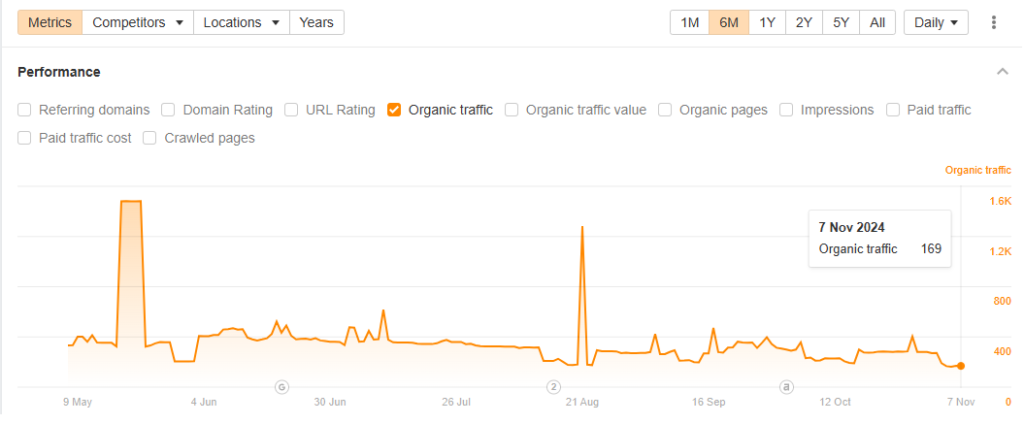
The real issue sat inside the keyword data.
Of the 660 US keywords the site ranked for, 68% of all estimated organic traffic came from branded search terms. Phrases like ‘hidden garden flowers’, ‘the hidden garden’, and ‘hidden garden los angeles’ made up the bulk of visits.
| Top 10 Performing Keywords | Position | Monthly Google Searches (US) |
| hidden garden flowers BRANDED | 1 | 60 |
| the hidden garden BRANDED | 1 | 100 |
| mother day flower delivery | 2 | 100 |
| hidden garden BRANDED | 8 | 900 |
| flowers for birthday delivery | 8 | 150 |
| flowers and garden | 8 | 80 |
| hidden gardens los angeles BRANDED | 1 | 20 |
| hidden garden la BRANDED | 1 | 30 |
| hidden garden los angeles BRANDED | 1 | 30 |
| hidden garden los angeles photos BRANDED | 2 | 10 |
All branded searches comes from someone who already knows the business exists. They’ve seen an Instagram post, been referred by a friend, or walked past the shop on Cotner Ave. That traffic is a reflection of brand recognition built through other channels. It isn’t bringing new customers to the site.
A site with 230 referring domains and an established local brand should have been generating thousands of organic visits per month, not 169. The traffic wasn’t there because the pages weren’t there.
Our Strategy
Two things needed to change. The site had to stop relying on people who already knew the Hidden Garden name, and it had to start appearing in front of people searching for a floral services in Los Angeles for the first time.
Local keywords were the answer. Terms like ‘florist los angeles’, ‘flower delivery malibu’, and ‘luxury flowers los angeles’ carry consistent search volume year-round.
Ranking for those terms would bring in a completely different type of visitor. Not someone who already knows Hidden Garden, but someone actively searching for a florist in their area and ready to place an order. That was the goal: build an evergreen pipeline of new customers through local organic search.
Alongside the local keyword push, we planned to grow the site’s overall authority with relevant supporting content:
- New collection pages for occasions the site didn’t cover
- Flower-type and colour-based category pages
- And blog posts tied to keyword research
Each new page would strengthen the topical relevance of every other page on the site. That gives Google more reason to trust hiddengardenflowers.com as a credible source for flower-related queries across Southern California.
SEO Implementation
Local-Intent Landing Pages
No dedicated URLs existed for local delivery terms when we started. Someone searching ‘flower delivery Santa Monica’ or ‘flower delivery Hollywood’ had nowhere to land. The site simply didn’t have a page that matched the query.
We built a templated landing page for each delivery location and rolled it out across multiple areas. Each page carried above-the-fold keyword-targeted copy, a delivery zone listing with specific towns covered, same-day delivery details, and internal links to the relevant collection pages.
Every page hit a minimum of 600 words of optimised content, which is roughly the threshold where Google can properly assess what a page is about.
The homepage was targeted at the highest-volume local term, ‘florist los angeles’. As the URL with the strongest backlink profile on any site, the homepage has the best shot at ranking for the most competitive keyword in the cluster.
This same templated approach then extended into new territory. We created collection pages for occasions the site hadn’t previously covered (such as Anniversaries and Bridal Showers) and built entirely new sections for flower-specific terms like ‘red roses bouquet’ and colour-based queries like ‘blue flower bouquet’.
EEAT: Social Proof and Consumer Transparency
Google’s EEAT guidelines (Experience, Expertise, Authoritativeness, Trustworthiness) weigh heavily in local service results. A florist page that lists products but tells the visitor nothing about the business behind them is missing signals that Google looks for when deciding which sites deserve page-one placement.
We added structured social proof across the site. We made customer testimonials more prominent, added information around The Hidden Garden’s award-wins to major pages, and made it clear The Hidden Garden employs its own couriers and doesn’t rely on third-party delivery services.
Consumer transparency got the same treatment. Freshness guarantees, returns policies, and service area boundaries were all surfaced clearly on each local landing page.
This wasn’t just an SEO play. A shopper comparing three florists in a Google search result is more likely to buy from the one that answers their practical questions before they’ve had to ask. I’ve seen this pattern across dozens of ecommerce sites. The pages that convert best are the ones that treat the buyer’s scepticism as a problem worth solving upfront, not an afterthought buried in a FAQ.
Technical SEO Cleanup
Existing pages had issues that were limiting their ranking potential regardless of content quality.
Collection page headings used generic labels like ‘Trending Now’ instead of keyword-relevant terms. Google reads H1 and H2 tags as signals about a page’s topic. A heading that says ‘Trending Now’ tells the algorithm nothing about whether the page sells birthday flowers or funeral arrangements. We replaced every heading across existing pages with phrasing that matched target keywords and related entity terms.
Meta titles were a similar story. Many didn’t contain target keywords at all. I’ve found that front-loading the location modifier tends to perform well for local florist queries, so titles like ‘Flower Delivery in Los Angeles | Same Day | Hidden Garden’ replaced the vague originals.
Running a proper technical cleanup before creating any new content was what made the rest of the campaign land. You can build the best landing page in the world, but if the site it lives on is sending Google confused signals through duplicate H1s or vague heading text, that page is fighting with one hand tied behind its back.
The End Result
A 9,470% Increase in Organic Traffic
Ahrefs estimated 251 monthly organic visitors to hiddengardenflowers.com on 1 January 2025. By 31 January 2026, that number was 24,021. That’s a 9,470% increase in twelve months.
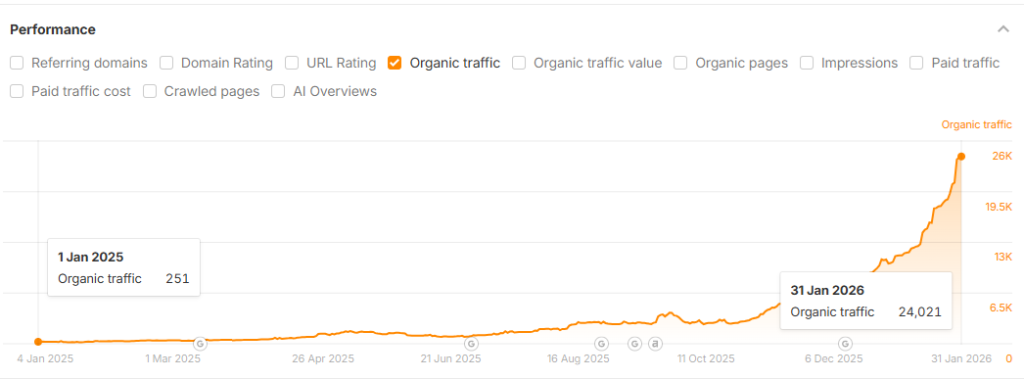
The first few months looked like nothing was happening. Traffic held flat whilst Google crawled the technical fixes and indexed the new pages. Then the line started climbing from August 2025 and didn’t stop. By November it was steep. By January 2026 it was vertical.
A 3,856% Increase in Page-One Keywords
The site had 67 keywords on page #1 of Google when we started. It now has 2,228.
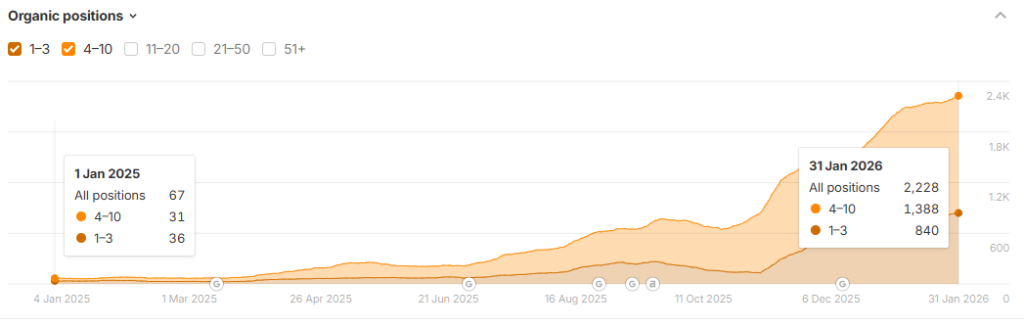
That branded dependency we identified in November 2024 is gone. Back in November 2024, 68% of the site’s organic traffic came from people searching for the Hidden Garden name. The current keyword profile tells a completely different story: 99.1% of the site’s ranking keywords are now non-branded.
Out of 2,228 total page #1 keywords, just 16 are branded terms. The rest are the local, product, and occasion-based queries that bring in customers who have never heard of Hidden Garden before and are finding the business for the first time through Google.
Local Keywords That Didn’t Exist Before
Hidden Garden ranked for none of the following keywords before working with Mint SEO. Every single one is now on page one of Google USA:
| Keyword | Position | Monthly Google Searches (US) |
| florist los angeles | 6 | 900 |
| los angeles florist | 8 | 400 |
| florist los feliz | 10 | 200 |
| luxury flowers los angeles | 4 | 150 |
| los angeles florists | 8 | 150 |
| florists los angeles ca | 8 | 100 |
| wedding florists in los angeles | 7 | 100 |
| florist los angeles ca | 10 | 100 |
| west los angeles florist | 6 | 90 |
| luxury florist los angeles | 8 | 60 |
| luxury flower delivery los angeles | 8 | 60 |
| la florists | 7 | 60 |
| flower delivery malibu | 9 | 60 |
| mother’s day flowers los angeles | 6 | 30 |
Twelve months ago, someone in Los Angeles searching for a florist on Google would never have found Hidden Garden. Now the site sits on page one for ‘florist los angeles’, ‘luxury flowers los angeles’, ‘wedding florists in los angeles’, and dozens more. Higher-volume terms like ‘flower delivery los angeles’ at 3,100 monthly searches and ‘flowers los angeles’ at 1,000 monthly searches are ranking too, with positions still climbing as the pages build authority.
This is what happens when an ecommerce SEO strategy is built around the right keywords. Every one of those local terms represents someone ready to buy flowers, not someone who already knows the brand.
If your ecommerce site is stuck in a similar position, Mint SEO’s ecommerce SEO services can identify exactly where the gaps are and build a plan to close them.
A note on these figures: Ahrefs estimates organic traffic from keyword rankings and average click-through rates. These totals include seasonal terms whose real volume fluctuates throughout the year, so actual traffic in any given month will sit below the Ahrefs estimate. Ahrefs estimated traffic is the most widely used method of measuring seasonal SEO progress over time, and the growth from 251 to 24,021 reflects a genuine shift in search visibility.