
Knowledge Hub
Off-Page SEO For Ecommerce: Where To Point Links And What It Costs
By John Butterworth · August 9, 2026
Send your next link to a category page. That one instruction is worth more to most stores than any tactic list.
Off-page SEO is everything working for your store away from your store. Links, mentions, reviews and coverage. For a shop it comes down to three decisions: which pages the links land on, how many you need, and what you agree to pay.
Link acquisition has been my work at Mint SEO for eleven years. I am John Butterworth, and digital PR is one of the eight disciplines behind the three million organic sessions we have driven for stores.
The first thing I check on a new store is where its existing links point. The answer is nearly always the homepage, from around a dozen referring domains, with one anchor phrase repeated across most of them.
The pages ranking for this question will give you tactics. I read them looking for a link target, a quantity and a price, and came away with none of the three.
What Your Store's Link Profile Needs To Look Like
On 9th August 2026 I read all fourteen pages then ranking in Google UK for "off page seo for ecommerce". Every one of them stopped at tactics. Three numbers settle the question: the referring domains your sector's page-one results carry, the monthly rate behind them, and the share of your own links landing on a page that sells.
How Many Referring Domains Your Sector Needs
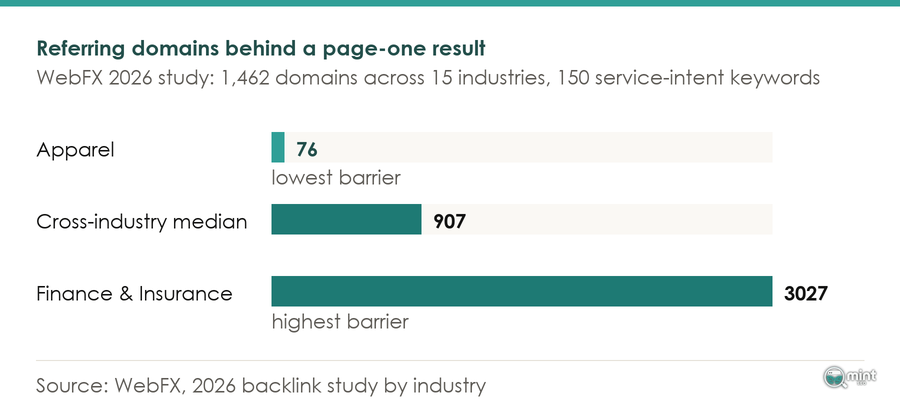
Analysis by WebFX covering 1,462 domains across fifteen industries found that page-one results carry a median of 907 referring domains. The range behind that median runs from 76 in Apparel to 3,027 in Finance and Insurance, which is roughly a fortyfold spread between the easiest and hardest sectors to compete in.
Read that range as the size of the job. Seventy-six domains is a year of steady work for one person; three thousand is a department with a budget to match. Your sector decides which of the two you signed up for.
Measure the sector you compete in. Treat any supplier quoting a generic link count as someone who has not looked at your results.
How Fast Competitors Add Referring Domains
Sectors differ as sharply in speed as in size. The same WebFX study puts apparel at the slowest link velocity at 15 new referring domains per month.
Finance and insurance sits at the other end, at the fastest pace of backlink growth at 101 new referring domains per month.
Match the total but not the rate and you fall behind next quarter, because the benchmark keeps moving. Your plan needs a target and a monthly rate. In consumer retail that monthly rate is small enough to reach without a large retainer.
It helps to know how low the bar starts. A billion-page sample run by Ahrefs found 66.31% of pages don't have even a single backlink, so a store with a dozen sits ahead of the typical page.
On our retainers we set the target from the sector itself. That is the difference between a plan a store can finish and one that never ends.
Your Homepage Is The Default Target And The Wrong One
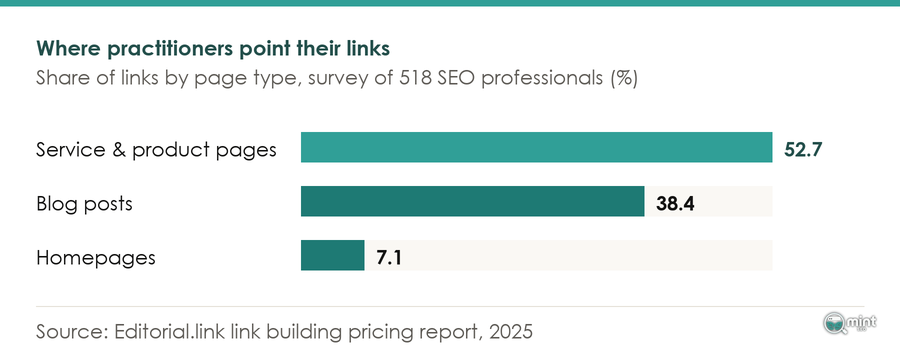
Pull up the last ten links your store earned and note where each one landed. A survey of 518 SEO professionals by Editorial.link found service/product pages receive most attention (52.7%), followed by blog posts (38.4%), then homepages (7.1%). On a store that means your collection and product URLs. In the audits I run, those three percentages are usually upside down.
Your category page carries the commercial intent and cannot earn links on its own merits. Nobody writes an article recommending a collection URL. Your homepage collects links by default and converts almost nobody.
A practitioner in r/bigseo put the split plainly this month: category pages, and blog posts that have most traffic, with active and reactive PR links going to the home page. Earned commercial links go to the pages that sell. Press coverage lands on the homepage anyway.
A link only pays once the page it lands on can hold a ranking, and category pages have their own rules for that. We put the word counts and the structure in how much copy a category page needs.
One Anchor Repeated Is The First Thing To Fix
Natural profiles spread their anchor text. In the Editorial.link survey, partial-match anchors comprise 41.7%, exact-match 25.1%, branded 20.5%, related/topical 8.7%. Read that as a majority of your anchors carrying your brand or a loose phrase, with the exact keyword used sparingly.
On 6th August a founder running a hydroponics store in Australia described their profile to r/bigseo as about a dozen referring domains, most sharing the same anchor text. A reply named the priority correctly: five new referring domains with varied anchors do more for you than a larger number all carrying one phrase.
Variety comes before volume on a thin profile. It is also the cheapest correction available to you.
What Earns A Store A Link Now
Rank the routes by how well the publisher already knows you. That ordering predicts your reply rate better than how clever the tactic is, and it sits inside the wider sequence we set out in which ecommerce SEO job to do first.
Start With Publishers Who Have Already Named You
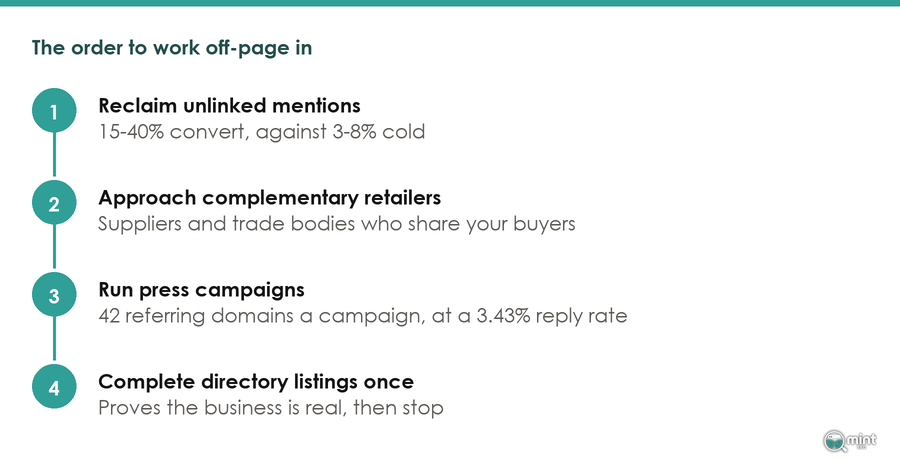
Somebody has mentioned your store without linking to it. Asking them to add the link runs at 15-40% for well-qualified mentions, compared to 3-8% for cold link requests, according to Reporter Outreach. Those two bands are the difference between a morning of work and a quarter of it.
The editorial decision that you are worth mentioning has already been taken. You are asking for an amendment to something already written.
It lands faster too. Reclaimed links often show ranking improvements within 2-4 weeks, while new links take 6-12 weeks, because the page carrying the mention is already indexed and already trusted. That speed puts the job at the top of the plan.
Then The Retailers And Suppliers Who Sell Alongside You
Next come the businesses selling to your buyers without competing for your sale, whether suppliers, complementary retailers or trade bodies. A link between you serves both audiences, which is the condition Google's policy tests.
Work that list slowly, at a few approaches a day. Your outreach ceiling is set by email deliverability. A domain flagged for volume costs you more than the links were worth.
Press Coverage And The Reply Rate You Are Working Against
Press is the one route here that returns more than one link at a time. An analysis of 371,631 articles by Reboot Online found average campaigns earn 42 unique referring domains at an average DR of 61. Hold onto the second number. Forty-two domains at that strength is a different purchase from forty-two directory entries.
Then look at what it takes. In benchmarks compiled by AM World Group, the average journalist response rate is just 3.43%, with 86% of reporters rejecting pitches for lack of relevance. Targeting decides the outcome before your story does.
Pitch length is a lever you control for nothing. Those same benchmarks show pitches under 150 words earn a 5.89% response rate, while pitches over 500 words earn 1.46%. A journalist decides in the preview pane, so the story has to be legible before they open anything.
What Directory Listings Are Still Good For
Directories prove you exist and do little else. Across the page-one profiles WebFX examined, the overwhelming majority of links are editorial mentions.
They still earn a morning of your time, because a listing establishes that a real business trades here. Complete them once and move on to the editorial work that carries the weight.
Some of that editorial work gets offered to you for a fee. Google's spam policies say any links that are intended to manipulate rankings in Google Search results may be considered link spam. Intent decides it, not the invoice.
Where Your Buyers Already Talk (And What To Put There)
Your buyers discuss products like yours somewhere, and those rooms are where mentions come from. Recent measurement suggests an unlinked mention now tracks visibility more closely than a backlink, and the figures behind that claim follow.
Why Brand Mentions Now Outrank Backlinks
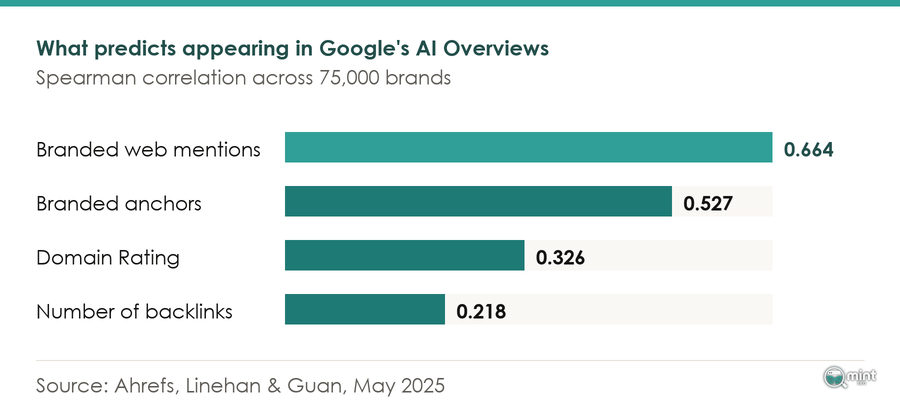
Two researchers put a number on it. Louise Linehan and Xibeijia Guan studied 75,000 brands for Ahrefs against appearances in Google's AI Overviews. Web mentions (0.664) correlate much more strongly than backlinks (0.218). Correlation is not causation, though a spread that wide still decides where a budget goes.
Two more figures from that study deserve your attention. Branded anchors: 0.527. Domain Rating: 0.326. Brand your anchors, and stop treating an authority score as the target.
Tracking by Muck Rack of what large language models cite agrees. Its May 2026 edition is headlined earned media consistently drives AI citations, holding at 84%, while paid and advertorial content accounts for 0.3%. Buying placement buys very little here.
This reweights links. Work that produces mentions now deserves as much of your budget as work that produces links, and we set out the answer engine work a retainer should cover in more detail.
The Rooms Worth Being In (And What Earns A Mention There)
Pick the two or three communities your buyers use, whether that is Reddit, a trade forum or the comments under the people they follow. Contribute usefully and be nameable. These places produce one buyer recommending you to another.
This costs time, and it resists outsourcing. It also has standalone value. Per LinkBuilding HQ, 80.9% of SEO experts believe that even if you don't reclaim the link, the unlinked mention itself still acts as a ranking signal in 2026.
Why Only Three Brands Get Named Per Sector
AI answers name a short list. Otterly.ai analysed over a million data points. The top-cited brand in any given sector wins an average of 31.4% of all brand citations, with the top 3 brands combined capturing 64.7%. A place on that list in your own category is the goal.
Research published on 5th August by Search Engine Land across roughly a thousand categories separates being cited from being recommended. In distant categories, 50% appearances are citations and only 25% are mentions, with only 9% getting both.
Closer to home that picture changes. The same research finds that in close categories that are more topically relevant to a brand, 74% are cited, 44% are named, and 34% get both.
Depth in one category therefore beats presence across many. Be the obvious specialist in what you sell.
There is a measurable payoff. Brands cited in AI Overviews see a 23% branded search lift within 30 days, which is how a mention turns into demand you can see in your own reports.
What Agencies And Publishers Charge Per Link
You are likely reading this because somebody has quoted you. Here is the market to judge that quote against.
The Going Rate And Who Is Paying It
A survey of 500 professionals run by Reporter Outreach in the first quarter of 2026 found 47% paid $500 or more per link, and 16% paid $1,000 or more. The four-figure end is what a competitive placement costs in a category where the publishers worth having already have a waiting list.
Practitioners meet the same floor in the wild. One on r/SEO described how the majority of the sites they contact ask for money upfront in exchange for a backlink, often over 500 euros.
Multiply your sector target by that rate before you agree to anything. Seventy-six referring domains at five hundred dollars is a very different conversation from three thousand of them.
The Markup Between Direct And Agency
Ask any supplier to separate the placement fee from their own. An analysis of 26,000 sites by BuzzStream found direct guest post cost averages $364.76; agency-mediated runs $1,459.06. That is roughly a fourfold difference on the same placement.
Some of that gap is real work: prospecting, negotiating and managing the relationship. The difficulty is that it comes baked into a per-link number, so two quotes that look comparable are not.
For scale, analysis by Siege Media finds typical campaign budgets range from $3,000 up to $25,000 per month in 2026.
Those budgets keep climbing, too. Publisher placement fees rose 20-40% in two years, which shifts the arithmetic steadily towards earning coverage.
Why Google Never Warns You A Link Was Devalued
Google discounts manipulative links. As one reading of the current backlink policy puts it, there is no notification appearing; rankings simply decline as the artificial boost is removed.
That analysis draws a distinction worth holding onto: Google devalued link counting, not links. Links still work. Counting them stopped working.
Since no alert is coming, buy links you would want if search did not exist. Give the work a quarter before you judge it, too, because surveys of working link builders put the wait at one to three months for most of them.
If you want the payback curve for the wider channel, we published what each benefit of ecommerce SEO is worth.
Where Mint SEO Digital PR And Link Building Fits
You now hold the three numbers: your sector's referring-domain target, the reply rate you are working against, and the market price. That is enough to decide whether to build this in-house or commission it.
If you would rather commission it, our digital PR and link building service runs the reclamation, the retailer outreach and the press campaigns described above. We point the coverage it earns at your category and product pages.
We run it alongside the technical and on-page SEO work, because a link to a page that cannot convert is a wasted link.
If you would rather hand it over, book a free consultation and bring your current referring-domain count to it. I will put your sector's page-one figure beside it and tell you what closing that shortfall costs at today's rates.

About the author
John Butterworth
John Butterworth is the founder of Mint SEO, a Manchester ecommerce SEO agency he started in 2024. He has 11 years in SEO and digital marketing, previously running SEO departments for market-leading brands and several agencies. He specialises in Shopify and ecommerce SEO, and his work has ranked over 100 websites and driven more than 3 million organic visits. He speaks at industry events including the SEO Mastery Summit.
Connect on LinkedIn →