
Knowledge Hub
Off-Page SEO For Ecommerce: The Links, Mentions And Ratings That Rank A Store
By John Butterworth · October 3, 2026
Off-page SEO for ecommerce is the trust your store earns on websites you don’t own. It comes from press links, brand mentions and reviews on sites Google reads, and it only lifts pages that are already in good order.
So sort your collection pages and templates first. Then chase press coverage first and best-product lists after it. On those lists, ask for a direct link to the product page even when the list marks its links sponsored. Collect reviews through Google Customer Reviews or an approved partner, since only those feed the star rating Google shows beside your store.
A write-up in the press is worth chasing because it sends buyers as well as trust. My advice is to pitch a number a journalist can’t get anywhere else, pulled from your own orders. Look through your sales data for a finding a writer would want to quote.
Off-Page SEO Is The Trust Your Store Earns On Other Sites
In practice, an ecommerce store’s off-page SEO comes from three kinds of outside proof. A publisher links to a page, a stranger names your brand in a thread or video, and a buyer leaves a review somewhere Google can read it.
The trust that proof builds can only lift pages Google can already crawl and match to a search. That's why I fix the technical problems on a store and its category pages before chasing a single backlink.
Thin collection pages hold a store back in AI answers as well, because Google's AI results mostly cite pages that already rank in search.
Leave the directory citations and the Google Business Profile to stores with a counter, a collection point or a genuine service area. Without any of those, an online-only shop has nothing for a local listing to rank, so that time goes into the work below.
Where An Online Store's Off-Page Links Should Come From
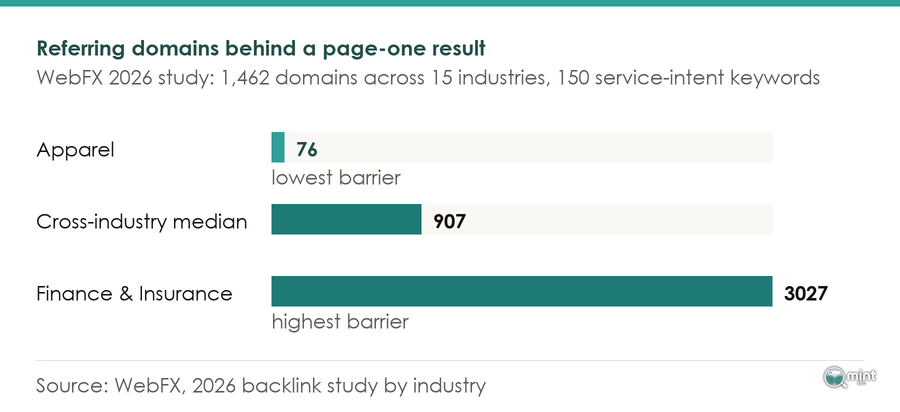
Earn your store's links from press coverage first, and pay for a guest post only on a site that passes three checks. Off-page SEO for an online store needs fewer links than the industry sells, and plenty of stores rank with few backlinks, especially in less competitive niches.
Press Coverage Earns The Links That Also Send Buyers
Press coverage earns the best backlinks a store can get. A journalist writes for readers, so the link carries trust and sends shoppers who click through to buy. Paid guest posts rarely send anyone.
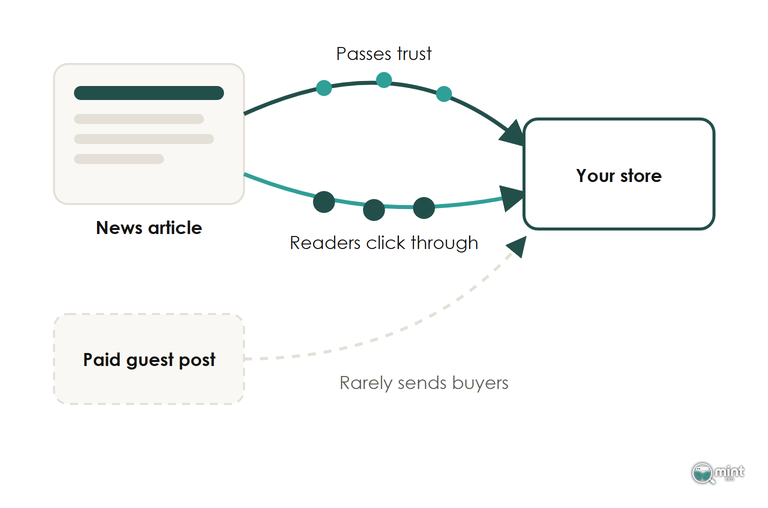
Once coverage starts landing, measure the results by referring domains: the number of separate sites linking to your store.
Let the anchor text on those backlinks be your brand name or a longer descriptive phrase. An exact-match anchor still works, but an ecommerce link profile full of them looks bought.
Domain Rating and Domain Authority help you size up a publication before you pitch it. Both are easy to inflate with spam, so treat them as rough yardsticks that Google doesn't rank on.
Pitches that land give a journalist a number they can't get anywhere else, pulled from your orders. Building one, and choosing the page it links to, gets a full walk-through in our guide to earning links for a store.
A Guest Post Is Worth Buying Only On A Site People Search
Paid guest posts are the shortcut link sellers offer a store most often, and they only work on a narrow set of sites. Before you pay, check the host site on three things.
A guest post on the wrong site can cost the store rankings as well as the fee. Google's spam policy counts a paid placement that passes ranking credit as link spam. When its systems discount those placements, the rankings they bought are gone for good, so buy few and vet each one.
That risk comes with backlinks you pay for. Spammy links you never built are a different matter, and Google ignores most of them on its own.
Mention swaps can carry the same risk as bought links do. Google's spam policy counts excessive link exchanges as spam, and a you mention me, I'll mention you deal with links going both ways is that trade under another name.
A disavow file is for a manual action from Google or a deliberate negative SEO attack on the store, nothing else.
Best Round-Up Posts
Plenty of publishers write list posts ranking the best electric cars, and the people reading them are close to choosing. If you sold electric cars, you’d want yours on that list. Getting onto that list matters because it’s third-party endorsement: a site your buyers already trust telling them your product is one of the best.
Find the round-ups that rank for the best searches in your category and offer the writer the details they compare on, such as price, specs and what sets your product apart. A link marked sponsored or nofollow still gets your brand named where shoppers and AI answers look. Ask for a direct link to the product page as well.
Product Reviews
You want links from people reviewing your products and linking back to you. That’s third-party endorsement Google loves: someone who has used the product telling their own readers it’s worth buying, and sending them to the page where they can.
These are reviewers who found the product themselves, which makes them a different job from gifting stock to creators, covered further down. When a review names your store without a link, ask the writer to add one to the product page they’re describing.
Suppliers & Manufacturers
If you have exclusivity on a manufacturer’s products, ask their website to link to you from a partners or stockists page. It’s a strong authority link, because the brand behind the product is pointing its own visitors at your shop.
It’s also an easy ask. The manufacturer wants its range to sell, and you’re the place to buy it.
Podcast Interviews
Interview coverage can come from news sites, but podcast appearances are the main one to go after. Being interviewed on a podcast is great coverage that always lands a link, as the show notes point listeners to the guest.
Pitch the shows your buyers listen to with a story only you can tell. The order-data angle that works on journalists, covered above, works on a podcast host too.
Mentions And Reviews Count Towards Off-Page SEO Without A Link
Off-page SEO for a store also runs on brand mentions and reviews that carry no link at all. A creator's review, a forum recommendation and a buyer's star rating all tell Google and AI answers that real buyers vouch for the store. Without a followed link each one counts for less than an editorial link does, but never for nothing.
Gifting Products To Creators Buys A Review, Not A Followed Link
Sending free stock to creators is an off-page tactic plenty of ecommerce stores already run, usually in the hope of a backlink. Google's spam policy names it directly: a product given in exchange for a post with a link back counts as a paid placement.
Put two lines in every creator brief. The link carries rel="sponsored", and the post says at the top that the product was gifted. That helps keep the store inside Google's rules and inside the advertising rules your customers' countries apply.
Your store is really paying for the review: buyers watch a creator use the product before they order, and that video does more selling than anything else in the post.
Point the link at the product or collection page they would buy from. Then brief the creator on the facts that sell it: sizes, materials and what it replaces, and never ask for a particular anchor.
Pick several small creators whose audiences already buy your category over one large account. Their followers are closer to a purchase, and the cost per post is lower.
Spread Social And Forum Mentions Across Several Platforms
Social posts and forum threads pass little ranking value through their links, which the platforms mark nofollow or ugc. They still get your brand named where search engines and AI answers can see it.
Getting your store named in AI answers specifically is covered in how SEO and AEO fit together.
Don't build that presence on one platform. In August 2026, ChatGPT cut its Reddit citations by at least 73% in two steps while the other AI engines kept citing the same threads, Otterly.AI's citation tracking shows. A store whose mentions all lived on Reddit would have lost most of its ChatGPT citations inside a week.
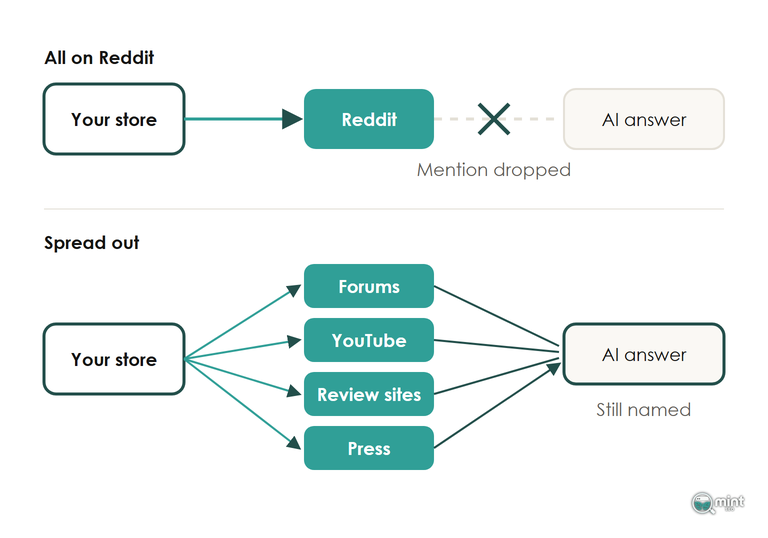
Spread the work across forums, video reviews and best-of roundups, then review sites and the press.
Video mentions carry real weight for AI answers. In a 75,000-brand study reported by The Next Web, how often a brand came up across YouTube videos tracked AI visibility more closely than how many people watched them. As the same report puts it, “a niche product reviewed by twenty small creators may register more strongly with AI systems than one featured in a single viral video”.
Forum work only holds up when it's done under the store's own name, answering the sizing, delivery and comparison questions buyers ask in threads about your category. A planted thread or a review from a fake account gets spotted by regulars and deleted by moderators, and the brand's credibility goes with it.
Reviews On Approved Sites Put A Star Rating On Your Store
Of all the off-page SEO signals an ecommerce store collects, a store rating is the one Google prints beside your name. It's a star score built from what buyers said after delivery, and it shows on free listings and Shopping ads.
The bar, set out in Google's store ratings overview, is about 100 eligible reviews gathered within a rolling 24 months. Those reviews are counted separately for each country you sell to, so a store that ships to Ireland needs reviews from Irish buyers before a rating shows there.
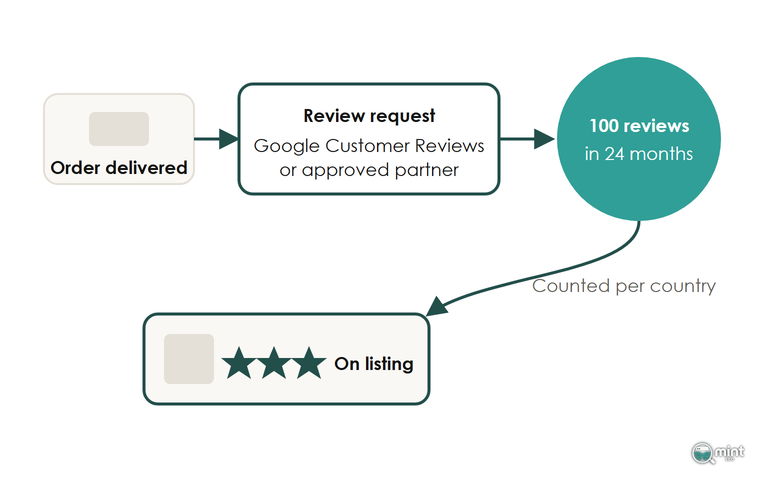
The reviews have to come through Google Customer Reviews, which is free in your merchant account, or one of the approved review partners.
A reviews app that only shows stars on your own product pages won't feed it unless the app is one of Google's partners. That kind of social proof on your product pages does a different job.
Google filters out reviews with no order behind them, so swapping or buying reviews gets a store nowhere. Ask every customer after delivery and keep asking, because older reviews drop out of the count.
You can check where you stand on Google's store pages address: google.com/storepages?q= followed by your domain.
Let Us Earn The Coverage While You Run The Store
Pitching journalists with your own data is slow work. Vetting guest-post sellers takes as long again, and so does getting your store named on forums and review sites. None of it pays until the store's own pages are in order.
Our digital PR and link building work takes that on for you. It runs next to the technical and on-page fixes that decide how much each link is worth. Mint SEO is an SEO agency that earns press links for online stores, and the pages those links point at get the same attention.
First, see where you stand. Page two of the free audit lists commercial keywords your competitors win where you're not on page one, with the monthly demand behind each. Those searches show which pages outside trust could help most.
It's a two-page PDF sent the same day, with no call and no obligation. Get a free SEO audit of your store and see which rankings are within reach.

About the author
John Butterworth
John Butterworth is the founder of Mint SEO, a Manchester ecommerce SEO agency he started in 2024. He has 11 years in SEO and digital marketing, previously running SEO departments for market-leading brands and several agencies. He specialises in Shopify and ecommerce SEO, and his work has ranked over 100 websites and driven more than 3 million organic visits. He speaks at industry events including the SEO Mastery Summit.
Connect on LinkedIn →