
Knowledge Hub
The AI Tools Worth Paying For (And The Ones Your Shopify Plan Already Covers)
By John Butterworth · August 9, 2026
Searching for the best AI tools for ecommerce turns up the same fifteen names in a different order every time. Every app in your admin has grown an AI tab this year, and your software bill has gone up to match.
Your question is not which tools exist. It is which two or three earn their money on a store your size, and what you can stop paying for.
Most of my week is spent inside other people's product catalogues, working out why one store ranks and the one beside it does not. That is the angle I can bring to this, and it is a narrower one than most lists of tools are written from.
Before writing this I read every page currently ranking for it, then went and counted what is on offer instead of taking anybody's word for it.
So I went and pulled the numbers myself. What Shopify's own app store returns for the term AI is not a shortlist anyone could work through, and I have put the count further down with the rest of the crawl.
Below is the shortlist organised by job. After it comes the test I use before recommending anything, the two jobs you may be paying for twice, and the one purchase here that can cost you traffic.
The Three Jobs Where An AI Tool Earns Its Subscription
Three jobs in an ecommerce business currently justify a dedicated subscription. Everything else is either bundled into software you already pay for, or cheap enough by hand that a tool cannot cover its own cost.
Work down this list in order and stop as soon as the next job stops describing your store.
Support comes first for a reason. Across the ecommerce store audits we run for Shopify brands, it is the one job of the three where you can count the saving per unit of work.
A countable saving is the only kind you can defend when the invoice lands. The other two ask you to take a number on trust.
Customer Support Automation
Support is the safest first purchase and the most widely adopted. Capital One Shopping's 2026 research compilation reports that 48% of retailers use conversational AI for customer service, with a further 24% piloting it.
It is countable in a way the rest are not. Every ticket closed without a human is a unit of work you can price, so the case becomes a piece of arithmetic.
Buy narrow here. Tools that work get pointed at order status, delivery dates and returns, which are the questions that repeat all day.
A bot pointed at selling reads as a bot. One that tells somebody where their parcel is reads as service, and that difference shows up in your ratings rather than your ticket count.
The apps merchants stay with year after year reflect that. Chatty AI Chatbot and Live Chat is rated 4.9 from 1,787 reviews and offers a free plan, and what it does is answer order status and FAQ questions, which is the narrow job where a bot helps.
Product Discovery And Personalisation
Personalisation is the second job worth a dedicated tool, and the one with the clearest threshold. You are not buying a feature here. You are buying a recommendation engine that improves on the traffic you already have.
That threshold is traffic. Below a few thousand sessions a month there is too little behaviour for a model to learn from, and what you get is an expensive best-sellers list.
Above it, the same tool starts doing something a merchandiser cannot do by hand, which is reordering a category for every visitor.
One number decides this purchase: add-to-cart rate from your category pages, before and after. Global average add-to-cart rates sit around 6.17%, against a global baseline of 5.96% recorded by Dynamic Yield, so you can see where you start.
Attribution And Analytics
Attribution is third because it gets harder as you add tools, which makes it the job most often bought too early. Your revenue band picks the tool here.
Polar Analytics, Triple Whale and Northbeam sit at different price points and pull down different brand sizes, so they are not interchangeable products.
Buying the one a bigger store recommended is how you end up paying for resolution you cannot act on. Match the tool to your own revenue band first.
An operator running a three-year Shopify stack named the underlying problem well. With that many data sources you end up manually connecting dots between Klaviyo segments and analytics spikes and inventory shifts.
Every tool you add makes that worse. More dashboards give you less clarity, which surprises people every time.
Get your underlying numbers straight before any attribution tool, because it can only report what you already collect. Our guide to the metrics worth tracking on a store covers what to have in place first.
Where that customer data should live is a related question with its own answer. We cover it in the piece on what a CRM does for an online store.
Generating Product Copy Is The One Job That Can Cost You Traffic
Content generation gets covered as one category among many. It is not one among many. Every other purchase on this page can waste money, and this one can lose you traffic you already have.
What Jasper And Shopify Magic Are Good For
A copy generator is worth having for the first draft of one page. It is not worth having for the final version of a thousand.
Start with the one you own. Shopify Magic is included with every Shopify plan at no extra cost and generates email subject lines, preview text and body copy inside Shopify Email.
If short-form drafting is the job you are hiring for, you have already bought the tool.
Jasper and the paid generators earn their place on volume and on brand voice control. Judge them by how much editing a draft still needs, because that editing is what decides whether the page ranks.
What Scaled Content Abuse Means For A Catalogue
Google's spam policies define scaled content abuse as generating many pages primarily to manipulate rankings, and they name AI-generated pages explicitly.
Google's March 2026 core update named scaled content abuse as a primary target, and sites publishing large volumes of AI-generated pages without editorial oversight recorded traffic drops of 50 to 80%.
Read that policy closely, because it is narrower than the panic around it. Google does not demote a page for being drafted by a model. It demotes pages produced at volume with nobody in the loop.
Which gives you a practical line: one person per page. If a human reads, edits and approves each description before it publishes, you are inside the policy. If a job generates four hundred descriptions overnight, you are outside it.
You Probably Have A Duplicate Copy Problem Already
Something else is worth knowing before you point a generator anywhere. Roughly 78% of ecommerce sites copy and paste manufacturer product descriptions, so most catalogues carry a duplication problem long before any AI turns up.
A generator will not fix that. It swaps one kind of near-identical copy for another, faster, and across more pages than before.
The useful question is which pages deserve original copy at all, and you can answer that without buying anything. Our guide to how much copy a category page needs sets out which pages earn the writing time.
That same logic decides where a generator is safe to point. Pages that earn original copy are pages worth drafting. The rest are better left short.
SEO consultant Aleyda Solis analysed five ecommerce subverticals and found that support articles, size guides, policies and educational content account for 20 to 40% of the pages cited in AI answers. She founded the international consultancy Orainti and has spoken at the major search conferences for years.
Those pages are rarely where a generator gets pointed, which is the miss. Support and policy copy is doing real work in AI answers while everybody optimises the product page.
How To Tell A Real One From A Listing
Any ranking of the best AI tools for ecommerce is worth as much as the criteria behind it. So here is how I judge a tool before recommending it, in an order you can reuse on anything this article never mentions.
Star Ratings And Review Counts
Start where the merchant starts, in the app store search box. Shopify's own app store returns 6,279 apps for the search term AI, which is where the trouble begins.
So on 9th August 2026 I typed “AI” into it and worked through the first 193 results in the order Shopify ranked them, eight pages deep, noting each app's star rating, its review count, what it charged and whether it held the Built for Shopify badge.
Across the first 193 apps Shopify returned for AI, 80% were rated 4.8 stars or higher, with a mean rating of 4.81 and a median of 4.90. The median review count across those 193 apps was 106, and 36% of them carried fewer than 50 reviews, on the search results as they stood that morning.
Pricing tells the same story, as does Shopify's own quality badge. Both are in the table above, and neither of them narrows the field either.
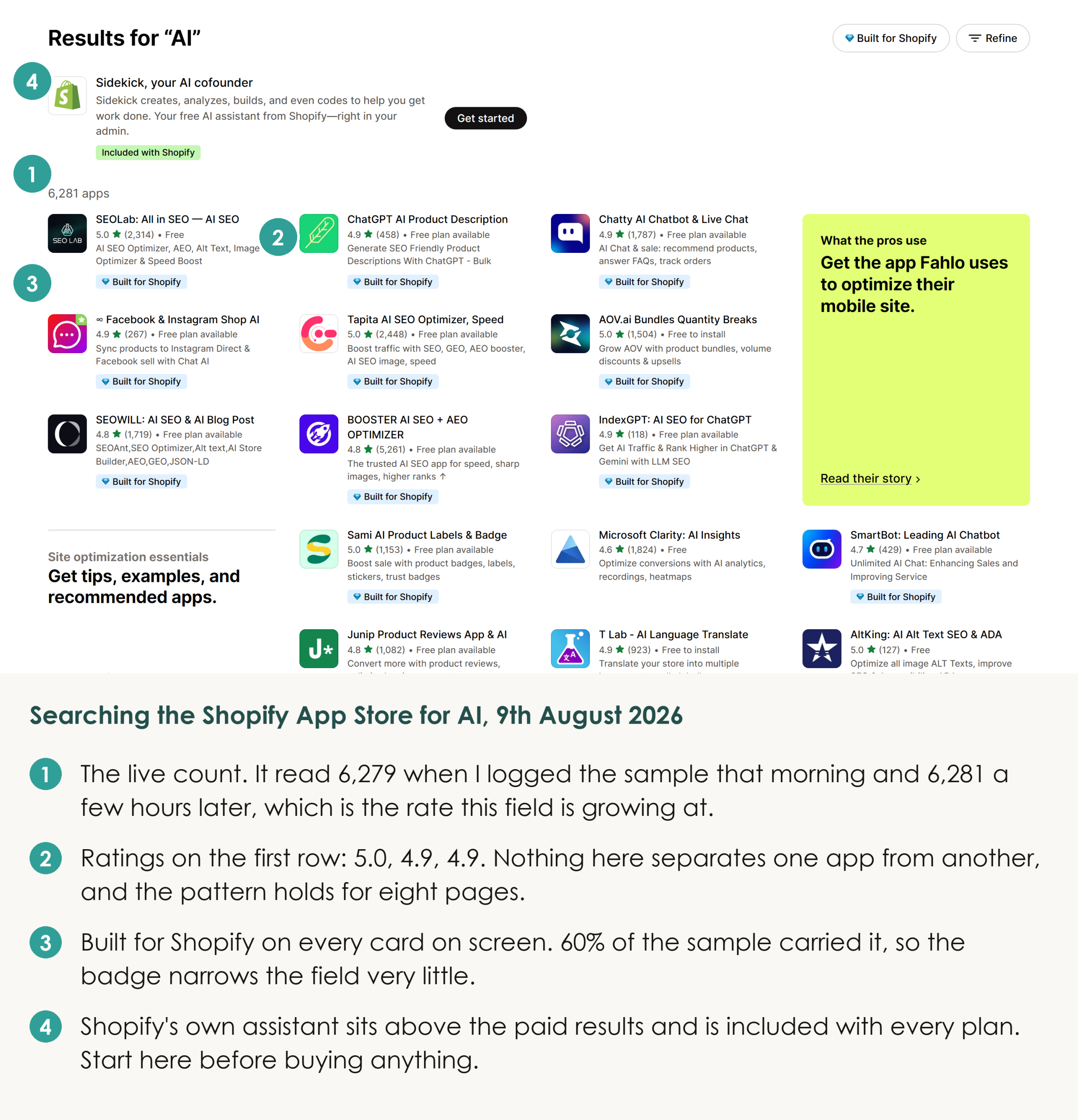
Read those together and the conclusion is uncomfortable. A filter that keeps four apps in five tells you nothing, and a rating built on forty reviews is a small sample of early adopters.
Price will not narrow it either, since published app store data puts the average paid Shopify app between 58 and 67 dollars a month with free options widespread. You need a different test.
Read The Case Studies, Not The Headline Number
Every AI support vendor publishes two resolution figures. Gorgias markets up to 60% instant resolution, but its own published case studies land between 26% and 56% depending on the brand, and its customer story for the apparel label Psycho Bunny records 26% of tickets resolved autonomously.
It is not one vendor doing this. Tidio markets its Lyro agent at 67% resolution.
Its own benchmark data puts well-configured knowledge bases at 55 to 65%, and most deployed stores land lower still. The pattern repeats because a marketed number describes the best case somebody achieved, not the median one.
Neither figure is a lie. A marketed ceiling assumes a well-configured account with a deep knowledge base behind it, which most stores do not have on day one.
What a named brand recorded in public is the number to plan against. Plan on the second one.
Check the claim against a cross-vendor baseline too. Zendesk's CX Trends research puts average AI chatbot resolution at 58% across industries, with ecommerce highest. Any vendor claiming far above that is claiming to beat its whole field, which is a larger claim than it sounds.
Who Wrote The List You Are Reading
This last check costs nothing and changes how you read everything else. On 9th August 2026 I fetched and read all seven pages then ranking on page one for "best ai tools for ecommerce", and checked each publisher against the tools it recommended.
Five of the seven were published by a company that appears on its own list. Four of those five placed themselves first or gave themselves a dedicated section.
Fin, the helpdesk AI agent published by Intercom, ranks for this query with an article titled 15 Best AI Tools for Ecommerce that lists Fin as number one.
Tolstoy's roundup of the best AI tools for ecommerce places Tolstoy first among its most popular tools and closes with a section on how the Tolstoy platform drives personalised experiences. Neither hides it.
Because neither hides it, the sensible response is not to skip them. Tolstoy's opening table maps a bottleneck to a tool type and the metric to watch, and it is the most useful single thing in this field.
Read these lists knowingly instead. Treat the number one slot as an advert, and take the rest as legwork somebody else has already paid for.
There is a measurable version of the same observation. Measured across the eight ranking pages fetched for this query, mean pairwise similarity was 0.85 with a standard deviation of 0.05, meaning the pages are close to interchangeable.
These lists agree with each other because they copy each other. That is worth knowing before you treat their consensus as a finding.
Check What Your Platform Already Does Before You Buy Anything
Most rankings of the best AI tools for ecommerce leave one thing for the reader to work out. For a lot of stores the right move after reading one is a cancellation.
Two of the jobs above are already covered by software you pay for today, and both suppliers expanded those features this year.
What Shopify Shipped While You Were Shopping
Two December releases ago you would have been right to buy a separate tool for this. Shopify's Winter 26 Edition, launched on 10th December 2025 under the name RenAIssance, shipped over 150 updates and gave Sidekick multi-step task execution and store-wide context.
Shopify's Spring 26 Edition, announced on 17th June 2026, put Sidekick on every screen of the admin, added voice input, and had it suggest replies inside Shopify Inbox. That is two releases in six months, both aimed at the same jobs you are shopping for.
Take that as a warning about buying. Your platform is absorbing simpler tools faster than most stores can evaluate them.
A subscription signed today may duplicate a feature that lands free in six months. Go and look before you buy: open the admin, open your email tool, and write down what each one already does.
It is an hour of work. On most stores it removes at least one line from the shortlist, and on some it removes the whole shortlist.
The Email AI You Are Already Licensing
Email is the clearest case of all. Klaviyo reported second-quarter 2026 revenue of $370.6 million, up 26% year on year, and raised its full-year guidance on the back of it.
The number underneath that one matters more here. Klaviyo's AI Composer agent reached over 95,000 users in its first month, with nearly a quarter returning weekly.
That is what happens when AI turns up inside a licence people already hold. It runs well ahead of what standalone tools manage on the same jobs.
Which means that if you run Klaviyo, your email AI question is already answered. The work in front of you is learning the features you pay for.
The Second Subscription Problem
Paying twice for one job is the most common overspend I see. A commenter in that same Shopify thread put it plainly.
If someone already pays for a tool like Gorgias, then having to pay extra for another tool to layer AI on top makes no sense to him. It makes no sense to me either.
Audit it on a spreadsheet once a quarter. One column for the job, one for the tool doing it, one for the cost.
Any job with two rows against it is a decision you have not made yet. That is usually where the first cancellation comes from.
The Ninety-Day Test That Decides Whether It Stays
Adoption is not this market's problem. Capital One Shopping's 2026 retail AI research reports that 89% of retailers have adopted AI while only 7% have scaled it.
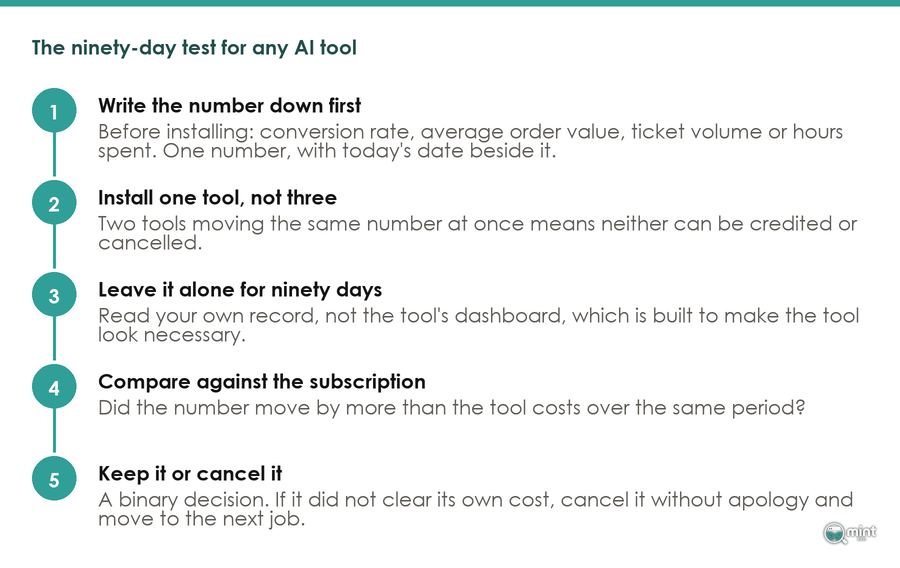
That gap is a measurement failure. The best AI tools for ecommerce are the ones that survive ninety days on your store.
The fix is unglamorous and takes about ten minutes. Write down what a tool claims to move before you install it, then read the same numbers ninety days later.
The Four Numbers To Write Down First
Four numbers cover every claim an ecommerce AI tool makes:
- Conversion rate, for anything touching the storefront or personalisation.
- Average order value, for recommendation and bundling tools.
- Ticket volume handled without a human, for support.
- Hours spent on the task, for anything generating content or reports.
Record them on the day you install, with the date beside them. Write them down yourself, because a tool's own reporting is built to make that tool look necessary.
Because you wrote the number down, the decision at ninety days becomes binary. Keep the tool if the number moved by more than the subscription costs you, and cancel it without apology if it did not.
If the tool touched your storefront, our piece on which store fixes to work through first is worth reading alongside the numbers, because a conversion change often traces to something the tool did to your pages.
What Walmart Did That Most Stores Do Not
The clearest worked example of this discipline came from a company with every reason to keep going. Walmart made roughly 200,000 products buyable inside ChatGPT from November, and then measured what happened.
Walmart's EVP of product and design, Daniel Danker, said in-chat purchases converted at one-third the rate of click-out transactions and called the experience unsatisfying. The checkout ran at a 1.18% conversion rate against an industry average of 2.5 to 3.0%.
Walmart withdrew from it, and OpenAI retired Instant Checkout in March 2026. A flagship feature reached enormous scale and was still wrong, which is the argument for measuring everything you install.
Something similar applies to how AI search treats your store. What Google is building next, including a protocol for buying inside AI Mode, is fed by your product data. No purchase changes it.
That is a different kind of work with a different bill attached. Our piece on the answer engine work a retainer should cover goes into it.
Where Mint SEO Fits If You Want The Organic Side Handled
Choosing the best AI tools for ecommerce is only half the job. Of everything on this page, the decision that can go badly wrong is the content one.
If you are about to point a generator at a catalogue, find out what condition that catalogue is in first.
That is the work we do. An ecommerce SEO audit tells you which product and category pages are duplicated and which ones earn original copy.
It is the difference between a generator that helps you and one that multiplies a problem you already had. I have taken this material to the stage at the SEO Mastery Summit.
On one store that work took organic revenue to £1.23M, a 256% increase, and the mechanism was unglamorous: fixing what the catalogue said before worrying about what else could be added to it. That is the shape of a search channel you own and can predict.
Get your catalogue checked before you scale anything across it. That is cheaper than unpicking it afterwards.
Book A Free Thirty-Minute Consultation
If you want a straight answer on whether your catalogue can take AI-generated copy, that is a short conversation. Book a free 30-minute consultation and we will look at your current rankings, the state of your product copy, and what to do over the next ninety days.
You get me on the call, and a rough direction whether or not you work with us. If your catalogue is in good shape and you should go ahead, I will say so.

About the author
John Butterworth
John Butterworth is the founder of Mint SEO, a Manchester ecommerce SEO agency he started in 2024. He has 11 years in SEO and digital marketing, previously running SEO departments for market-leading brands and several agencies. He specialises in Shopify and ecommerce SEO, and his work has ranked over 100 websites and driven more than 3 million organic visits. He speaks at industry events including the SEO Mastery Summit.
Connect on LinkedIn →