
Knowledge Hub
How To Write Product Copy That Sells Across A Whole Catalogue
By John Butterworth · August 14, 2026
Your product page, your collection page and the button beside it all sell differently, which makes ecommerce copywriting three separate jobs. They usually get treated as one.
A rewrite of the wrong pages changes nothing. Mint SEO is my agency, run out of Manchester, and across eleven years in SEO I have driven more than three million organic sessions.
Most of that work has been catalogue audits, and enough of them turns up the same lopsided pattern. Your best-selling product has been polished four times, while four hundred other pages have never been written at all.
This year that stopped being only a conversion problem. Google's first broad core update of 2026 rolled out from 27th March and finished on 8th April. Ecommerce sites carrying original content came out of it with average visibility gains of around 22%.
What follows is what to write on each page type, where to get the sentences, and which pages to open first.
What A Product Page Description Has To Do
What a buyer needs the page to settle
Your description has one job, and it settles two questions that are worth writing on a sticky note before you touch a page.
One question asks what the product does in practice, and the other asks whether the product is for someone like the person reading it.
None of that is a stylistic preference. In usability testing at the Baymard Institute, research lead Edward Scott recorded that 'every single user relied on the product description at some point during test sessions'.
Shoppers reach for the description while they are deciding, and those two questions are what they reach for it to answer. Frame it that way and the length question answers itself. A description is finished when both are settled.
Name the mechanism, then the outcome
Working copy names a physical mechanism, then the outcome it produces, in that order.
Take the SoftForm pillow from Bearaby, sold in 32 words. 'A cooling latex pillow cushions your head and aligns your back, for deeper, stiller sleep.'
Then comes the mechanism, in the sentence after it. Breathable plant-based Melofoam keeps the air flowing, so you stop tossing and turning.
Mechanism first and outcome second, believable because of the order. Reverse those and you get a claim with nothing holding it up.
Magic Spoon runs the same move with numbers. Its peanut butter cereal page opens on 'Crunchy, nutty, and perfectly sweet' and then produces evidence: 4g net carbs, 13g complete protein, 140 calories. Sensory language earns the read, and figures close it.
A specification list is not a description
A specification block answers what the thing is. It never answers whether it is for you.
You can watch that happen on True Classic, which gives two different long-sleeve three-packs one 65-word block, opening on premium fitted crew neck long sleeve and a combed ringspun cotton jersey. That detail is precise and worth keeping. Missing is the sentence saying who the fit suits, on a brand whose whole proposition is fit.
Which detail carries the weight depends on your category. Ingredients on a moisturiser, drainage on a boot, thread count on a sheet.
Lalo handles its category detail properly on the 5-inch Shadow Amphibian boot. Its passive drainage system, the page explains, is not designed to keep water out but to let it flow in and out.
A shopper who missed that would read a boot letting water in as a fault. Explaining a design decision your buyer would otherwise misread is the highest-value work any description does.
Writing Lines A Buyer Can Act On
Benefits are physical, not adjectival
A benefit lands when it names the physical moment of use. It dissolves when stated as an adjective.
Handles on the stock pot at Great Jones are described as ones that 'allow you to get a confident, four-finger grip on your heaviest hauls of pasta'. Its glass measuring cup gets printed measurements in ounces, cups and millilitres, with no mental math.
You can see your own hand on the pan, and no adjective gets you there. Every line then gets a test. Can I picture a buyer doing this, or have I only labelled the product good?
ColourPop takes the idea further and labels the slots on the page. WHAT IT DOES carries the function, while THE GOOD STUFF carries the ingredient list. A shopper scanning for one thing finds it without reading the rest.
Cut the words that describe nothing
Premium, quality and perfect survive because nobody checks whether removing them changes anything.
Well-run stores carry them too. Take Dr. Squatch, the clearest live example I have found, on a brand with a famously strong voice. Its Oceanside Orchard body wash opens 'Lather up with scents of crisp coastal apple, airy sea salt, and smooth cedarwood'. The deodorant in that scent opens 'Stay confident all day' and then runs the identical scent line.
That is twenty-two words and twenty-four, the same after the opening verb. Good scent language, telling a buyer nothing different about a body wash than about a deodorant.
Neither page answers the question separating them, and both read as complete. That is how a line survives being written once and approved twice, by people reading for tone while the information stayed missing.
Delete a word. If the line lost nothing, it was carrying nothing. That test is faster than any rewrite, and it is the working version of the active-voice rule everyone quotes.
Asking For The Order Without Shouting
What the button copy has to survive
Your ask is read after the doubt. Its job is to remove the last reason to hesitate.
Hesitation is what TUSHY writes against. It gives a full page for its Handheld Sprayer Mounting Hardware Kit. The page opens by telling you the parts 'come included standard with the TUSHY Handheld Bidet Sprayer'. It then adds 'Grab an extra set if you've lost them!' A How It Works section covers the two ways to store the sprayer.
Spare parts make the least glamorous page in any catalogue. That page also proves whether a store writes for buyers or only for its best-sellers. Two lines answer the only questions it ever gets, in the order they get asked.
The small print that does the closing
Microcopy beside the button carries more of the close than the button does, and nobody is ever assigned it.
Delivery timing, the returns window and what happens if the size is wrong all belong there.
Over on the Shopify Community, merchants asking how to write descriptions circle structure and keyword placement. One reply gets to the point: there is no best practice for this, it needs more of a mix strategy.
Nobody in that thread mentions the lines around the button, which is where the unanswered objection sits. An unanswered objection is why a shopper who has already decided still closes the tab.
Write those lines against the specific hesitation a shopper on that page is holding, and the button itself can stay as boring as you like.
The Collection Description Nobody Fills In
What the collection description is for
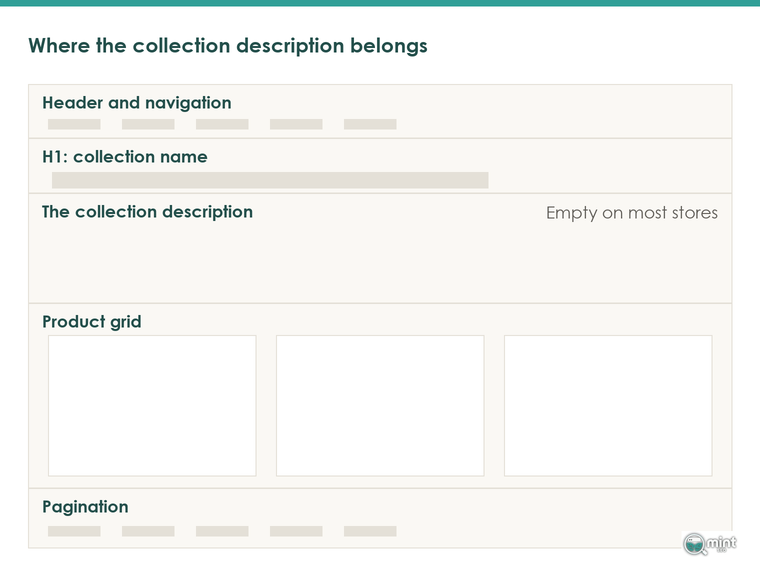
Every Shopify collection gets its own description field in the admin, and standard themes render it above the product grid as ordinary indexable text. On most stores it sits empty.
That matters because a grid shows twelve products and no basis for choosing between them. Above it is the only place your store gets to say which one suits which buyer.
Tiles cannot make that decision on their own.
Collection pages take the category-level commercial searches, where somebody is comparing options rather than checking a single item, while product pages take the long tail underneath them.
Filling that field is page-level optimisation with a writing job inside it.
Writing above the grid without repeating the products
Collection-page ecommerce copywriting fails when it restates the products underneath. It works when it gives a buyer some way to narrow them.
So write the decision rule instead: who each option suits, why the expensive one costs more, and which to choose for which use.
Stop once that rule is stated. A paragraph summarising the products below is the grid rewritten in prose, and original catalogue content was what gained in the March 2026 core update. Shorter than a summary, and it is the half that earns.
Your Buyers Already Wrote The Copy
Reading reviews the way a copywriter does
Words that work are already in your reviews and your support inbox. Good ecommerce copywriting is mostly a transcription job, and ecommerce copywriting done badly is usually invention.
Review mining is a defined procedure with an output. Joanna Wiebe founded Copyhackers in 2011 and named the practice.
She describes her own run of it plainly. Her account has her reading a stack of Amazon reviews for maybe two or three hours. She pasted the reviewers' own words into 1 of 3 tables, with as few summaries or abstractions as possible.
Those tables are the deliverable. You can start this afternoon and finish the day holding a document your writers can work from, rather than waiting for anyone to feel inspired.
Finding the language shared across buyers
One pass over your reviews can serve a whole catalogue, provided you sort for the wording that recurs.
Sorting for the overlap is the move. Eden Bidani has spent over a decade writing conversion copy and now heads strategy and copy at CAPE.Agency, and she put it plainly in a February 2026 interview. Look for common denominators, she said, when you are writing for a broad audience.
She also rates one thing above every survey: sitting down for a few minutes with someone who bought the product and loves it. Sort what you collect by what people asked, and those questions become the ones your descriptions answer.
Start With The Pages Nobody Wrote
Check which field your theme renders
Before auditing anything, open one product page in a browser and find where its words come from.
We learned this the hard way this week. Every one of marinelayer.com's 250 products returns an empty description field, yet its rendered page carries a full Details block served from theme metafields.
An audit reading the wrong field would have condemned 250 pages that were already written. One check, one page, five minutes.
The three failure modes, and which one you have
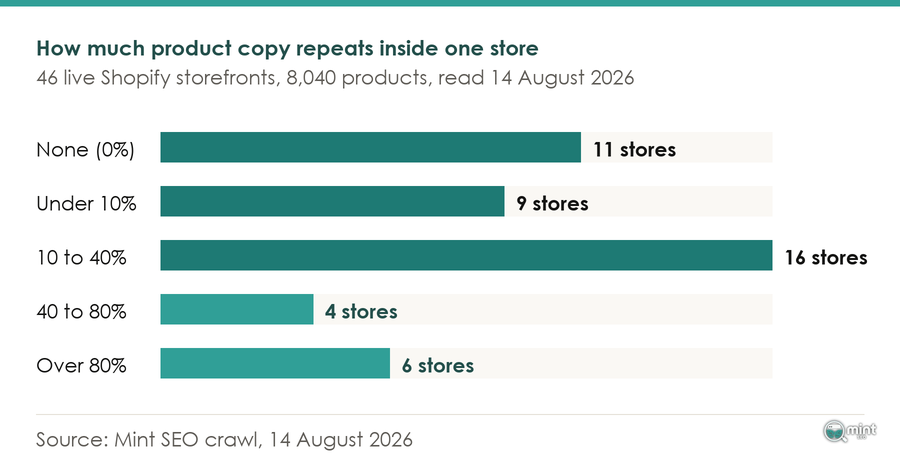
We wanted to know how often a shopper meets the same paragraph twice on one site, so on 14th August 2026 we read 67 consumer storefronts in apparel, home, beauty, food and outdoor. Each one gave up to 250 products through its public product endpoint. Forty-six answered, which came to 8,040 descriptions.
Those descriptions were then compared against the others inside the same store.
Ten stores had at least two in five products carrying wording identical to another product on the same site. Six of those ten ran above four in every five.
Eleven stores had none of it at all. That last number matters most, because it shows individually written catalogues surviving at 250 products. Duplication is therefore something a store chooses.
Catalogue copy fails in three ways, and each needs a different fix.
The repeated catalogue is the commonest of the three. Thursday Boots runs one 65-word feature list on the Statesman in Brandy and the Statesman in Black Oil Tan, changing only the leather name. Colourways modelled as separate products get one description written and then repeated once per colour.
That repetition is a catalogue-structure problem wearing a copywriting costume, and the variant model is the fix. Where colours genuinely need separate products, HydroJug shows the cheap version. Its Olive 32oz Sport bottle opens on 'A muted green neutral made to work with everything, every day' and then runs the shared 307-word body underneath.
One written-to-order sentence per colour stops two pages reading as one.
The unwritten tail is the second. Lalo's 5-inch Shadow Amphibian carries 242 words, and its 8-inch version carries none at all.
That same split shows up at Magic Spoon, in a different aisle. A case of its peanut butter cereal gets 143 words, and the apple cinnamon oatmeal beside it gets nothing.
Holes like that are never on the hero product, and they are not random either. They sit on the size, the colour and the accessory.
The title read back is the third. Two Taylor Stitch jeans carry ten-word descriptions that are their own titles read back, including 'The Democratic Jean in Rinsed Organic Selvedge from Taylor Stitch'.
That leaves the field filled and the page silent, and no completeness audit will ever flag it.
The order we work in
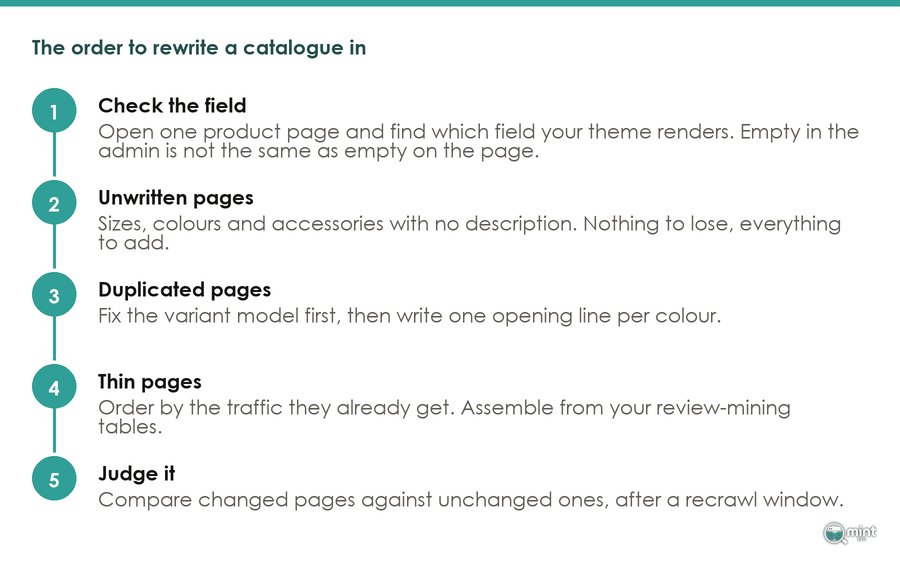
Unwritten pages first. An empty page has no ranking and no converting value to lose, so it is the cheapest ground you own.
Duplicated pages come second, and the structural fix comes before any writing.
Thin pages come last, in order of the traffic they already get. By then your review-mining tables exist, so this stage is assembly from a document already on your desk.
Brooklinen shows the profile most stores have. Across its 250 products we measured a 51.5-word median with duplication on only 24 of them.
Its thin pages sit in the tail. On the same catalogue, 113 products carry under 20 words.
A store in that position should be adding pages before it touches the ones it has.
Two habits make the sequence hold. Track changed pages separately from unchanged ones, which is far easier when your conversion tracking already reports cleanly.
Give it a recrawl window before judging it, the same discipline that stops an A/B test being called after a weekend. Harney & Sons proves where this ends up: 250 products, an 83-word median, no duplication at all, on a catalogue of teas differing from each other far less than shoes do.
Where An SEO Partner Fits Into This
Four hundred descriptions do not get written in a week by anybody. Stores that get through them work to a fixed shape per page type, one pass over their reviews feeding every page, and an order that puts the empty ones first.
That is the work itself, and it is why our content writing runs from funnel content all the way through to commercial collection and product copy.
At catalogue scale, ecommerce copywriting is a production problem wearing the clothes of a craft one.
It is the same argument as customer retention: a compounding channel is one you own outright. Catalogue copy is the piece of that channel most stores have never claimed.
What you do with those fields matters more than which platform holds them, which is worth knowing if you are still choosing one.
If you would rather check the order of work before committing a week to it, book a free 30-minute consultation. You will be talking to me directly, and you will leave with your failure mode named and a rough 90-day direction. Bring one product URL and one collection URL and we will read them together.

About the author
John Butterworth
John Butterworth is the founder of Mint SEO, a Manchester ecommerce SEO agency he started in 2024. He has 11 years in SEO and digital marketing, previously running SEO departments for market-leading brands and several agencies. He specialises in Shopify and ecommerce SEO, and his work has ranked over 100 websites and driven more than 3 million organic visits. He speaks at industry events including the SEO Mastery Summit.
Connect on LinkedIn →