Knowledge Hub
How To Earn Links That Lift Your Store’s Collection Pages
By John Butterworth · September 22, 2026
Open your backlink report and sort it by target page: on a typical Shopify store the product pages have none, and most of what exists lands on the homepage. For a shop, ecommerce SEO link building means choosing which pages can attract a link and routing that authority to the collection pages that take orders. Those collection rankings are where link building for ecommerce earns its money.
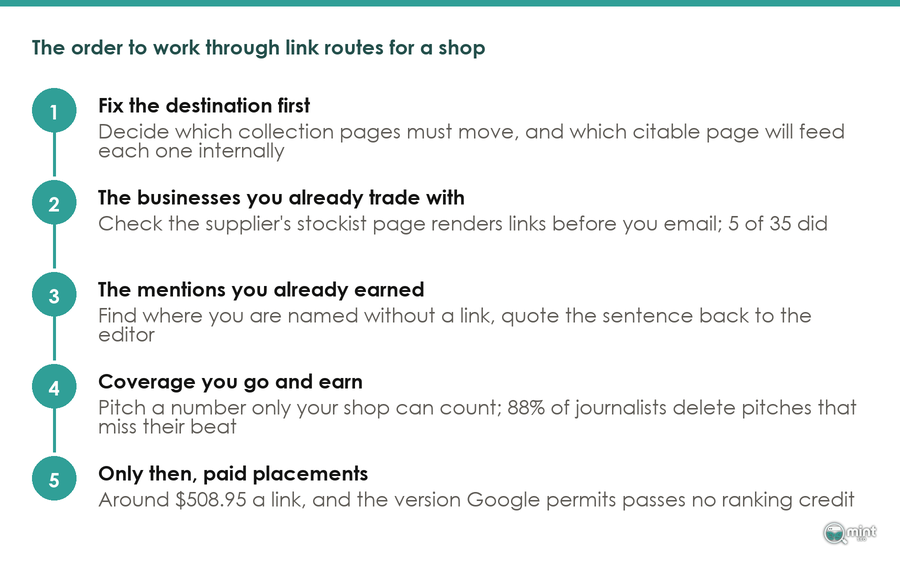
Point outside links at your buying and care guides, and link each guide to the collection it serves. Earn those links first from the brands you stock, from journalists who want figures only your orders hold, and from sites that already mention you. Then get your products into the best-of roundups your buyers and ChatGPT read, by joining the affiliate networks editors use and asking for a direct link to your collection as well.
Point Links At Your Guides, Then Pass Them To Your Collections
A store earns links on the pages that answer a buyer's question, and its collection pages get their share through one internal link from each of those pages. I'm John Butterworth, founder of an ecommerce search agency in Manchester, with 11+ years in SEO and more than 3M organic sessions driven across the stores I've worked on.
A Buying Guide Earns The Link A Product Page Cannot
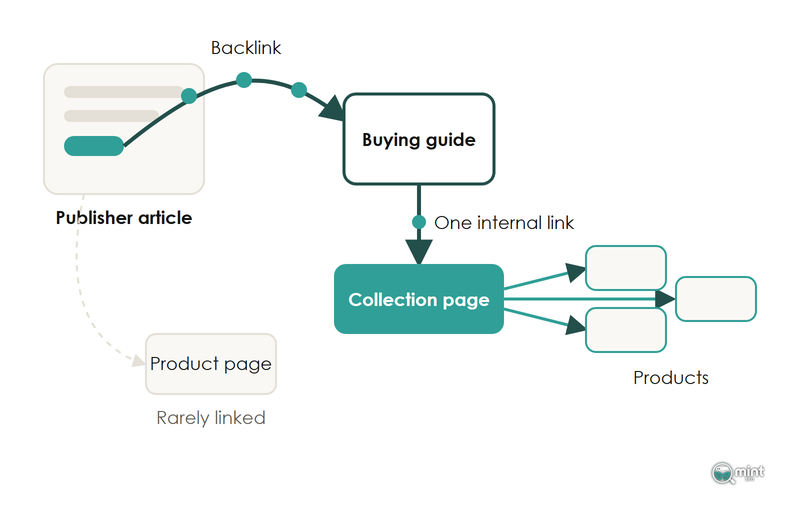
When a writer links out, it's to a page that backs up a point in their own piece. Your buying guide does that because it answers something their reader asked, and so does a fit or care guide.
A product page carries a price and a basket button. Few bloggers will link to one, because the link reads as an endorsement of a sale.
Link builders aim their backlinks the same way. BuzzStream's trends report found 68% of the link builders it surveyed prioritise blog posts as link targets, while 41% focus on product pages.
Start by writing the guides your buyers read while they're still deciding what to buy. A sizing guide for your best-selling range gives a journalist something to cite, and so does a plain comparison of your two most popular lines. We've collected the formats that have already earned stores coverage in our ecommerce content marketing examples.
One Descriptive Link Carries The Authority To The Collection
Authority moves along links, including the ones inside your own site. A guide with nothing pointing onward keeps everything it earns, and the collection it was written for gets none of it.
Add one internal link near the top of each guide to the matching collection, for example a merino guide pointing to /collections/merino-jumpers. Write the anchor text in the words a shopper would type, such as "men's merino jumpers". Change that wording from guide to guide so each anchor describes its own page.
In Shopify the link takes a couple of minutes: open the blog post in the admin, select the range name in its first paragraph and link it to the collection's /collections/ URL. We cover how many internal links a collection needs, and where they sit, in our guide to ecommerce internal linking.
Start With The Links Only Your Store Can Earn
The first links to chase come from people who already have a reason to name your store. Earning them costs no placement fee and needs no link swap with another shop, which keeps your store clear of the paid and exchanged links Google's spam rules are written to catch.
If you're weighing up a link swap or a paid package instead, our guide to off-page SEO for ecommerce covers what those offers cost and the risks they carry.
Ask The Brands You Stock For A Where To Buy Link
If you're an authorised stockist, the brand behind your best-selling range probably keeps a stockist or where-to-buy page already. It wants shoppers to find you, so a request to be listed asks it to do something it does anyway. Email the brand's trade or marketing contact with your store name and the page to use, and ask for the entry to carry a link.
Point that entry at your collection page for the brand's range. An outside link can go straight to a collection here, because a where-to-buy list is a directory for shoppers. The route suits niche shops best: a store selling trade tools rarely gets written about in magazines, yet every manufacturer it stocks keeps a dealer list.
Pitch Journalists Figures Only Your Sales Data Holds
Journalists take many of their story ideas from PR, and they discard most of what they're sent. Cision's 2026 State of the Media findings put both halves in numbers. "66% of journalists rely on PR-provided content" for story ideas, and "72% of journalists say fewer than a quarter of pitches are relevant".
What gets through is something the journalist can't find elsewhere, and a store's order history holds figures nobody outside the business can see. Open your order export and look for one pattern only your sales could show, such as which colour sells out first when the weather turns. State its date range and send it to the journalist who covers your category.
Point the pitch at the guide from the first section. Coverage that lands there passes its authority on to a collection.
Ask Sites That Already Named You To Add The Link
Search for your store name in quotes, then your founder's name and your best-known product, and note every page that names you without a link. Those sites have already decided you're worth writing about, so the ask is the easiest yes on this list.
Email the author with the exact sentence and the URL it should point to, since you're only asking them to change one sentence. Run the search again every quarter, because new mentions keep appearing once the other routes start working.
Earn Backlinks From The Best Of Roundups
Best-of roundups belong in an ecommerce store's link-building plan. Each one puts your store on a publisher page that already ranks in Google for the product searches you want to win, and in front of shoppers who are picking between brands.
Be clear about what you are earning. Most roundup links carry a sponsored tag and run through a tracking URL, so their value to you is visibility and sales. The ranking benefit sits with a direct link that carries no sponsored tag. Ask for one of those on every placement.
Roundups Are The Pages ChatGPT Reads For Best Product Answers
When a shopper asks ChatGPT which product to buy, the answer cites roundups. A June 2026 study by AIVO Research found that "when a real person asks ChatGPT for the 'best X' in their own words", it "cites a listicle 100% of the time".
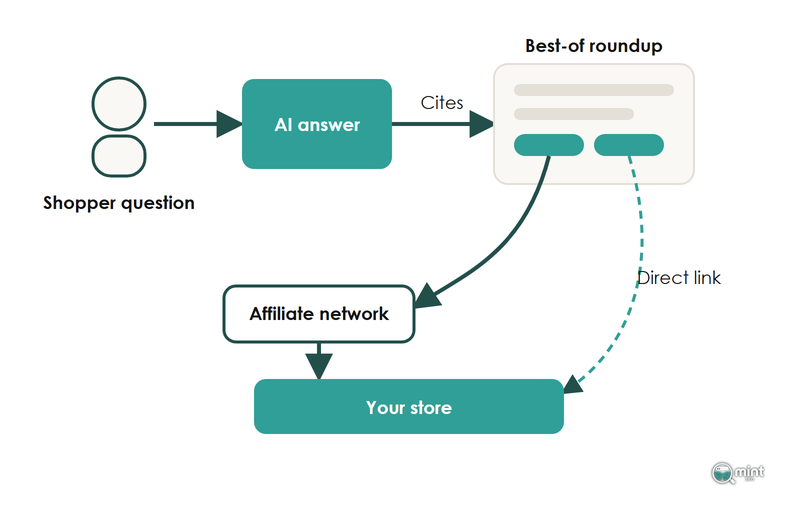
A store named across the roundups for its category is a store the assistant can recommend. A store missing from them is much harder for it to recommend, whatever its own pages say.
Join The Networks Editors Use Then Ask For A Direct Link
A commerce desk is paid on commission, so it favours the shops it can earn commission from. The step that gets you included comes before the pitch: open an affiliate programme on the networks those publishers use, which in the UK usually means Skimlinks, Awin or Amazon's own tag.
Those commerce desks send real traffic. For the Guardian's shopping section, Digiday reported that "since its launch last October, The Filter UK has driven 62 million page views and around eight million clicks to retailers". Digiday put Google's share plainly: "traffic from Google makes up more than 20% of the overall traffic to The Filter".
For your store, that means the visitors a roundup sends are already comparing products, and they land on whichever page the editor chose to link.
Which page that is decides who gets the sale. Where a product is listed on a marketplace as well, editors often link there instead, and that roundup's click and commission go to the marketplace. Give the editor your own store on a network so there is a better option to link.
Make the direct link easy to give you. Send the URL of the collection page from the first section along with your product details, and ask the editor to add it beside the affiliate one. That is the link doing the SEO work, and plenty of editors will add it when asked.
How We Run Link Building For Shopify Stores
Collection pages are where our Digital PR & Link Building service aims its work. It builds authority through earned links and digital PR, the referring domains that move competitive rankings, for the collections a store needs to rank.
It's ecommerce SEO link building aimed at the collections that take your orders, and the goal is revenue from organic search that keeps compounding in a channel you own. I run the retainers myself. When we worked with Hidden Garden Flowers, we took the site from 251 to 24,021 monthly organic visitors.
That work starts with knowing which collections to point links at first. Book a free 30-minute consultation and I'll look at your rankings and the quickest wins with you.

About the author
John Butterworth
John Butterworth is the founder of Mint SEO, a Manchester ecommerce SEO agency he started in 2024. He has 11 years in SEO and digital marketing, previously running SEO departments for market-leading brands and several agencies. He specialises in Shopify and ecommerce SEO, and his work has ranked over 100 websites and driven more than 3 million organic visits. He speaks at industry events including the SEO Mastery Summit.
Connect on LinkedIn →