
Knowledge Hub
Customer Retention In Ecommerce Starts Before The First Order Lands
By John Butterworth · August 13, 2026
Ask an ecommerce owner what they are doing about customer retention in ecommerce and you will hear about an email sequence, a points balance, or a win-back discount. All three of those start after the parcel has landed.
I run an ecommerce SEO agency from Manchester, and in the audits I do the second order is usually lost earlier than that. It goes on the product page, and in the week your customer spent waiting for something nobody gave them a date for.
This article works through the three changes that raise a repeat rate, in the order to make them. Then it gives you the number to judge them by.
What Decides Whether A Customer Comes Back
Three things decide it. What your product page promised about delivery, what happened between the order and the doorstep, and whatever reward you offer afterwards.
They matter in that order, which is not the obvious one. Narvar surveyed 3,461 US shoppers for its State of Post-Purchase Report, and on-time delivery came out as the strongest single loyalty driver in it. Half of consumers say they are also less likely to shop again after a late delivery, and 6% cut ties for good.
More than half of shoppers (55%) say that on-time delivery would make them more likely to buy from a retailer again.
A delivery that lands when you said it would is the strongest move available to you. A late one costs half your chances before any programme has anything to work with.
Everything else you might install competes for what is left of that.
I've spent 11 years in SEO and driven around 3M organic sessions. That is long enough to watch a lot of retention budgets go to the wrong end of that list.
Stores buy the last item first, because it is the easiest one to buy.
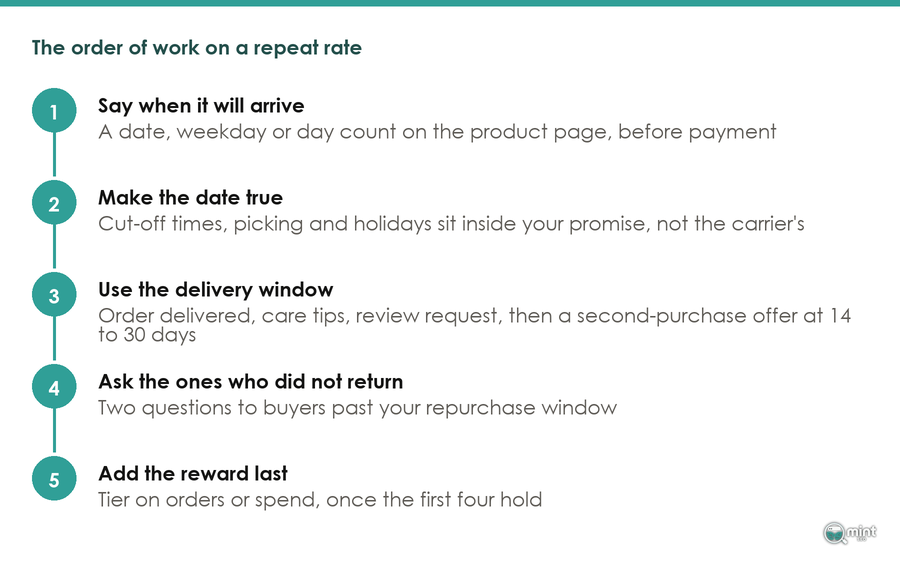
Telling A First-Time Buyer When The Order Will Arrive
Start here, because this change happens before your customer has paid you anything.
A first-time buyer forms an expectation about delivery whether you give them one or not. When the page says nothing they invent a date, then judge you against it.
You are then measured against a promise you never made, which is a poor trade. The Narvar survey puts the scale of it plainly.
We found 74% of consumers received a package later than the estimated delivery date in the past year.
Arriving late against the promise is now the ordinary case, and your shopper is braced for it before they ever reach your page.
A date does work before anyone buys, too. Conversion consultancy The Good reports that 75.1% of shoppers indicated that putting an EDD on the product page or in the cart positively influences their decision to buy an item.
On Shopify you switch this on. According to Shopify's own documentation, automated delivery dates appear for your customers by default on your product pages, cart and checkout.
If your pages show none, a theme is hiding it or somebody has switched it off. Ten minutes in your theme settings is the whole job.
Making that date true is the harder half of the job, and it belongs to you. Your carrier's transit window is a different number entirely. Shipping platform ShipperHQ draws the line between the two.
Carrier on-time performance measures whether the carrier delivered within their stated transit window after pickup. Your delivery date accuracy measures whether the package arrived by the date your store promised the customer.
A carrier can hit its own target while your customer still gets the parcel two days late. Your cut-off time and your picking sit inside the promise and outside the carrier's number.
There is more than one honest way to say it. Three of the 70 storefronts in the crawl further down this page do it three different ways.
Get it by Wed, 19th Aug | Order within 47m 30s
That is a product page at Chubbies, naming both the day and the deadline the shopper has to beat.
ORDER NOW FOR SHIPPING ON MONDAY 17th AUGUST
That one is Foundry Coffee Roasters. A roaster cannot promise an arrival date, because the stock does not exist until it is roasted, so naming the dispatch day works instead.
Handcrafted to order, please allow up to 5 working days for delivery.
That is Earthbound. Five days is a long wait to admit to, and admitting it with the reason attached makes it read as craft. Nobody opens a support ticket on day three.
The Days Between Dispatch And The Second Order
Once the parcel is moving you have the only stretch of time when a first-time buyer is certain to be thinking about you. They are checking tracking.
Use that window in the order your customer needs it. Selling comes last. A merchant on Shopify's own Merchants Community set out the sequence that works for smaller stores.
Post-purchase flow: order delivered -> how to use/care tips -> review request -> second purchase offer after 14-30 days.
Notice where the offer sits. By then your customer has the product, knows what to do with it, and has been asked what they thought of it.
What shoppers expect after checkout and what they get are a long way apart. Accenture research reported by Lateshipment found 56% of customers are disappointed by their post-purchase experience, while only 17% believe brands care what happens after they buy.
Clearing that bar costs a few well-timed emails and no new software.
When A Rewards Programme Is Worth Running
Now the reward, which works once the two changes above are done.
Shopify's own summary of that merchants thread, written in August 2026, found the same order of work. The main theme was that many smaller stores are moving away from complex earn points, redeem points schemes toward simpler retention loops.
Rewards do lift revenue where the foundations hold. Rivo reported in January 2026 that loyalty members generate 12 to 18% more revenue than non-members, so this is a real return and worth having.
The condition attached to it matters more than the number. That same merchant thread was blunt about sequencing: fix the repeat-purchase basics first, then add loyalty once the repeat rate has moved.
Where fundamentals are weak, they argued, loyalty apps add cost and no orders. That holds because a points balance cannot argue a customer out of a bad first experience. It pays people for returning who were returning anyway.
What tends to fail, on that merchant's account, is discounting too early. Complicated points systems, rewards buried in a menu and absent reminders all do the same thing.
Where a scheme is worth running, tiering on orders or spend beats a points economy. Three orders earns early access and free delivery. Your customer can hold that in their head without opening an app.
Another store owner in that thread found discounts underperformed, and that customers responded better to exclusive content. Your own catalogue may differ, so test the reward before you commit a margin line to it.
Asking The Customers Who Did Not Come Back
Everything above is general advice about customer retention in ecommerce. What tells you which of the three is your problem is the group who bought once and never returned, and they will tell you if you ask.
Hardly anyone does, which is why that disappointment figure above is worth a second look. Most of it never reaches the store, because reporting counts orders and nobody logs an experience.
Somebody who waited nine days for something they expected in three does not file a complaint. They stop buying without saying so, and your dashboard shows one order and no signal at all.
Send a short survey to buyers who have passed your repurchase window without ordering again. Two questions will do.
In the ecommerce SEO work I do, a store's analytics almost never separate a first-time buyer from a returning one on the same product page. Nobody in the business can then see which pages bring people back.
Fix that before you spend anything on a scheme. The reporting is what will tell you whether the scheme worked.
Which Retention Rate To Measure, And Over What Period
Two numbers get used to track customer retention in ecommerce. Your retention rate is the share of customers you started a period with who bought again. Your repeat purchase rate is the share who have ordered more than once.
Of the two, the repeat purchase rate is usually the more useful, because it does not need a clean starting cohort to mean anything.
The period attached to them is what these numbers usually get wrong. Subscription platform Recurly makes the point about compounding: annual churn is not twelve times monthly churn, so a 5% churn rate means nothing until you know the period it covers.
Retention behaves the same way, so a rate with no window attached is not a measurement at all. Take your window from your own data instead, because a category label will not give you one.
Pull the interval between first and second order for every customer who has ordered twice, take the median, and measure over roughly that.
A coffee subscription and a garden furniture brand should not share a window, because their products are used up on completely different clocks. Analytics platform Stormly names the trap in one line.
A customer who bought a new coat is not churning just because they did not buy another one in 30 days.
In 2026, the average ecommerce repeat purchase rate sits around 28.2%, so be careful comparing yourself with it. Propel's August 2026 benchmark round-up states the problem in one line, then shows how far apart the verticals sit.
What is a good retention rate? is unanswerable without a vertical attached. A 30% repeat purchase rate is excellent for a fashion brand and alarming for a grocery brand.
Find your own row before you judge your own number. A grocery brand sitting on the all-ecommerce average is in trouble; a luxury brand sitting there is beating its category by a wide margin.
Even inside one catalogue, a blended figure hides more than any industry average does. In one catalogue Stormly describes, the supplements line recruits customers who return at 54%, against 7% for buyers whose first order was a clearance item.
Split your rate by the product somebody bought first. That names the products recruiting customers worth keeping, and the ones recruiting people who were never going to stay.
If you sell on subscription, the split that matters most is not by product but by reason for leaving, and it changes the first check you should run. Across the Recurly network in July 2026, total churn ran at 3.60%, split 2.34% voluntary and 1.25% involuntary.
Roughly a third of that is a card that failed, and the customer never left at all. Fixing failed payments is a billing job, and the cheapest retention work in this article.
What Seventy Storefronts Had Installed
We wanted to know whether stores build the reward or the arrival date, so we went and measured both.
On 13th August 2026 we crawled 70 live storefronts. For each one we rendered the homepage and identified the platform, then looked for a loyalty or rewards scheme.
We followed one product link and rendered that page too, looking for a real date, weekday or day count tied to delivery or dispatch. A free delivery threshold did not count.
Every positive was then re-rendered and read by hand before it went into the total, because a pattern match that treats a free-delivery threshold as a promise would have flattered the result.
Of the 70 stores we measured, 19 ran a loyalty or rewards scheme. Seven told a first-time buyer when the order would arrive. Put side by side, the split is not close.
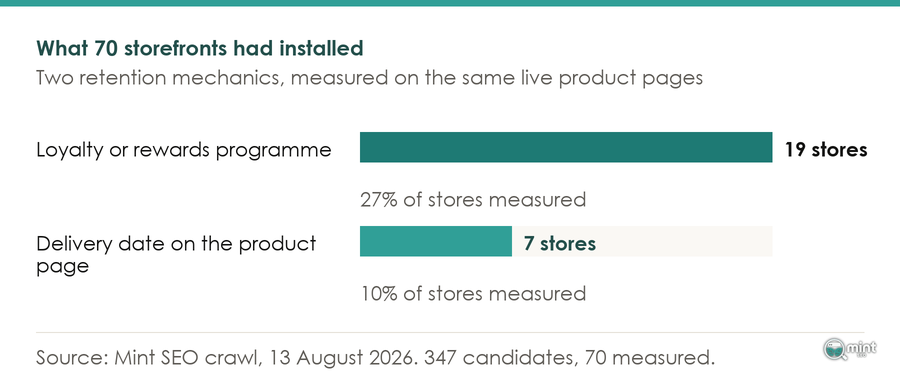
Sixteen of them had built the reward and still had not answered the question. Three had done both.
Sixty-three of the 70 were Shopify stores, which is the platform whose own documentation says automated delivery dates appear by default. Perhaps a setting was turned off, perhaps a theme does not render it, perhaps the store does not meet an eligibility rule. The shopper lands on the same silent page either way.
A reward is a decision a merchant makes once, and an app installs it that afternoon. An arrival date is a promise that has to survive a warehouse, a cut-off time and a carrier, and it is never finished.
That explains which one gets done first. It also explains why doing them in that order costs stores their second orders.
Getting A Second Opinion On Where Your Store Leaks
Every change here asks you to judge one of your own pages, and that judgement is hard from inside the business. The reporting that would settle it is usually the missing piece.
Mint SEO is a specialist Shopify and ecommerce SEO agency, and I run the projects myself.
Work that lifts a repeat rate is mostly the work that wins the first visit too, as our ecommerce SEO guide sets out. A product page answering the delivery question gets found and converts, which makes on-page SEO work pay twice.
Delivery messaging that renders fast enough to be read is technical SEO work. Authority to compete for those searches comes from digital PR and links.
Underneath all of it sits customer retention in ecommerce, because a repeat rate raises what every organic visit is worth. Our guide to what a CRM does for an online store covers the tooling side of that.
The free 30-minute consultation is a call with me, covering your rankings and your biggest quick wins. Book your free consultation and we will work out which of your pages is losing the second order.

About the author
John Butterworth
John Butterworth is the founder of Mint SEO, a Manchester ecommerce SEO agency he started in 2024. He has 11 years in SEO and digital marketing, previously running SEO departments for market-leading brands and several agencies. He specialises in Shopify and ecommerce SEO, and his work has ranked over 100 websites and driven more than 3 million organic visits. He speaks at industry events including the SEO Mastery Summit.
Connect on LinkedIn →