
Knowledge Hub
What Six Real Shops Publish (And What Each Page Is There To Do)
By John Butterworth · August 12, 2026
Lists of ecommerce content marketing examples keep handing you the same three companies. Glossier published for years before there was much to buy, Gymshark built a following and sold to it later, and Dollar Shave Club made one video.
None of that is a plan you can run on Monday with the people you have got.
I have spent 11 years on ecommerce SEO. Running the retainers at Mint SEO myself means a lot of my week goes on blogs that publish diligently and sell nothing. Writing is rarely the problem.
What is missing is a decision, taken before anybody was commissioned, about what the content was for. Six real shops below have made that decision, and you can open every one of them.
They are Cotswold Outdoor, Ooni and Lick. The others are Vinterior, Oddbox and Snag.
For each one I have gone through what they publish and where it sits on the site. For each I have also written down the commercial job the page does, since that job is what you can copy.
Six Stores Whose Content Does One Identifiable Job
The six ecommerce content marketing examples below cover very different catalogues, and no two of them publish for the same reason.
What they share is that you can work out from the page itself what the content is there to do.
Cotswold Outdoor Tells You Not To Buy Yet
Outdoor retailer Cotswold Outdoor has traded since 1974 and runs 79 shops alongside its site. One of its best pages is a guide called When To Replace Your Walking Boots, and it is a page about not buying boots.
It opens with a benchmark. Most walking boots last somewhere between 500 and 1,000 miles of regular use, or roughly one to three years for someone walking a few times a month. The next line refuses the easy answer.
So the honest answer is: check the boots themselves rather than the calendar. A pair walked hard for eight months can be more worn out than a pair that's sat in a shed for three years.
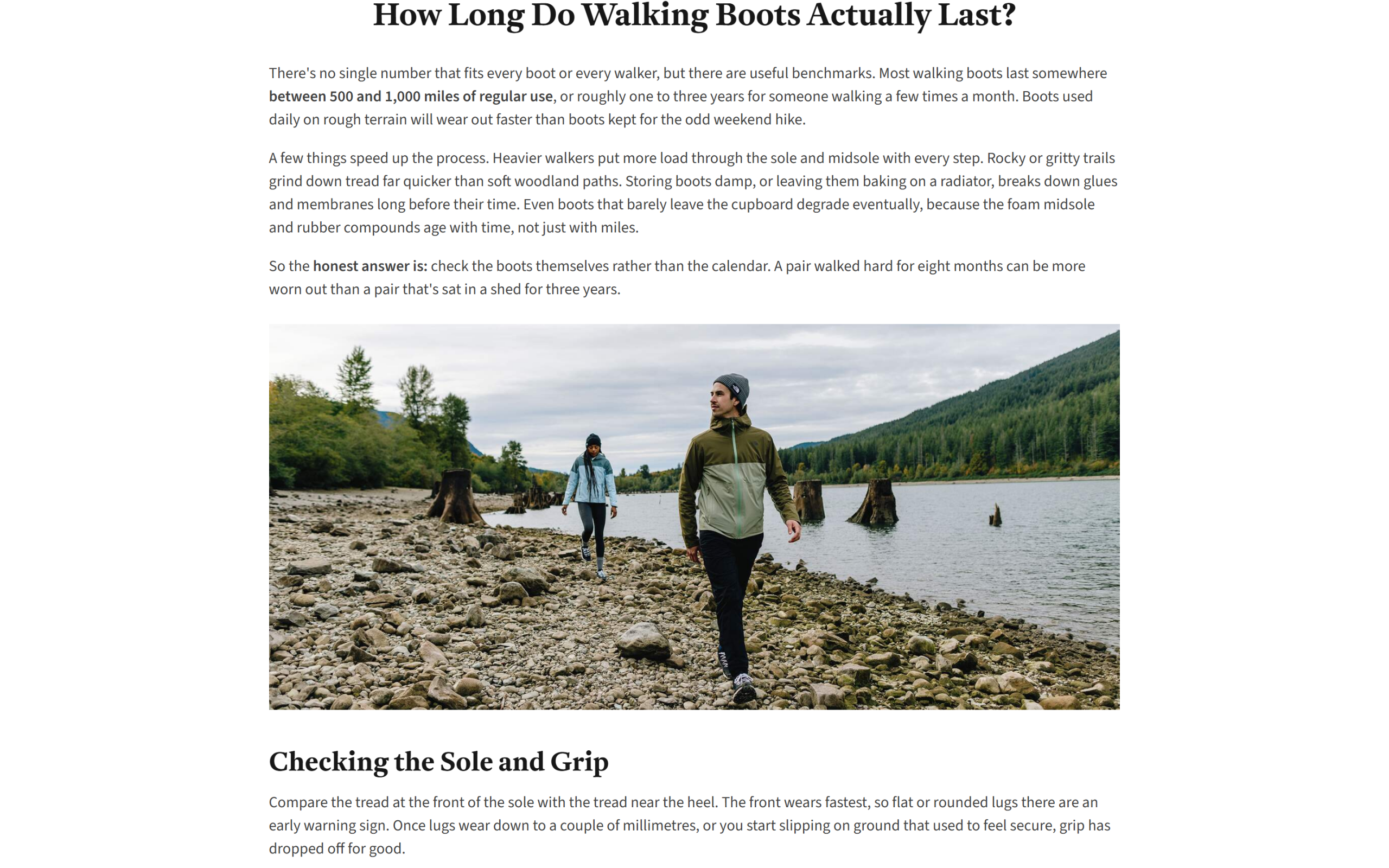
Next comes a check you can run in your kitchen. Compare the tread at the front of the sole against the tread at the heel, then flex the sole looking for cracks. Press the midsole foam near the arch to see whether it springs back.
Look for split seams, run them under a tap, and try them on with your usual socks. Two or more warning signs and you start shopping. One line then carries the whole commercial decision.
As a rough guide: one part failing means repair, two or three parts failing together means replace.
Underneath sits a Care & Repair range, and the same guide shelves a Nikwax cleaning gel at £3.95 against an RRP of £5.00. Someone who arrived wondering whether to spend a hundred and fifty pounds leaves having spent four, and comes back when the boots really have gone.
Filing is the other thing worth copying. Cotswold Outdoor indexes its advice hub by activity, so walking sits beside camping and climbing beside snow sports.
Somebody who has decided to try wild camping therefore lands in one place spanning tents, mats, bags and clothing. That catches the decision well before it becomes a product search.
Better still, at the end of the advice sits a footwear finder. 'Click below to find the perfect footwear for your next adventure in 5 easy steps.'
Ooni Gets More Use Out Of An Oven You Own
Scotland-based Ooni sells one expensive object every several years. Its recipe library is how the brand earns a reason to invoice you monthly, and the promise on that page shows who it addresses.
The page offers to 'Discover a world of culinary inspiration, designed to help you make the most of your Ooni pizza oven.' Not a prospect. Somebody who has already paid.
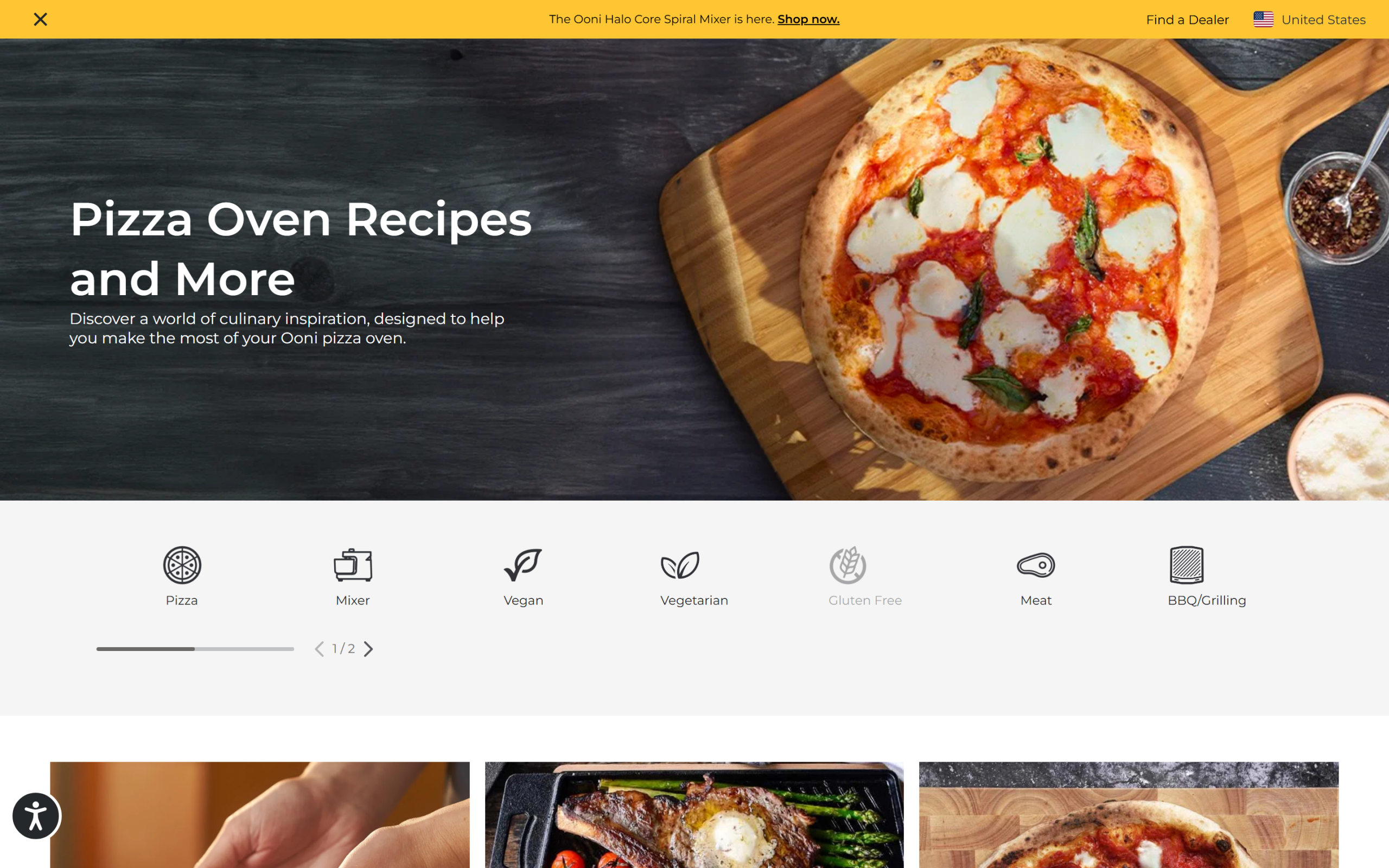
Everything about the library serves that one decision. Recipes are filed by dish type alongside dietary need, so vegan and gluten-free sit beside pizza and fish. Each carries a difficulty rating with timings, and Classic Pizza Dough is marked 3 to 4 hours prep against 1 to 2 minutes in the oven.
Groceries are sold on the same site, so a recipe doubles as a shopping list. That is the whole mechanism, and it works because the audience already owns the hardware.
Scale followed from it. Natalya Stecko, a consultant at SALT.agency, recorded the site attracting around 589,416 monthly visitors, up from 117,900 three years earlier.
Her teardown also counted 88.6K keywords sitting in the top 100 organic results. Recipes are what hold a footprint that wide, because each one answers a phrase the catalogue never could.
Those numbers describe a footprint, and the footprint is the useful part of these ecommerce content marketing examples.
The reason is arithmetic. A catalogue of ovens holds a few hundred phrases at most, whereas every recipe is another page answering something a customer typed.
Ooni runs a finder on the same principle. 'This quiz consists of seven questions about your pizza-making skills' before it lands you on a product page.
Rival brand Gozney makes a broader promise. 'Limitless possibilities. From 60 second pizza to stone-baked sourdough bread' sets up a library that reaches past pizza.
When two direct competitors independently land on one structure, the category requires it.
Lick Moved Its Content Into The Navigation
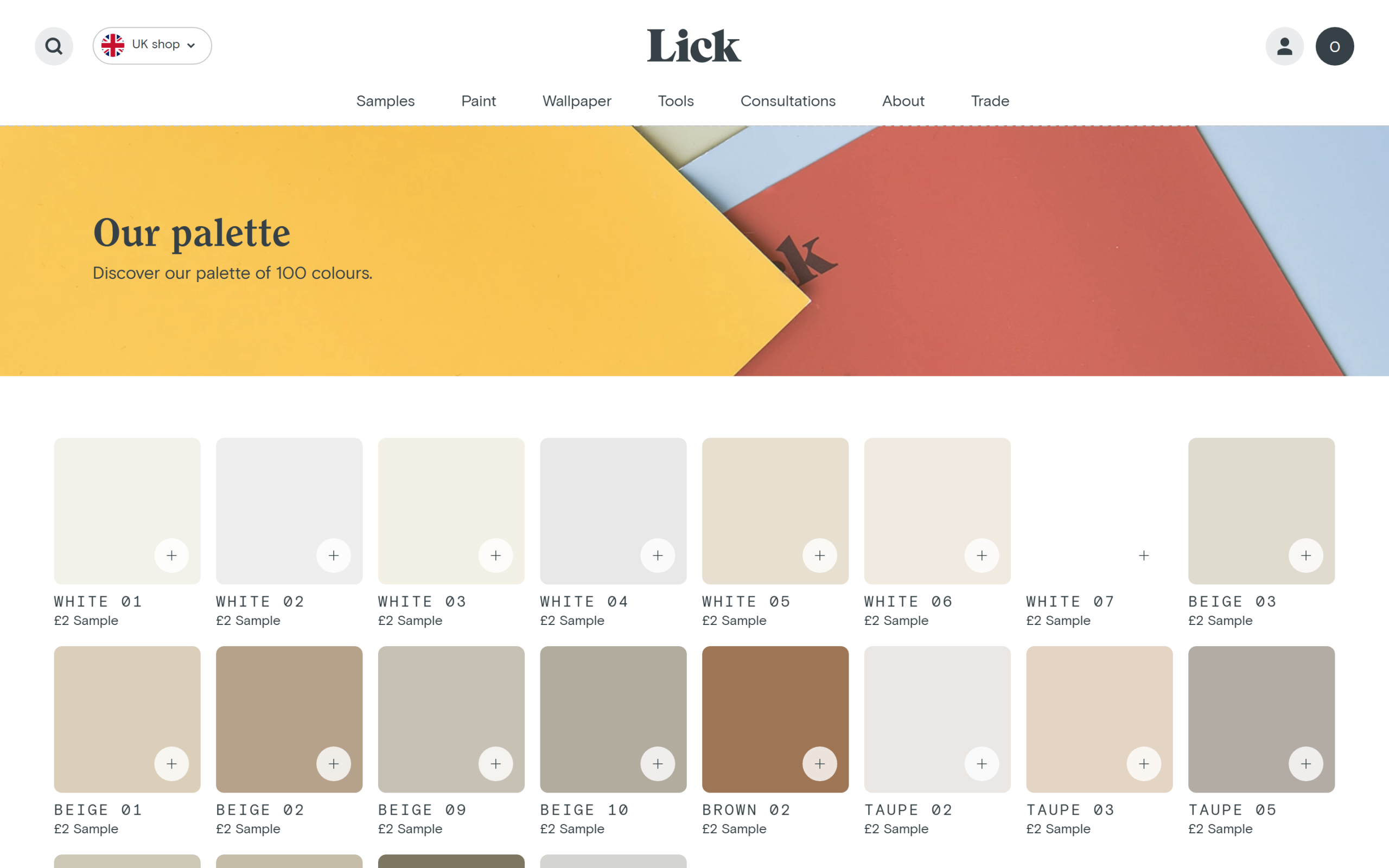
Paint brand Lick sells something nobody can judge on a screen. Its answer is the sharpest structural move in this list. On the hundred-colour palette the filter reads 'By mood: Calm and relaxing, Cosy and warm'. Five moods run across the range.
Think about where that judgement would normally live. It would be a blog post on choosing a calming colour for a north-facing bedroom, read once by whoever landed on it.
Lick took the same thinking and made it a product filter, so it now works on every session.
Around that sits a ladder for one decision. 'Our colour quiz is here to help you choose in a few clicks', which handles the shopper who wants a fast answer. Real-paint samples at £2 apiece, listed on that palette page, serve the one who needs to see it on a wall.
LickStudio bills itself as 'The home of colour consultations and design advice', catching anyone who would rather ask a person. Each rung picks up somebody the rung above lost.
Vinterior Writes What Outlives Its Stock
Vinterior runs a marketplace for vintage and antique furniture, so almost every product page it has is temporary. A chair sells once and the URL goes quiet, so durable visibility has to come from somewhere other than the catalogue.
Its editorial is organised around whatever does not sell out. A Behind the design strand runs Meet the designer beside The history of, then Design movements beside Meet the dealer.
Pages about periods and makers keep ranking regardless of this week's stock.
They also feed buyers into whatever happens to be listed. If your catalogue churns, this is your model, and our note on how much copy a category page needs applies the same logic to permanent pages.
A maintenance strand covers furniture care and reupholstery. It does for Vinterior what boot care does for Cotswold Outdoor, and two businesses with nothing in common landed on the same move.
Oddbox Answers The Question A Surprise Box Creates
Oddbox delivers surplus fruit and vegetables, so subscribers open a box they did not choose. That produces one recurring question every week, and it is the question that decides whether they cancel.
Content answers it. A recipe strand and a cooking guides strand carry the load, with the recipe index kept on its own route, away from the news feed. The thing a customer needs weekly therefore has a fixed address.
Zero-waste tips, grower stories and pieces on food waste run alongside it. Those keep the reason for subscribing in front of the person already subscribed, which is retention work at heart.
Boxes hand Oddbox a publishing calendar for free, because the material is whatever went out that week. On 30th July 2026 that produced a piece on Wimbledon waste and surplus strawberries, which no competitor could have planned in advance.
Snag Is Not Trying To Sell You Anything
One of the six breaks the pattern, and it is here because a list where every example converts would teach you the wrong test.
Hosiery brand Snag built its business on the position that sizing is the industry's fault, and its blog argues that in public. Essays there cover body standards, sizing and self-image.
One is titled 'The Evolution of the Ideal: Body Standards Through History', published on 7th July 2026. A piece like that sells nothing on the day. It is why customers believe the sizing claim when they meet it on a product page.
Beside them the brand describes itself as 'The home of ingenious hacks and creative crafts to transform your tights and clothes', teaching customers to keep what they own. That last part looks like an error in an attribution report.
It also buys the brand the credibility the rest of its argument needs. Judge the strand on click-through and you would delete the only thing on the site doing the persuading.
The Test A Buying Guide Has To Pass
Buying guides are the format nearly every store already has, so it is worth being precise about which ones do any work.
A guide is worth publishing when it hands the reader a rule they can apply without you standing there. Cotswold Outdoor's repair-or-replace line is a decision the reader can take home.
A guide that only lists the options leaves them where they started.
Format therefore decides more here than cadence does. A Semrush ecommerce study reported by 1Digital Agency found purchase-intent pages drove 68% of assisted conversions against 19% for standard blog posts.
Purchase-intent there means category pages, comparison guides and product FAQs.
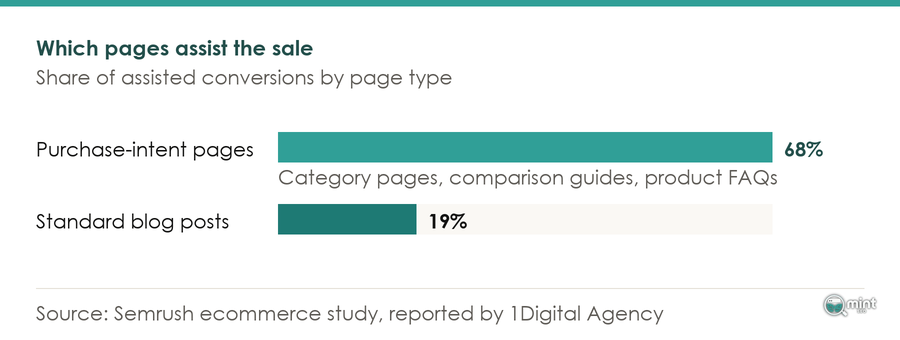
Publishing more often will not move those numbers. What moves them is a page attached to a purchase decision. A second reason to weight your effort that way has arrived more recently.
That reason is where Google now puts the answer. The rollout is recent enough to still be moving. A compiled dataset at SeoProfy records AI Overview presence growing from 6.49% to 24.61% of queries before settling back.
Analysis by Triangle Direct Media found ecommerce queries trigger AI Overviews just 4% of the time, against 40-50% for informational searches. Follow that through and a page whose whole job is answering a general question becomes the most exposed thing in your catalogue.
Google will increasingly answer it above you, while a page attached to a decision somebody is making with a card in their hand sits outside that firing line. We set out what to do about it in our piece on answer engine work.
Cotswold Outdoor is instructive again, running guides at both ends of one product's life. 'Top Tips for Choosing the Perfect Walking Boot' serves the person shopping. The replacement guide serves the person who already bought.
Sleeping bags, mats and walking poles all get the same treatment. Handling accessories as seriously as the hero product is what makes a hub rank across a category.
Which Of These Examples Your Store Can Copy
Knowing why you keep meeting the same handful of brands makes the choice easier, so I checked the field instead of guessing at it. Twenty pages, being everything Google returns for 'ecommerce content marketing examples', went into a text file on 12th August 2026. Every brand each page holds up as a model got tallied.
In that count, Shopify's own content marketing guide and its stablemates turned up more often than any other name. Behind it, REI is named on 7 of the pages, with Patagonia and Away on 5 apiece. None of the 20 names any of the six above.
That is a supply problem, and no verdict on the shops. Anyone working through the search results has simply never been handed them.
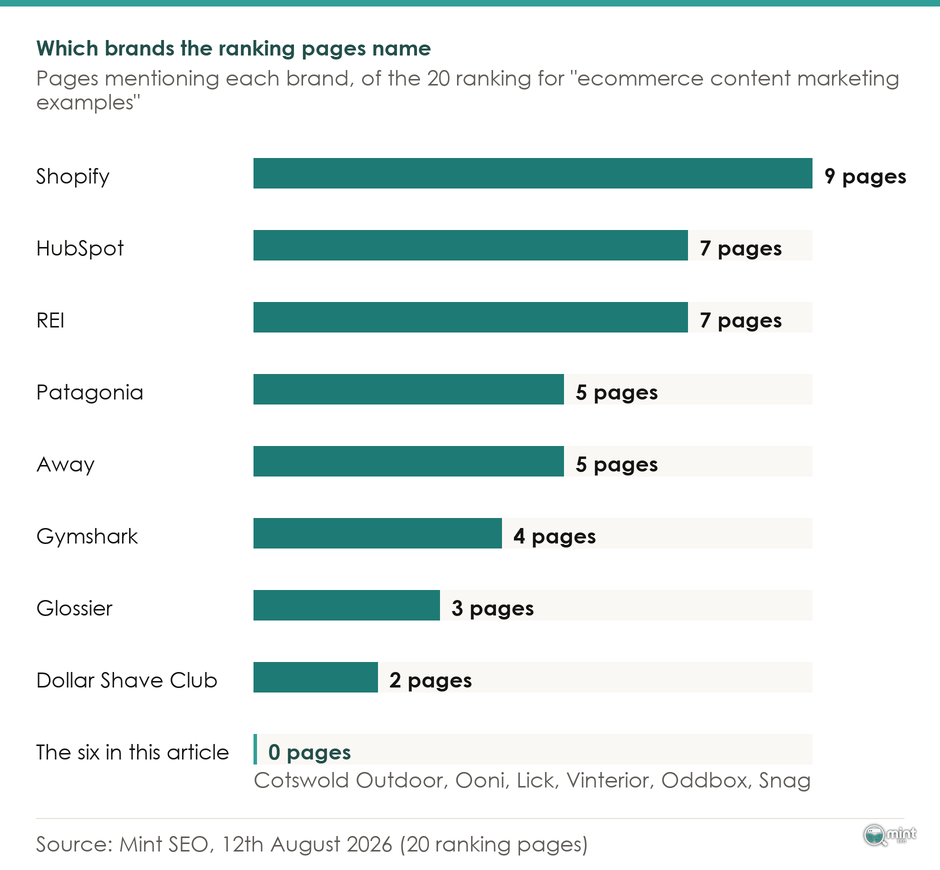
Look again at what that named list has in common. Mostly large American brands, in a field answering a question with no country in it, and most cited for campaigns run at a scale you are not operating at.
Glossier and Dollar Shave Club are genuinely interesting businesses. Both are also cases of building an audience first and selling to it afterwards, a route needing either years or a viral accident.
Our six are copyable because each starts from something the shop already had. Two began from stock on the shelf, one from what went into last week's boxes, and one from a decision customers were already struggling with.
So start with the one nearest your own sale. Sell something expensive that gets used repeatedly, and you write recipes with the consumables beside them.
Sell something customers cannot judge on screen and you build the ladder from quiz to sample to person. Watch stock turn over faster than a page can rank and you write about the category, leaving the item alone.
Sell considered kit that gets weighed up first, and you build the guide layer, then finish it with a finder.
Having no audience yet is still not a reason to start with brand-building. None of the stores above began with readers either.
Cotswold Outdoor's guide is built around boots it already sells. Ooni's recipes work because somebody already owns the oven, and Oddbox's work because a box already turned up.
Each one starts from a customer already in hand. If nobody is reading you yet, the demand still exists in the market and what is missing is a page standing in front of it.
Our note on where an ecommerce funnel loses people covers which stage to look at first.
Getting A Content Programme Built Without Guessing
Six mechanisms, and only one or two of them will suit what you sell. Picking wrong costs a quarter of publishing before the miss shows up in the numbers.
Our content writing service is built around that decision. We choose the format from the commercial job it has to do.
That might be a guide layer for a considered purchase, usage content that drives reorders, or editorial holding visibility your product pages cannot.
Content is one of eight disciplines we run as a single system. Keyword strategy sits with on-page SEO work, technical SEO with feed optimisation. Agentic optimisation sits with Answer Engine Optimisation, digital PR with the content funnel.
Running them together is why we tend to know quickly whether a store's problem is its content at all.
I have 11 years behind that judgement and 3 million organic sessions driven. What that buys you is a shorter run-up: the format gets chosen from your catalogue in the first week, before two quarters of publishing go by.
For a straight answer on which of these ecommerce content marketing examples suits your catalogue, book your free consultation and I will tell you which one fits. Worth reading next is our guide to which ecommerce SEO job to do first.

About the author
John Butterworth
John Butterworth is the founder of Mint SEO, a Manchester ecommerce SEO agency he started in 2024. He has 11 years in SEO and digital marketing, previously running SEO departments for market-leading brands and several agencies. He specialises in Shopify and ecommerce SEO, and his work has ranked over 100 websites and driven more than 3 million organic visits. He speaks at industry events including the SEO Mastery Summit.
Connect on LinkedIn →