
Knowledge Hub
Ecommerce Lead Generation, Measured Across 54 Live Storefronts
By John Butterworth · August 8, 2026
You are paying for visitors who leave without telling you who they are. Fixing that is what ecommerce lead generation is for.
If the opt-in rate on your form is stuck in single digits, that rate is one of two numbers deciding how many addresses you end the month with.
I am John Butterworth, and I run Mint SEO from Manchester.
Most of my week goes on organic search for Shopify and ecommerce stores, which means I spend my time on where the visitors come from.
What follows covers the capture work properly, and then the half a popup tool has no reason to sell you.
It is measured. We recorded what 54 live storefronts do to a first-time visitor, and those findings sit under the headings they belong to.
Ecommerce Lead Generation Is Two Numbers Multiplied Together
A lead here is permission to contact someone: an email address, or an SMS consent, handed over before they buy anything. Your monthly count is qualified visitors multiplied by the share of them who give that permission.
Both of those are levers, and that matters because only one of them is a setting inside an app. That's why the other gets left alone for years, and why an article about lead generation almost always turns out to be an article about forms.
Visitors Multiplied By Opt-In Rate
Put real figures through it. A store on 40,000 monthly sessions converting two visitors in every hundred collects 800 addresses a month. That is the whole calculation, and both of its inputs are things you can change.
Lift that to four in every hundred and you get 1,600, which is the change every page on this subject is about. Leave the rate alone, add 20,000 qualified sessions, and you get 1,200 instead.
Those extra sessions turn up again next month, and the month after; an opt-in rate does not compound like that. Your first job is working out which of the two numbers sits furthest from where it should be.
Both figures assume the visitors could plausibly buy. Ten thousand more from a cheap placement will lift the denominator and leave the revenue alone.
What 54 Storefronts Do On Arrival
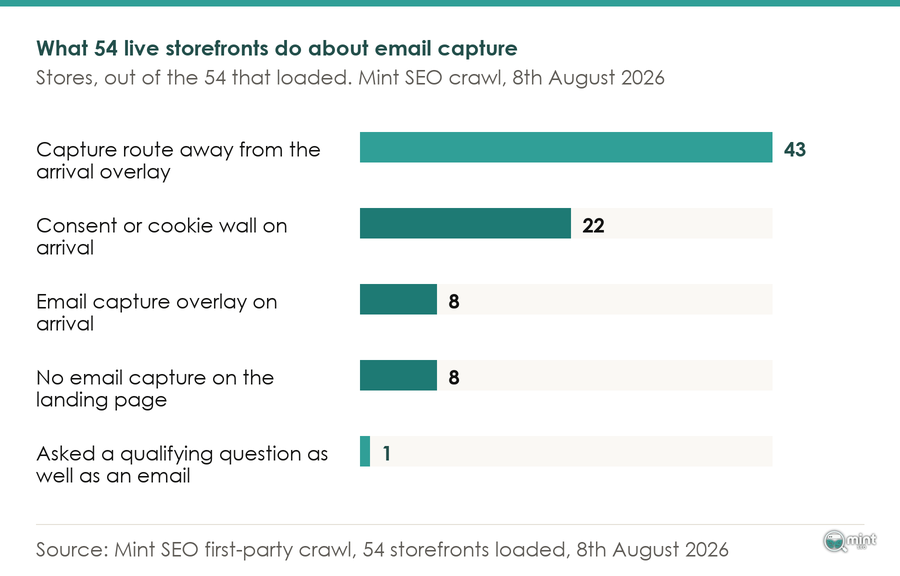
On 8th August 2026 we sampled 55 storefronts from page one of Google for twelve commercial buying queries, one of them “buy handmade ceramic mugs online store”. Each store was loaded once in headless Chromium at a 390×844 mobile viewport and watched for twenty seconds with no scroll or click, asking the browser every 400ms what was painted at the centre of the screen.
Of the 54 storefronts that loaded, 8 put an email capture overlay on top of the page before the visitor did anything, Kodiak Leather among them. That is 15 percent, and every counted case was screenshotted and checked by eye.
At the other end, eight of the 54 stores had no email capture anywhere on the page we landed on. Eight gated the page and eight asked nowhere on it, which isn't the picture a popup vendor's own blog paints.
An arrival overlay is a minority choice here, and an equally sized minority never asks at all. Which of the two you should be is a decision about your traffic.
What A Good Opt-In Rate Is, And Why Your Traffic Decides It
Before changing a form, find out whether the number it produces is bad or ordinary.
Every ecommerce lead generation benchmark you will find is an average of something. Knowing what it averages is the difference between a useful comparison and a misleading one.
Published Opt-In Benchmarks, By Device
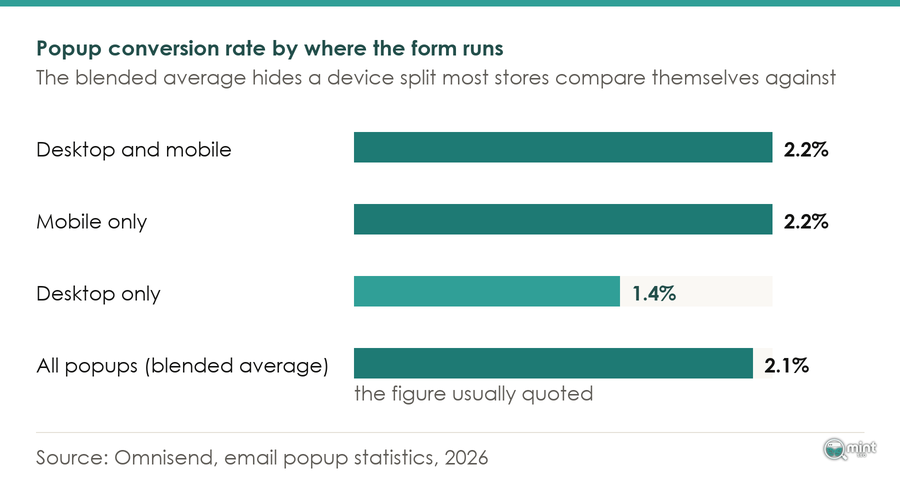
Our 54 storefronts were loaded at a 390×844 viewport, which is the mix most of them serve. That choice matters, because Omnisend's 2026 dataset reports: “Popups shown on both desktop and mobile converted at 2.2%, and mobile-only popups also averaged 2.2%. But desktop-only popups lagged far behind at 1.4%.”
If your form only runs on desktop, the blended average is the wrong yardstick. Match the benchmark to your form type and your traffic mix before you compare anything.
Opt-In Rate By Form Type And Traffic Source
Form type moves the figure more than device or timing does. Klaviyo publishes its own benchmark data, and it sets the general submit rate at 3%. It expects 3-8% from a standard pop-up form, 10-13% from exit-intent forms, and 10-13% from phone number capture-only forms, “especially when targeted at email subscribers”.
An exit-intent form and an arrival form are two different meetings, and treating them as one setting is where the comparison breaks. Channel does the same thing to the number.
u/claspo_official answered a thread from a store spending $12k a month on ads with ranges: “Cold paid traffic usually converts around 1-3% if the opt-in is decent. Retargeting traffic can hit 8-10%. Generic join our list popups? Basically dead, under 0.5%.”
Split your own reporting the same way before touching anything. If cold paid drags the blended figure down, the form may be fine and the work belongs upstream.
What To Offer, And Why Ten Percent Off Is The Default
Offer is the largest single lever on the rate, and it's the one most stores never revisit after launch.
Why Ten Percent Off Is The Lazy Answer
Our sample shows how uniform this has become. Six of the eight gating overlays were built in Klaviyo and six offered a first-order discount: 10% off four times, 5% off once and $40 off once. One of them, Kodiak Leather's duffel collection, gates at 5.4 seconds with “Sign up and save 10% on your first order” and a dismissal reading “Maybe later”.
Ten percent sits in the form template as the shipped default, and it survives because nobody has a reason to change it. There is a cost to that beyond the margin.
The cost is in what the shopper hears first. Writing in an r/shopify discussion of immediate discount popups, u/datagekko put it plainly: “The bigger problem is offering a discount to someone who hasn't even seen your product yet. You're anchoring the relationship to a deal before they know what you sell.”
On a store built on craft or materials, price is the wrong opening line.
Two Stores In Our Sample That Offered Something Else
Two of the eight traded something other than a straight first-order discount. On its weekender product page, Satchel & Page runs a competition: “You deserve a win. Enter for a chance to score a $1,000 Satchel & Page Gift card.”
Taking the other route, Cuero Bags waits 12.8 seconds and then offers “an extra 5% off, on top of your 20%”. That incentive is incremental, so the list isn't taught that the real price is lower.
We recorded what was offered rather than what it converted at, so treat both as shapes to test. Write down what you can trade that is not margin: early access to a restock, a fit guide for a category people get wrong, or entry to something.
How Much You Can Ask For In Return
Once the offer is worth something, you can ask for more than an address, up to a point. Omnisend found that “popups with one to three fields performed almost the same, while four or more fields caused a sharp drop in conversion rate”.
Three fields is the ceiling and most stores spend one. Spend the spare two on something you will send against. A size or a category preference is worth a flow; a first name isn't.
When To Show The Form, And Whether It Must Be An Overlay
Timing and route get decided separately from the offer, and both ship with a default worth overriding.
Setting The Delay From Your Own Analytics
Stores we measured are slower than Omnisend's published optimum. Our median gating overlay appeared 7.6 seconds after the page began loading, and the slowest took 17.6 seconds.
At the far end of that range, Farmhouse Pottery holds its overlay back for 13.3 seconds on its mugs collection page, long enough that a quick browser never sees it. Omnisend's timing breakdown puts the optimum tighter: the best results came from a 6-10 second delay, which reached 2.4% on average.
That puts the median store in our sample at the top of the useful band, and the slow tail gives impressions away. Your own data should set the delay.
In that same discount thread, u/TFDangerzone2017 gave the method I would use: “Check your analytics to find your visitor time on page. Subtract 5-10 seconds. Set that length of time as the delay.”
Capture Routes That Are Not An Overlay
Most capture in our sample happened somewhere else entirely. 43 of the 54 stores had a capture route that was not an arrival overlay: an embedded footer form, a sticky tab, or a form further down the page. That is four stores in five.
Those routes stay available for a whole session, so a single dismissal never ends the conversation. Trigger choice matters as much as timing does.
That choice is measurable. Split by trigger, the same email popup dataset reports afterViewedPageCount at about 2.3%, afterScrollDown at about 2.1% and onExit at about 1.8%.
That puts the second-page-view trigger ahead of the exit-intent one that gets most of the attention.
Whichever trigger you land on, run a persistent route alongside the timed one. A footer form or sticky tab costs nothing per impression, and it gives the people who closed your overlay somewhere to go later.
Stop Showing The Same Box To People Who Already Said Yes
Who sees the ask is a separate decision from what it says and when it fires. It's also the cheapest ecommerce lead generation fix on this list.
Suppress The People Already On The List
Every impression served to somebody already subscribed is an interruption that cannot produce a lead. Your email platform already knows who those people are, so this is a configuration job.
Suppression takes an afternoon and needs no design work at all.
Then there are the people who said no. Klaviyo is blunt about what happens when there is no second chance: “If someone closes your form on first load and there's no way back in, that subscriber is gone for good.”
A dismissal at second 8 is usually about timing. Suppress known subscribers, and leave a permanent route in the footer for everyone who closed the overlay.
One Extra Tap Buys You A Segment
Almost nobody uses the moment for anything beyond the address. Of the eight stores that gated on arrival, exactly one asked the visitor a qualifying question.
That one is The Natural Pet Store. Its overlay asks “Tell us about your pets” and offers Cats, Dogs and Others as options alongside the discount.
That is one tap, answered by people who have already decided to subscribe, and their list lands pre-split into the two segments the shop sells to.
Pick the one question your catalogue is organised around and ask that.
If you can't name the flow you'd send to each answer, don't ask it.
What Keeps A New Subscriber On The List
A discount code is spent inside one order. What keeps the address worth having is what the list sends afterwards. The place to say so is the form itself, before the address has been handed over.
What The Emails Do After The Discount Code
If a code was the only thing you sold, your second email has nothing behind it. Naming what comes next changes who signs up: fewer people chasing a one-off saving, more who want the thing you send. That is a better list at the same size.
That is also where a list stops being a coupon channel and becomes something you can run properly. Exclusivity is the strongest version of it when a store can support one.
Exclusivity of that kind has a ceiling case. Pointing at it in the same r/shopify thread, u/datatenzing wrote: “Supreme did drops where the only way to find them was via email. You can ask a lot of questions before substantial drop off. Might want to steer them towards a private group.”
Very few stores have that kind of pull, but it scales down well to a restock list people can't get on any other way.
Two Stores That Said What The List Delivers
Two stores in our sample spelled it out inside the form. Opening 1.65 seconds after load, Wolf Ceramics offers “Sign up for (infrequent) updates from the studio about restocks and sales, plus a 10% off discount code for your first order”.
“Infrequent” is doing the work there, because the objection it answers is inbox volume. Cultiver's linen collection page gates at 6.5 seconds with: “ENJOY $40 OFF. Subscribe to receive $40 off your first order, and get access to curated lookbooks, styling inspiration and exclusive stories from our journal.”
Discount opens it and the content commitment is what the reader is asked to stay for. Put your version in the form copy, where the decision is being made.
What The Capture Layer Costs You In Google
Popup tooling has no reason to raise this next part. It's also what I get asked about most in audits.
Intrusive Interstitials, And The Shape Google Named
Google described the problem shape precisely, in guidance on making content easily accessible that has been in force since January 2017. Its named pattern is “showing a popup that covers the main content” immediately after someone lands from the search results. That is a description of an arrival overlay.
Usefully, the same guidance says what is fine, and it is a size test rather than a ban: “Banners that use a reasonable amount of screen space and are easily dismissible.” A strip is acceptable; a cover is what Google went on to describe. Our sample sits on the wrong side of that line, because every one of the eight gating overlays covered the full mobile viewport.
Whether any of the eight has lost rankings over it is unknown to us. All eight ship the shape Google published, on the visitors Google sends them.
Fixing that doesn't mean giving up the overlay. Hold it until the second page view, or turn the arrival ask into a dismissible strip and keep the full overlay for exit.
INP, And The Interaction Delay A Capture Layer Adds
The heavier cost isn't a ranking question at all. As web.dev's INP documentation puts it, “Chrome usage data shows that 90% of a user's time on a page is spent after it loads”, which is the window an overlay script and a consent banner both compete for.
Interaction to Next Paint catches it, and the same documentation is specific: “INP observes the latency of all interactions a user has made with the page”. Being a field metric, a clean lab score on a stripped test page tells you nothing about the store your customers load.
Overlays also rarely arrive on their own. 22 of the 54 stores showed a consent or cookie wall on arrival, before any marketing overlay was counted, so a good share of these pages run two blocking layers over one first screen.
Measure INP with the capture layer live, on real traffic.
Then fix it where the theme is the cause, because a capture layer is rarely the only script competing for that first screen.
Where The Visitors Worth Capturing Come From
Back to the first multiplier, which every section since has held still. For most stores it is the bigger of the two. It also decides what a captured address is worth once you have it.
Conversion Rate By Traffic Source
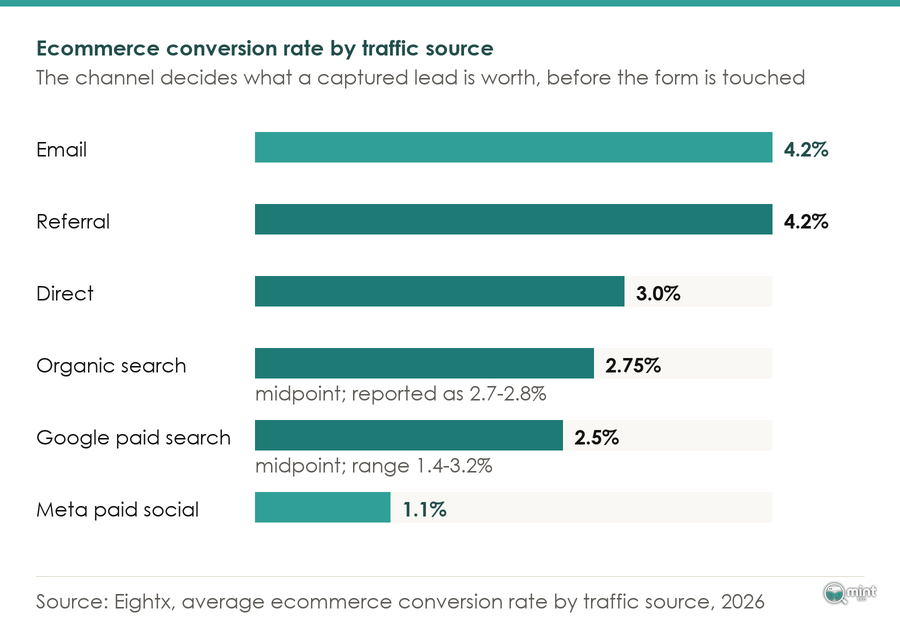
An address is worth what the visitor behind it was worth, which is why the source of a lead matters as much as the number of them. Eightx measured session conversion by source, and its 2026 breakdown puts it at “Email 4.2%, referral 4.2%, direct 3.0%, organic search 2.7-2.8%”, before either paid channel is counted.
Paid sits at the bottom of that same table: Google paid search at 2.5% and Meta paid social at 1.1%. Shopify's own blended figure is 1.4%, with the top fifth at 3.2% and above, so a lead's channel matters more to its value than the store's overall standard does.
Read that as a statement about lead value. An address captured from a cold paid-social audience and one captured from an organic search visitor go into the same list and behave nothing like each other.
Audit your mix before buying more of it.
If capture runs mostly on paid social, a higher opt-in rate wins you more of the least valuable lead you can collect.
Core Updates Move The Visitor Half
Organic sessions look like the constant in the calculation. Google re-decides them, and its own Search Status Dashboard records when. The May 2026 core update started on 21st May 2026.
A core update touches none of your capture settings. It changes how many people arrive to see them.
That is the number a form cannot reach, and it moves on Google's schedule.
Once the denominator itself is moving, ecommerce lead generation stops being a popup problem and becomes an organic strategy for the store.
Where A Second Opinion On The Demand Half Helps
Everything above this heading is work you can do yourself this week: the offer, the delay, the suppression rule and one extra field. Demand is slower, and it's the half of ecommerce lead generation where an outside read pays for itself.
You can't see your own search visibility from inside the store. Our free 30-minute consultation is a call directly with me. It covers your current rankings, the biggest quick wins behind them, and a rough 90-day direction.
There is a longer version of that. Our SEO audit sizes the visitor half: which searches your catalogue could win, and what sits between you and each one.
Eleven years in, I still run the retainers myself. Book the call if the visitor number is the one that's stuck.

About the author
John Butterworth
John Butterworth is the founder of Mint SEO, a Manchester ecommerce SEO agency he started in 2024. He has 11 years in SEO and digital marketing, previously running SEO departments for market-leading brands and several agencies. He specialises in Shopify and ecommerce SEO, and his work has ranked over 100 websites and driven more than 3 million organic visits. He speaks at industry events including the SEO Mastery Summit.
Connect on LinkedIn →