
Knowledge Hub
Ecommerce Chatbot Examples: What 56 Real Shopify Stores Actually Run
By John Butterworth · August 16, 2026
The same handful of brands turns up in every list of ecommerce chatbot examples: H&M's style quiz, Sephora, Domino's pizza ordering. Most of those launched on Facebook Messenger years ago, and a shop your size has nothing in common with any of them. I went and looked for myself instead.
I have spent eleven years on ecommerce SEO at Mint SEO, and the answer still surprised me. On the live Shopify storefronts I checked in August, the commonest setup was no chat at all.
Where stores did run something, a single vendor took most of the market, and the tools filling the round-ups barely showed up.
What 56 Live Shopify Storefronts Actually Run
How I loaded 56 storefronts and logged every request
Here is the full method, so you can repeat it. On 16th August 2026 I crawled 56 live Shopify storefronts, drawn from a frame of well-known direct-to-consumer brands each verified as running Shopify on an earlier pass, logging every network request against a list of 32 named chat and AI vendors. All 56 rendered and were measured.
I used a real browser at 1280 by 900 and waited nine seconds on each page, because most chat clients load late.
A store counts as running a chat tool when its homepage fetches that vendor's client. Gorgias calls gorgias.chat and Siena calls chat.siena.cx.
That definition matters more than it sounds. My first pass matched on page source and produced three false positives, all from the word "manifest" in an ordinary <link rel="manifest"> tag. Requiring real network traffic removed them.
More than half of the 56 storefronts run nothing at all
Twenty-two storefronts load a chat vendor's client and twenty-nine load none. Five others carry a vendor's configuration in the page without the client ever loading, which is a store paying for an app that is not running.
Check your own site for that last one this afternoon. It takes a minute and it is the cheapest saving in this article.
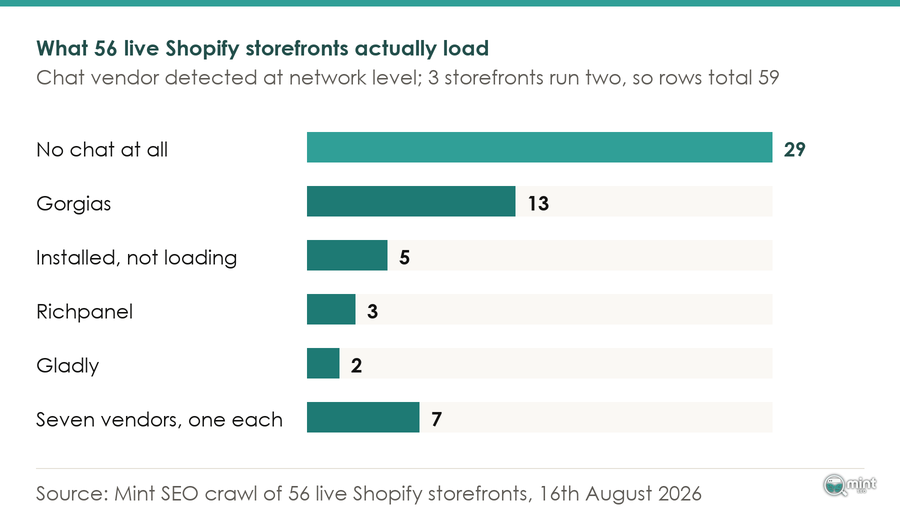
The honest reading of the split is that a chatbot is not table stakes. Almost every guide on this search starts from the assumption that you need one, and almost every publisher of one sells one.
One vendor is most of the market, and the tail is thin
Of the 22 storefronts running anything, Gorgias accounts for 13. The rest drop away fast.
The crawl found Richpanel on three storefronts and Gladly on two. Seven more turned up once each, and most of them appear in the examples below.
That shape matters when you are drawing up a shortlist, because a vendor holding thirteen of the twenty-two has already seen your catalogue size and your support load many times over, and the one-storefront vendors have not.
Gorgias states on its own pricing page: 'We power customer conversations for 40% of Shopify brands'. I would normally treat a vendor's self-reported share carefully. My sample matches its shape closely enough that I believe the direction, if not the decimal.
Not one storefront loaded Tidio, Drift or Ada
I searched all 56 storefronts for 32 vendors. Eight well-known names returned nothing on any storefront in the sample:
- Tidio: heavily marketed to small Shopify stores; zero loads
- Shopify Inbox: the platform's own free chat app; zero loads
- Drift: B2B conversational marketing; zero loads
- Ada: enterprise automation; zero loads
- Tawk.to: the best-known free live chat; zero loads
- LiveChat: long-established paid live chat; zero loads
- Crisp: popular low-cost all-in-one; zero loads
- Re:amaze: an ecommerce-native helpdesk; zero loads
A tool can be good and still be absent from every store you are being told to copy. Worth knowing which sort you have in front of you.
Eight Real Storefronts, And What Each One Chose
These eight ecommerce chatbot examples come from the 22 storefronts my own crawl found running something, and I picked them to span store sizes, from household names down to a one-person shop. Each one is checkable: open the site and the same client loads. They are the ecommerce chatbot examples I send clients who ask me this question.
Glossier, running Gorgias
Glossier shows what the default choice looks like, and that default is a helpdesk with a chat window on the front. Support runs through the system holding the order record.
A question about a late order therefore gets answered from live order data, with no scripted branch involved.
So if you sell a moderate catalogue to a lot of people, this is the setup more of your peers picked than any other.
Gymshark, running Intercom
Gymshark is the only storefront in my sample on Intercom, a general business support platform built for software companies as much as shops. That choice suits a company whose support load goes well beyond order status.
Brooklinen, running Siena AI alongside Gladly
Brooklinen is the only storefront running a dedicated AI agent. The detail worth copying is that it runs alongside a human-first helpdesk, which stayed in place.
The AI layer takes the repeatable contacts and the human platform stays underneath it.
According to Tracxn, Siena has raised 4.7 million dollars in total. A vendor sitting on a household-name storefront can be a fraction of the size of the ones filling the tool lists, which is worth remembering when you catch yourself judging a shortlist by how often you have heard the name.
Beardbrand, running Richpanel
Beardbrand sits on the second most common vendor in my sample, and Richpanel appears in almost none of the guides ranking here. For a mid-size brand that is the useful signal: your practical shortlist is not the published one.
Tentree, running Gladly
Tentree uses a platform built around one continuing customer conversation, where most helpdesks open a separate ticket each time.
That model fits a brand whose customers ask where the product comes from and what the company does with the money.
Those questions do not close cleanly the way a delivery query does, which is exactly why the ticket model fits them badly.
Pura Vida Bracelets, running Kustomer
Pura Vida Bracelets runs an enterprise CRM-style support platform. This marks the point where support stops being a widget decision and becomes a customer-data decision.
In my experience that shift comes with order volume, and it catches stores out because the catalogue has not grown with it.
Cheekbone Beauty, running Octane AI with HubSpot chat
Cheekbone Beauty is the counter-example in the set. Octane AI is a quiz and conversation tool aimed at marketing, paired here with a CRM chat.
So one slot in the corner of the page holds two different jobs: qualifying a shopper, or answering one.
Qualifying is measured in captured emails and completed quizzes, answering in deflected contacts.
Picking the wrong one is how stores end up disappointed by a tool that is working exactly as designed, just against a target nobody agreed on first.
Nerdwax, running Brevo
Nerdwax is a small independent store running the chat bundled inside the email marketing platform it already pays for.
For a small catalogue fielding a handful of questions a week, that bundled chat is often the honest answer, and it saves paying a monthly fee for a helpdesk nobody has time to configure.
Our rundown of the best AI tools for ecommerce covers where bundled tools hold up.
What An Ecommerce Chatbot Is In 2026: Three Different Products
Those eight stores are not running the same kind of thing, which is why comparing ecommerce chatbot examples on a feature grid goes wrong. One phrase now covers three products with different owners, prices and jobs.
The rule-based widget, which the vendors are retiring themselves
A decision tree: the shopper picks from buttons and the bot follows a branch. Its own vendors are withdrawing it.
MyAskAI reports that 'Older autoresponder rules retire on January 30, 2026, so AI Agent is now the supported path.' Evaluating a tool on the strength of its rule builder therefore means evaluating the part being switched off. If your shortlist was built around which branch editor felt friendliest, rebuild it around how well each vendor answers from your own order data.
The AI support agent, which answers from your own order data
Most of the 22 run this kind. It reads your product data, your policies and your order records, then answers in prose. Where it meets your customer database, our guide to ecommerce CRM goes further.
Drag reports that Zendesk's Forethought, acquired in March 2026, 'markets up to 80% autonomous resolution, the same headline number Siena uses, sourced from vendor case studies.'
Drag notes that the figure comes from the vendors' own marketing material, because it was gathered from vendor case studies. Treat 80% as a ceiling until somebody independent audits it.
Funding is real even where the resolution numbers are marketing. Drag puts Sierra's May 2026 raise at 950 million dollars and Decagon's January raise at 250 million. Money on that scale buys engineering time, so expect the category to keep improving whether or not the 80% holds up today.
The external shopping agent, which never touches your store
A third kind cannot be installed at all. It is ChatGPT, Gemini or Alexa answering a shopper's question about your product before that shopper ever reaches you.
You cannot configure it, you cannot see it, and the first you know of the conversation is a visitor landing on a product page already knowing what they came for.
Deflection Rates, And The Price Of A Resolved Conversation
Real automation rates are a quarter to a half
MyAskAI reports that 'Gorgias caps automation at about 60% of email and chat', with the cases it collected landing between 26% and 56%. Gorgias publishes a customer quote from Orthofeet's Courtney Bajek: 'we surpassed that and are now above 50% automation'.
That MyAskAI range is useful because it sits well below the ceiling vendors advertise. Plan for half your contacts at best.
You pay per resolution, so the bill tracks your contacts
MyAskAI records that 'Gorgias AI Agent pricing is $0.90 per resolved conversation.' It is a fair model with a consequence people miss.
Contact volume drives the bill, because a store with a support problem pays more to automate it than a store without one.
Run that against two thousand contacts a month with half of them resolved by the bot, and the rate MyAskAI records comes to 900 dollars before a human answers the rest. Work out your monthly contacts before you compare plan tiers.
Two-thirds of shoppers have already had a bad one
LiveRecover's round-up of consumer research cites a Verint survey finding that 'two-thirds of customers report having had a bad experience with a chatbot'. It also reports that '52% of customers say the worst thing about chatbots is that they misunderstand their questions'.
Baymard Institute's research separately finds that the three most common ways of implementing live chat all cause problems for users, the floating bubble included. That is a design finding, and it applies to whichever tool you pick.
Both point at where the fault usually sits. Comprehension is a knowledge-base problem: a bot never given your sizing information will misunderstand sizing questions whoever built it.
The contact you remove from the page never reaches the bot
Across the Shopify stores we run SEO for, the questions reaching support are the ones the product page failed to answer. Sizing and materials come up most, followed by delivery windows and returns.
When we audit a store the fastest win is almost never a new app. It is answering the thing a shopper currently has to ask, on the page itself, before they open a chat window. Most of that work sits in ecommerce UX.
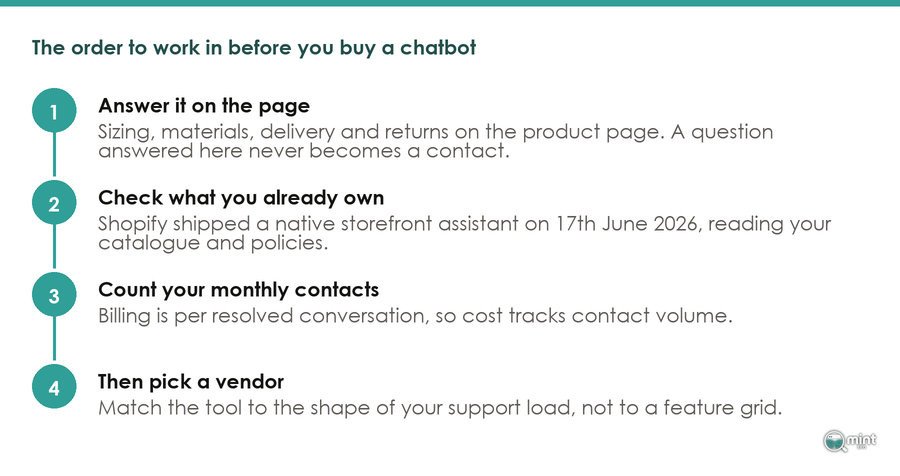
None of that argues against chat. It argues for doing chat second, because every question answered on the page is a contact that never reaches the bot at all.
What Shopify Shipped On 17th June, And Why It Comes First
The assistant reads what is already in your admin
Your buy decision changed on 17th June 2026. Shopappy records that 'A new AI sales associate joins Inbox, living on your storefront', shipped as part of Shopify's Summer '26 Edition alongside more than 150 other updates.
It answers buyer questions and handles order enquiries from the product data already sitting in your admin. Shoppers signed in with Shop get personalised recommendations. Shopappy records that the same release extends it past the website, with 'a new retail AI Sales Associate' reaching the point of sale.
Merchants control both the tone and the point at which a human steps in.
Those last two controls are exactly what merchants complain a bot takes away, and they now arrive as settings.
The platform has withdrawn a chat surface before
That release is worth weighing before you rely on it. Shopify's own changelog states: 'Starting February 19, 2025, the Inbox in Shop App will be discontinued.' Merchants could no longer be messaged there, and they lost access to conversations which had come through it.
Shopify's stated reason was that the inbox was being rebuilt, and June's release is what it was rebuilt into. The lesson worth taking is that a chat channel is not permanent infrastructure and transcripts do not always survive the change.
Check what you already have before you install anything
My crawl found none of the 56 storefronts loading Shopify's own chat app, two months after that June release. Read that as a reason to test it rather than a verdict on it.
That same crawl found five dormant installations: three on Zendesk, one on Gorgias and one on Octane AI. All of them carry configuration that never loads, so money already going out on chat is not always buying a working one.
Switching it on costs nothing and it reads data you have already entered.
It is the only option on this page you can evaluate this afternoon without signing a contract, and the only one where everything it reads is data you have already typed into your own admin.
Where The Sale Gets Decided Now, And What You Still Control
The in-chat checkout everyone planned for was pulled
For about six months it looked as though buying would move inside the assistant itself. Digital Applied's account of the retreat records that by February 2026 roughly thirty Shopify merchants were live on OpenAI's Instant Checkout, against the million announced at launch.
The plumbing behind those agent protocols is the same product-data work we cover in our guide to the ecommerce product feed.
The reason was conversion. Digital Applied reports Walmart EVP Daniel Danker putting checkout inside ChatGPT at 'approximately 3x worse' conversion than a click through to walmart.com, and Walmart withdrew in March.
Shopify put its summer effort somewhere else entirely. Ambaum records Promoted Placements, which 'enable merchants to earn revenue on attributed purchases you drive'. Shopify put its money behind attribution while the till stayed on the storefront.
That conversion shortfall explains the retreat. Gartner analyst Bob Hetu puts it plainly: 'OpenAI underestimated how difficult the enablement of transactions was'.
The traffic did not stall, only the checkout
Demand went the other way entirely, and the numbers are only days old. Reporting Shopify's second-quarter results on 5th August 2026, TechCrunch recorded that 'AI-driven traffic and orders to Shopify stores had tripled year-over-year in the second quarter.'
Its president Harley Finkelstein described AI as 'a complement to search, rather than a substitute for it'.
What that demand is made of matters more than its size. Shopify reported that '75% of AI-attributed purchases in Q2 happened outside the top 100 categories', so agents are finding specific products deep in the catalogue, which is demand a brand-only competitor page never captures.
That demand lands in a specific place. Finkelstein put the mechanism plainly on the same call: 'half of all AI-referred sessions are landing directly on a product description page. That is 2.5 times more than what we see with traditional search'. The product page is the landing page now.
What you control is the product data the agent reads
You cannot configure someone else's assistant, but you can decide what it finds when it looks.
Ambaum reports a new product-data layer in Shopify's summer release that 'automatically standardizes and enriches your product data'. Shopify states that 'data syndicated by Shopify drives 2x more conversion in AI chats'.
Forrester analyst Emily Pfeiffer states the underlying point plainly: crawling and scraping is inadequate to get the full breadth of product data needed for commerce.
Clean product data is therefore the lever. It is also what makes a product page rank, which is convenient, because you were going to have to do it anyway.
Getting Your Store Ready For The Conversations You Cannot See
The ecommerce chatbot examples above may have convinced you that your real problem is not which widget to install. It is whether an assistant can find and recommend your products. That is the conclusion I would draw too.
Mint SEO does that work for Shopify stores: making a catalogue legible to whatever is reading it, whether Googlebot or an assistant answering a shopper mid-chat.
I run those retainers myself from Manchester, so the person who looks at your product data is the person you speak to. Our agentic commerce service was built for exactly this problem.
That job is the eight disciplines applied to a catalogue: keyword strategy, technical SEO and on-page structure. It is also the work behind our answer engine optimisation.
For a straight answer about where your store stands, book a free 30-minute consultation and I will tell you what I would fix first.

About the author
John Butterworth
John Butterworth is the founder of Mint SEO, a Manchester ecommerce SEO agency he started in 2024. He has 11 years in SEO and digital marketing, previously running SEO departments for market-leading brands and several agencies. He specialises in Shopify and ecommerce SEO, and his work has ranked over 100 websites and driven more than 3 million organic visits. He speaks at industry events including the SEO Mastery Summit.
Connect on LinkedIn →