
Knowledge Hub
Successful Shopify Store Examples And What You Can Copy
By John Butterworth · September 23, 2026
Five successful Shopify store examples are worth a small store owner's time: Gymshark and Represent in the UK, and Beardbrand, Ruggable and Graza in the US. Each has sales or reviews you can check, and each made one decision on its collection or product pages that a new store can copy. Those decisions run from naming a collection after a search to answering buyer questions under the product grid.
I've spent 11+ years in SEO, a lot of it inside Shopify stores, and when a store has slow sales I'd look at its collection pages first. Most of the decisions below cost a small store a few hours each. The ones that needed money or fame are in here too, with the reason a new store should hold off on them.
Five Successful Shopify Stores And The Storefront Decision Behind Each
Each store below has a revenue figure you can check or a review count you can see on its own pages. I checked the collection and product pages of all five stores on 23rd September 2026, reading the page titles, the headings and the review data each product page publishes.
Gymshark Gives Each Leggings Style A Collection Page
Gymshark's women's leggings collection is titled for gym, workout and everyday wear and holds the whole leggings range. Above the grid it links to separate collection pages for each leggings style.
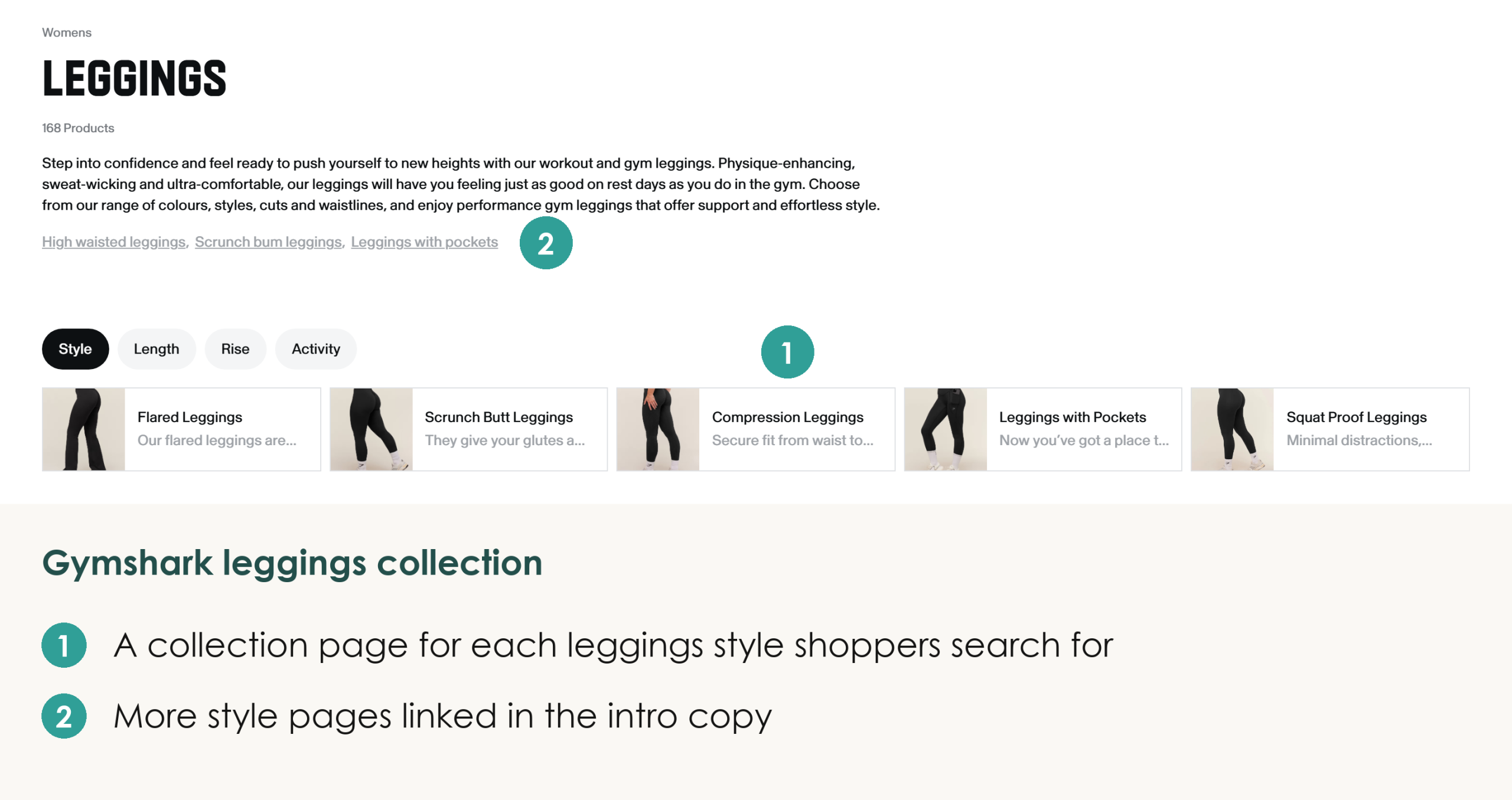
There is one for flared leggings and one for squat proof leggings, with more alongside, and each matches a phrase a shopper types. Someone who searches for squat proof leggings lands on a page that holds only squat proof leggings, with the full range a click away. On Shopify you can build the same thing with automated collections that pull products in by tag, one for each way your customers describe what they want.
Those style pages sit inside a business that made £646 million in revenue in the year to 31st July 2025, about 6% up on the year before. Those figures come from the SGI Europe report on Gymshark's latest accounts. A new store can build the same style pages this week.
Represent Keeps Weekly Drops Findable After Launch
Represent began in 2011 with T-shirts printed in a garden shed in Horwich, a town in Greater Manchester. Represent's revenue reached close to £100m in 2024, according to a Drapers profile from October 2025, and each regular product drop lifts site traffic by about 30%.
Represent launches a product nearly every week, and that routine is why it's the store I'd point a Manchester founder at first. A drop brings people in for a few days, and the collection it lands in keeps those products selling afterwards. The hoodies sit in a collection whose title carries two phrasings shoppers use for one garment, oversized and baggy.
Its collections sitemap lists 842 URLs. File each launch under its product type as well as its campaign name. The product type is what people still search for once the campaign's over.
Beardbrand's Collection Page Doubles As A Buying Guide
Beardbrand's beard oil collection reads like a buying guide. Below the products sit sections on the benefits of beard oil and how to apply it in three steps. Further down it covers other uses and the four key oils, and Google can read the whole block as FAQ content. Temple Smoke Beard Oil, one of the products on it, showed 4,687 reviews at an average of 4.62 when I checked.
Beardbrand did this explaining on YouTube long before it did it on the store. Founder Eric Bandholz built the brand on videos that explain beard care and grew it to seven-figure annual revenue without outside investment, as Judge.me's write-up of his founder session records.
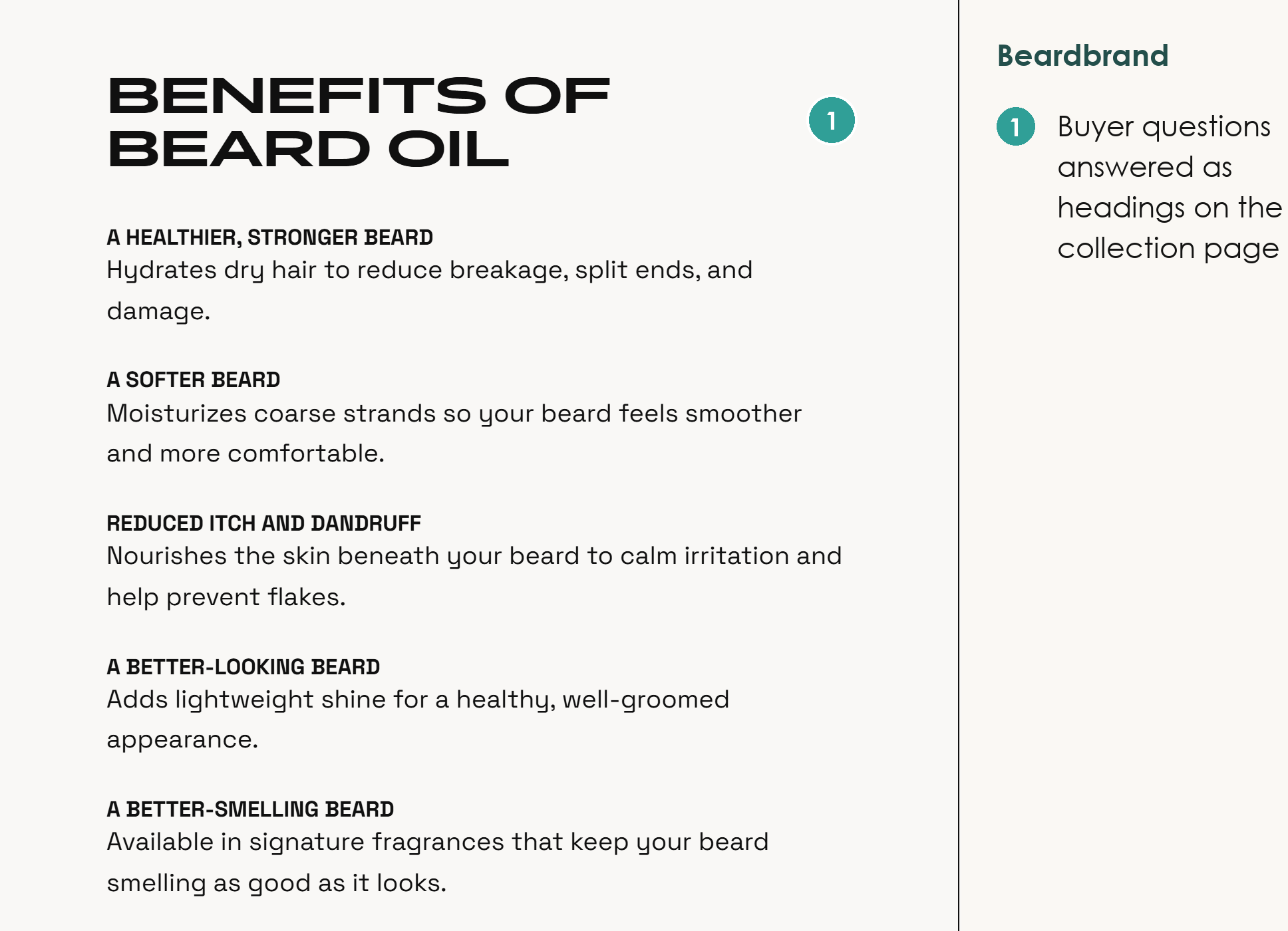
A first-time buyer types their questions into Google, so a collection page that answers them can rank for those searches and settle the doubt where the buyer can add to basket. Take the three questions customers email you most and answer them under your main collection's product grid. Our guide to ecommerce content marketing examples sets out the test a buying guide has to pass before it earns that place.
Ruggable Named Its Main Collection Washable Rugs
Washable Rugs is the name of Ruggable's main collection, a business built on one product idea: a rug you can put in the washing machine. The page title adds stain resistance and easy cleaning, two of the main reasons people buy one. Below the grid it answers whether washable rugs can go in the dryer and whether they are worth it.
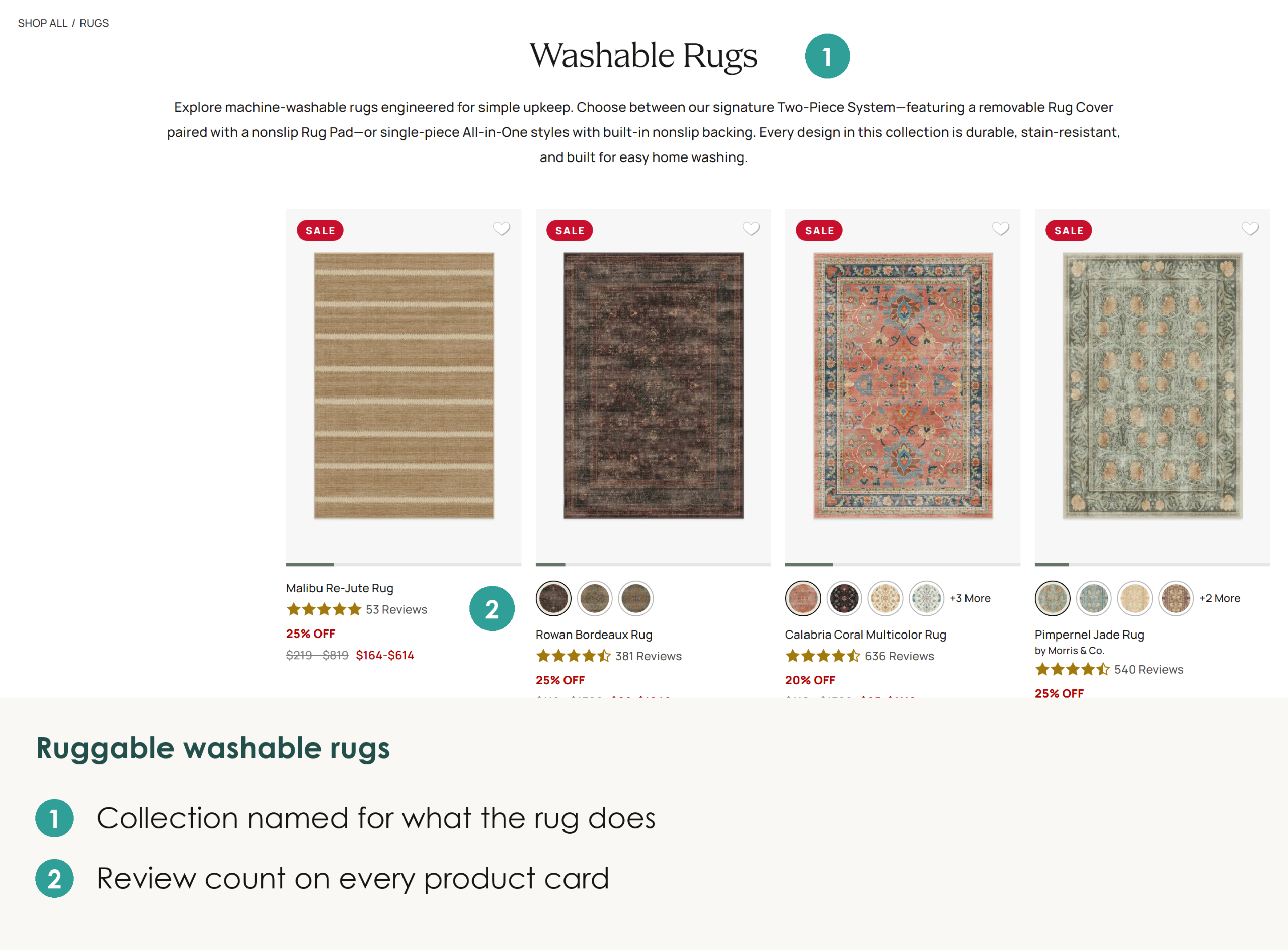
Every product card shows its review count, and when I checked, the Cambria Sapphire rug's own page carried 5,493 reviews. When a product is new enough that nobody searches your brand, shoppers search for the problem instead. So name your main collection after what the product does.
Graza Names Each Olive Oil By Cooking Use
Graza, the olive oil in a squeeze bottle, was projected to “surpass $48 million in sales and reach 18,500 retail outlets by the end of 2024”. Nosh reported both figures in February 2025, in its interview with the company about Frizzle, the third oil Graza launched after Drizzle and Sizzle. Its chief executive credits the bottle and branding with the launch, and the oil itself with repeat orders.
Its two oils are called Drizzle and Sizzle, one for finishing a dish and one for cooking with. The Drizzle page says in a single line that it goes on food as a dressing or a dip. It also sells the refill can on the same page.
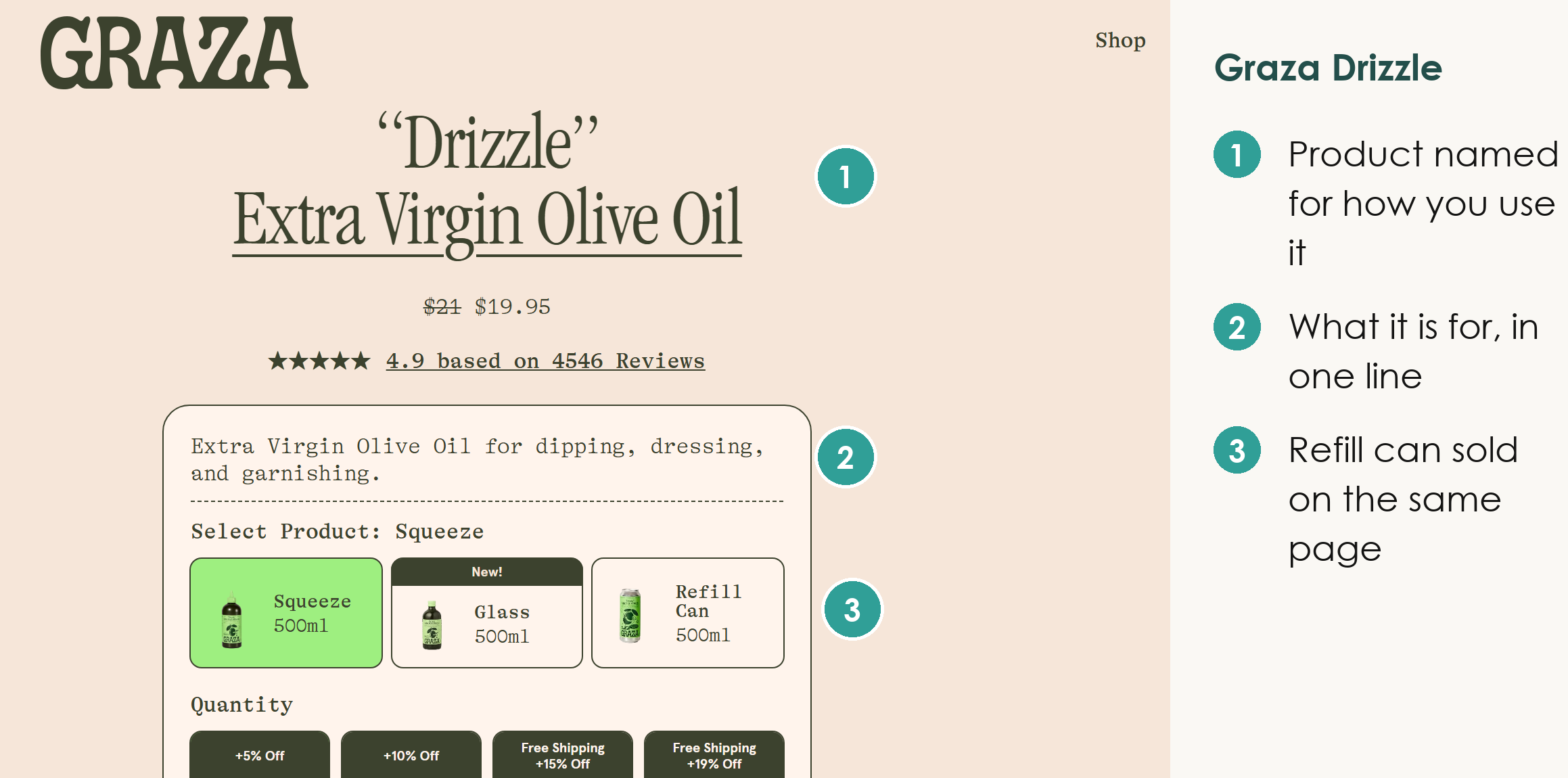
Naming a product after its use takes a decision away from the shopper, and it costs nothing to copy. Graza's olive oil collection page has about 80 words, no H1 heading and no meta description. Its growth came from the bottle, social media and supermarket shelves. A search-led store should copy the product naming and skip that collection page.
What A Small Store Can Copy This Month, And What Takes Money Or Fame
Five of the decisions in these successful Shopify store examples need only time and a Shopify admin login, while the other three need a budget or a following that a store taking its first orders rarely has.
Copy How They Name, Group And Explain Their Products
When I checked the product data on Gymshark's best-selling everyday leggings, the average rating sat well short of five stars, and they still sit first in the collection's top ten. A middling average on a best seller has not stopped Gymshark selling it, so there's no reason to hide your own mixed reviews. Our guide to ecommerce social proof covers where to put them.
New stores that ask why nothing is selling usually miss these same basics. Product titles are copied from a supplier's listing and match nobody's search. Or the store sells several unrelated categories, so no collection page has an obvious buyer.
Fix the naming and grouping before you pay for traffic, because ads sent to those pages buy visits that don't convert. Our guide to writing a category page that ranks takes you through the collection page itself. Product pages under a collection need the same care, and our guide to product page SEO covers the fields to change first.
Hold Off On Weekly Drops, Retail Distribution And A Bare Category Page
Represent's weekly launches need a design team, stock and a following big enough to lift traffic every time. Graza's supermarket shelves need a sales team and money tied up in stock. Neither is a starting point for a store that's still taking its first orders.
Death Wish Coffee's ground coffee collection has no H1 heading and no meta description, and its page title is the one word Ground followed by the brand name. That works for a brand people search for by name.
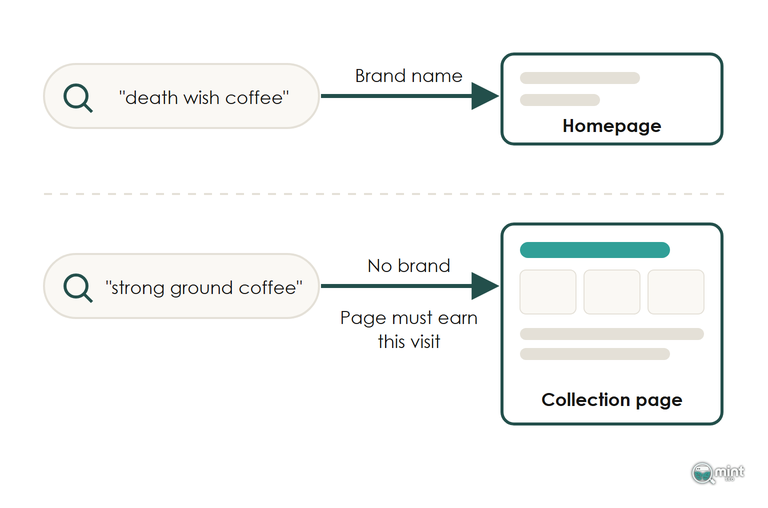
A shopper who types strong ground coffee finds nothing on that page to match their search, which is what the diagram shows. A new store has nobody who searches for its name yet, so every visit from Google comes through a search like that one. A bare collection page hands those visits to someone else, and our guide on getting traffic to a Shopify store covers the other channels while search builds.
How To Tell A Successful Store From One That Only Looks Successful
Check a store's accounts or its review counts before you copy it, because a polished storefront says nothing about whether the business makes money.
Allbirds Stayed On The Lists While Losing $77.3m
Allbirds lost $77.3 million in the year to 31st December 2025, and its annual report warned of substantial doubt about its ability to continue as a going concern. That filing also says it is closing all its remaining full-price US shops.
In spring 2026 it sold the shoe brand for $39 million, as TechCrunch reported.
Its storefront still looks like a winner, with a clean men's sneakers collection, FAQ markup and more than 1,300 collection URLs in the sitemap. None of that polish shows up in its accounts, so a store's place among successful Shopify store examples tells you nothing about whether it makes money.
Filed Accounts And Review Counts Are Checks You Can Run Yourself
UK companies file their accounts at Companies House, where anyone can read them for free, so the Gymshark and Represent accounts are there to check. Allbirds' loss appears in the annual report every US listed company has to publish.
Those accounts also show what a revenue headline leaves out. SGI Europe's report on Gymshark's puts pre-tax profit down to £7 million from £11.9 million the year before, as it spent on physical shops and events.
For a private store, look at the review count on its best sellers. The figure a product page shows is usually in its structured data too, and a product with thousands of reviews has sold thousands of units. Sites that estimate revenue are weaker evidence, because they model traffic and guess. Run these checks on any store in your own niche before you copy it.
Getting Your Store Found Before Your Brand Is Famous
The decisions you can copy all live on your collection and product pages: what they are called, what they answer and how they link to each other. That work is what our On-Page SEO service covers for Shopify stores. It runs from titles and headings on collections and products to copy that answers what shoppers search, plus the internal links between collections.
On-page SEO work like this earns a store without a famous name its category searches, and those visits keep coming month after month without an ad bill behind them. I've driven more than 3M organic sessions across my career with this kind of work. If you'd like a second opinion on your own collections, book a free 30-minute consultation and I'll tell you which one to fix first.

About the author
John Butterworth
John Butterworth is the founder of Mint SEO, a Manchester ecommerce SEO agency he started in 2024. He has 11 years in SEO and digital marketing, previously running SEO departments for market-leading brands and several agencies. He specialises in Shopify and ecommerce SEO, and his work has ranked over 100 websites and driven more than 3 million organic visits. He speaks at industry events including the SEO Mastery Summit.
Connect on LinkedIn →