
Knowledge Hub
The Shopify Profit Margin Your Admin Does Not Show You
By John Butterworth · August 17, 2026
Your revenue graph is up and your bank balance is flat, while the profit margin in your Shopify admin says everything is fine.
That mismatch is the margin problem I see most in Shopify stores, and it is rarely a bookkeeping error.
Eleven years of running Shopify SEO retainers has taught me that margin is where owners are most often wrong about their own business, and rarely by a little.
Reconciling a store's reported margin against its banked cash is a job I've now done a few hundred times, in the Shopify audits Mint SEO runs from Manchester.
The shortfall is almost never in the cost of goods. It sits in the lines Shopify leaves out of the report.
Here is the reassuring part. The figure Shopify shows you is real; it just measures far less than you think it does.
A Good Shopify Profit Margin Depends On What You Sell
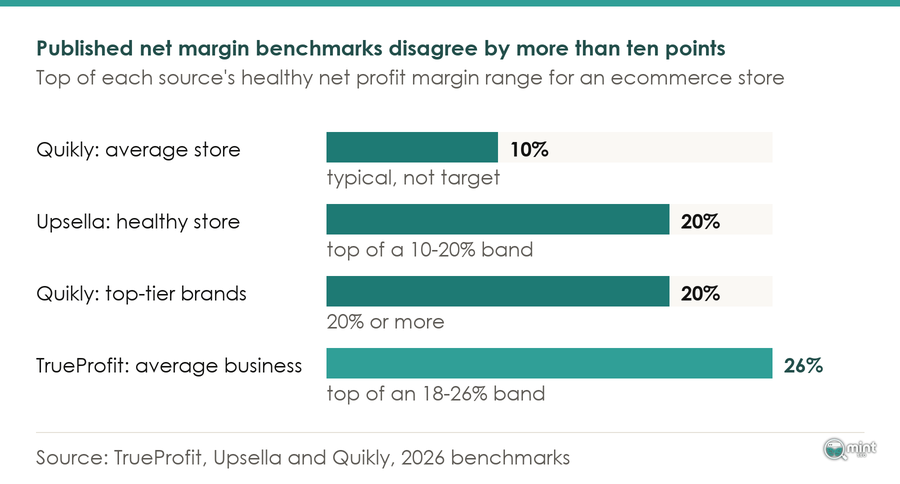
Upsella's 2026 figures put a healthy Shopify store at a gross margin of 50-70%, with a net margin of 10-20%, and that band is where most UK stores selling physical products should expect to sit. Treat it as a sanity check. The published figures behind it disagree with each other more than most summaries of them admit.
What Each Source Publishes For Net Margin
That disagreement is the useful finding here. Reporting on ecommerce margins this year, TrueProfit puts an average business at 55-70% gross margins.
TrueProfit's analysis also gives 33-51% contribution margins for those businesses. Net profit, once everything else is out, lands at 18-26%. The drop from contribution down to net is advertising and apps and premises and people. It is wider than any gross figure suggests.
Quikly's guidance lands somewhere different again. It records the average store's net margin hovering around 10%, with top-tier brands reaching 20% or more.
Those views of good sit more than ten points apart on net margin, and both are honestly reported. They measure different store populations at different sizes, using different definitions of which costs count.
Use the band to place yourself, then stop. A store sitting at 4% has a problem that every one of those reports would recognise, while a store at 16% has reached the point where the published averages stop being able to tell it anything useful about its own catalogue.
Why Your Category Matters More Than The Average
What you sell moves your Shopify profit margin further than any average does. A brand with pricing power holds a high gross margin because customers accept the price.
A store competing on price in a crowded category cannot, however well it runs its operations. TrueProfit's analysis puts a gross profit margin between 60% and 70% as the sweet spot for sustainable ecommerce growth. It notes that anything above that band usually needs real differentiation, and better buying alone will not get you there.
That matches what I see in audits, where the stores holding the strongest margins are rarely the ones with the cleverest supplier deals. Pricing power comes from the product and the brand around it.
Compare yourself against your own last twelve months instead, and against stores selling roughly what you sell at your price point. A blended cross-category average makes a poor yardstick for one catalogue.
For the wider set of numbers worth watching alongside it, I have written up the ecommerce metrics that matter separately.
Gross, Contribution And Net Are Three Different Numbers
Three numbers get called profit margin. They answer three different questions, Shopify reports only one of them, and getting that straight is what makes every later figure on this page usable.
Which Margin Answers Which Question
Gross margin answers whether a product is worth stocking at all. It removes what the product cost you and nothing else.
Contribution margin tells you whether an individual order was worth taking. Costs that ride along with the order come out too. That means delivery, packaging and card fees. MetricMosaic states the calculation as Contribution Margin = ((Revenue − COGS − Shipping − Transaction Fees − Packaging) / Revenue) x 100.
Then there is net margin. It tells you whether the business works, because everything comes out of it. Advertising, apps, the plan fee and your own time all count.
A store can hold a perfectly healthy gross margin and still lose money on the majority of its orders, once delivery and card fees and packaging are counted against each one. The middle number exists for precisely that reason.
The Formula Behind The Percentage In Your Admin
Start with what the admin figure is. Shopify's documentation states that its profit reports calculate margin as (net sales − cost) / net sales x 100, where net sales already has discounts and refunds deducted. So the profit margin Shopify puts on your screen is a gross margin.
That gross figure rests entirely on what sits on the cost side. Shopify defines cost per item as the price you paid the manufacturer. Its documentation is explicit that the figure is excluding taxes, shipping, or other costs.
Delivery sits outside that definition. Card fees, packaging, apps and ad spend sit outside it too. Between them they are most of what stands between a sale and your bank account.
Discounts and refunds are the one leak the figure does capture, because they sit inside net sales already. Everything else on your statement is outside it.
There is also no net profit report to go looking for. Shopify's documentation lists five views of it. They cover margin by market, gross figures by product or variant, and margin by individual order.
None of those reaches net. The profit-analytics vendor Syncost notes that Shopify doesn't track net profit, which is why a whole app category exists to assemble it.
The Products That Are Missing From Your Profit Report
Check this one today. Shopify states that profit is reported only for products and variants that had cost recorded at the time they were sold. Any product you never gave a cost per item is absent from the report entirely.
You get a report that looks complete while covering part of your catalogue. Shopify even warns that you might notice a discrepancy between the net sales number displayed in your sales and profit reports.
That is the missing-cost problem surfacing as two figures which refuse to reconcile.
Open your profit report and compare its net sales against your sales report for the same period. Where they disagree you have products missing a cost, and filling those in comes before trusting any margin figure in the admin.
Whatever the report covers, the number is only ever as good as what was typed into it, and a data-entry slip can produce arithmetic no reader would believe. According to a Shopify Merchants Community thread, a merchant posting as manvswild reported a product showing Profit -$1,363.46 Margin -3,788.4%.
Diagnosing it took a Shopify Partner posting as magecomp exactly one line. I think you have added the wrong values for both fields. You may need to reverse it.
A price entered as a cost gives you a number that is obviously wrong. A cost entered slightly wrong gives you one that looks plausible, and that is the more expensive of the two.
Where The Figure Went In The Admin
Finding the figure at all now takes more effort than it used to. If you went looking for the inline margin on a product page recently and could not see it, you are not imagining that, because Shopify moved it.
According to a Shopify Merchants Community post from last October, a merchant posting as petgrocer described it plainly.
Recently they have hidden the COST, MARGIN and PROFIT behind a drop down menu, that has a tiny little arrow you must click to access.
Complaints continued into this year. According to a June 2026 thread on the same forum, a Shopify Partner posting as PieLab named the practical risk of collapsing the field out of sight. It also makes it dangerously easy to make mistakes during a quick update and accidentally price a product so low that you lose money.
In July 2026 another poster, SectionKit, confirmed there is no native way to reverse this change in the admin dashboard right now. So the risk is permanent until you stop pricing off that screen.
My own advice here is the one a Shopify Partner posting as PaulNewton already gave in that thread. Businesses that grow have roles that work through reports, or custom dashboards, not the dogma of some SASS's web ui admin.
Read margin from a report you control. The product screen was never the right home for it.
Work Out Your Real Margin On A Single UK Order
Now for the arithmetic on a UK store. Take one order, remove the VAT first, then apply the card rate for the plan you are on and take off the cost of getting the thing to the customer.
Take The VAT Out First
If you are VAT registered and your prices display inclusive of VAT, a sixth of your shelf price was never yours.
Shopify's own tax documentation takes that as read. It notes that Customers in the United Kingdom expect product prices that are inclusive of their local value added tax.
HMRC puts UK standard rate VAT at 20% on most goods and services. On a VAT-inclusive price that comes to 20/120 of the total, or 16.67%. Work in the other direction and the error compounds, because dividing a margin into the gross price flatters every product in the catalogue by the same sixth.
Shopify handles this correctly in its reporting, because its net sales figure excludes tax. Where it goes wrong is on the back of an envelope, when a merchant divides margin into the price the customer paid.
It also explains why profit margin on a Shopify store drops the month it crosses the VAT threshold. HMRC states that registration becomes compulsory once your total taxable turnover for the last 12 months goes over 90,000 pounds.
The UK accountancy practice Social Commerce Accountants works the consequence through on a fifty-pound sale. Before VAT you sell for 50 pounds and keep 50 pounds. At that same price after registering HMRC takes 8.33 pounds, and you keep 41.67 pounds.
Registering without repricing is therefore a cut of a sixth to everything you sell. It is the largest single margin event in most stores' history, and no warning email announces it.
Your Card Rate Is A UK Rate
Card fees come next. The UK numbers here are their own. According to Shopify, online standard card rates run at 2% plus 25p on Basic.
Shopify puts Grow at 1.7% plus 25p and Advanced at 1.5% plus 25p. The equivalent US rates are higher and do not apply to you. Note the fixed 25p as well, because on a ten-pound order it costs more than the percentage does.
Shopify records Amex and international cards higher on every UK plan. Those rates run at 3.1%, 2.7% and 2.5% respectively, so your sales mix shifts your effective rate without anything changing on the website.
Selling in person shifts it again. Shopify documents 1.7% on Basic and 1.5% on Advanced for a market stall in Manchester's Northern Quarter or any other in-person sale, with no fixed pence element at all.
The Gateway Surcharge That Does Not Get Quoted
This is the fee I find unaccounted for most often. Take payments through a provider other than Shopify Payments, and Shopify charges a percentage of order value on top of whatever that provider charges you.
According to Shopify, that surcharge runs at 2% on Basic and 1% on Grow. It falls again to 0.6% on Advanced and 0.2% on Plus. Gateways still charge their own fee on top of this one. A store on Basic pays twice to take the same payment.
A store turning over twenty thousand pounds a month on Basic hands over four hundred pounds for something no customer ever sees.
It is also the quickest item on this page to fix. That is why it opens the levers below.
One Fifty-Pound Order, All The Way Down
Put those rates together on a single order. Take fifty pounds on Basic with VAT-inclusive pricing, against a product that cost you fifteen pounds.
Assume a tracked label at three pounds fifty and forty pence of packaging. Substitute your own product cost, label and packaging figures.
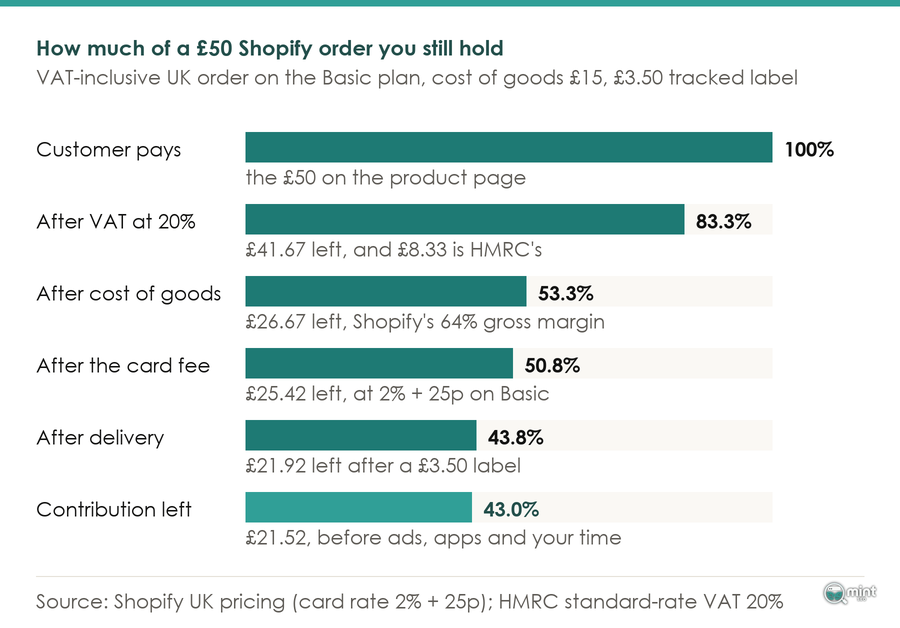
Shopify's documentation would report this product at a 64% gross margin. That is correct on its own terms, because net sales of £41.67 less cost of £15.00 leaves £26.67. Your contribution on that same order comes to £21.52, or 51.6% of net sales.
Advertising, apps and the plan fee all still come out of that £21.52, as does your own time. Only once those are out do you have a net figure. Run a third-party gateway on Basic and the surcharge described above takes another pound. As noted above, that drops contribution to £20.52 and 49.2%, on the same product at the same price.
Carrier Surcharges And Packaging Fees Both Rose In 2026
Four UK cost lines moved this year. None of them asked whether your prices had moved too.
If you set pricing last year and have not revisited it since, this section explains why your Shopify store’s profit margin drifted while nothing appeared to change.
Royal Mail's Surcharges Moved Twice This Year
Royal Mail surcharges sit on top of the tariff, and both of them went up. The UK courier consultancy Elovate records that from 3 May 2026 the International Surcharge rate increased from 6.5% to 12%, with its figures checked in the middle of that month.
Elovate records that the Royal Mail UK fuel surcharge increased from 11% to 16% over the same period. Parcelforce moved in that window too, so switching between the two carriers avoided nothing. Surcharges apply to the price after any discount you negotiated. A hard-won account rate gets marked up along with everything else.
One newer charge matters if you handle returns. Elovate records a correction charge for Tracked 24 and Tracked 48 return items that exceed weight or size limits, which is currently set at 11 pounds.
Eleven pounds on a mis-declared return exceeds the entire contribution on the fifty-pound order above. BBC News reported the underlying tariff rising as well, taking a first-class stamp to £1.70 on 7th April 2026.
Packaging Fees Now Depend On What The Box Is Made Of
Packaging became a margin decision this year too. Last December the government published illustrative Year 2 waste disposal fees for the packaging Extended Producer Responsibility scheme, modulated for the first time by how recyclable each material is.
That scale is not trivial. PackUK's figures put plastic at 415 pounds per tonne (green), 455 pounds per tonne (amber), 545 pounds per tonne (red). Red sits a third above green and 1.2 times amber. The same weight of packaging therefore carries a third more cost purely on how a recycler will treat it.
Reporting on the sharpest mover of all, the compliance scheme Ecosurety records that Wood has increased by 60% (from 280 pounds per tonne last year to an amber fee of 450 pounds for the current period). That is 170 pounds a tonne more.
A store shipping in wooden crates or wood-fibre void fill therefore priced its packaging against a rate that no longer exists.
Two caveats before you panic or relax. According to PackUK, the scheme covers organisations turning over £1 million or more that handle over 25 tonnes of packaging a year, so a smaller store is outside it until both of those thresholds are crossed.
These are illustrative rates as well, with PackUK expecting confirmed fees in June 2026 after a reporting deadline of 1st April 2026. Anyone pricing a range for the coming year is therefore pricing against an estimate, and the sensible response is to leave yourself some headroom on price.
Inside that scope, the packaging spec you chose last year may be the wrong one now. The difference between a green and a red rating on one material is worth more than most sourcing negotiations.
The Levers That Move A UK Store's Margin, In Order
Sourcing and pricing are the two slowest levers available to you, so they come last here. This is the order I work in, ranked by how fast each one moves the number against how much disruption it costs.
Fix The Fee Arithmetic Before The Operations
Do the fee maths first. It moves your margin this week and changes nothing about how you operate.
Start with your monthly order value. Apply the gateway surcharge for your plan, then compare that total against the plan fee one step up.
Shopify states £25 a month for Basic, £65 for Grow and £344 for Advanced. A store paying the 2% surcharge on Basic crosses the cost of Grow at roughly four thousand pounds a month of gateway volume, and everything above that is given away for nothing.
That same arithmetic makes annual billing the other free one. Shopify puts Basic at £19 a month when paid yearly, with Grow at £49 and Advanced at £259. No migration, no operational change, no conversation with a supplier.
The plan you sit on deserves the same scrutiny as the platform itself, which I have covered in how to choose an ecommerce platform.
Raise The Delivery Threshold Past Your Average Basket
Delivery is the next line worth attacking. Free delivery thresholds get set at a round number and left there, and if yours sits below your average order value, you are paying for delivery on orders that were converting anyway.
Set it above your current average basket so the offer has to earn the extra item. Higher order values also spread the fixed costs of each order across more revenue, lifting the effective margin without touching a price.
The mechanics of getting baskets up sit in my guide to ecommerce upselling.
With the threshold set, check what share of revenue your shipping takes. EasyApps puts a reasonable band at 5-10% of revenue. Anything over 12% points at the shipping model itself, and not at the rate you negotiated.
Cut The Returns You Can Predict
Returns eat into your Shopify profit margin too, and most of them are foreseeable. A return costs you the outbound label and the inbound label and the handling, against an order that contributed nothing at all.
Most of those preventable ones trace back to the product page, and to what it failed to tell the buyer. EasyApps reports that better photos, descriptions and size guides cut returns by 20-40%, which lands straight in margin because nothing else about the order changes.
Packaging format deserves a pass at the same time. Moving suitable products from boxes to mailers cuts the per-order shipping cost, and it interacts with courier size bands and that eleven-pound correction charge.
Sourcing Compounds, Discounting Does Not
Last comes the slow one. EasyApps notes that reducing cost of goods by even 5% compounds across every unit you sell. That is why it repays a slow, properly run supplier conversation.
Discount discipline belongs here in the opposite direction, because discounts sit inside the net sales figure Shopify reports.
A habit of small promotions therefore shows up as a falling margin with no obvious cause, because nothing in the admin separates a deliberate price cut from a product that has simply become dearer to sell.
EasyApps records underpricing as the most common margin killer of all. It usually starts with matching a rival's price without knowing their cost base.
Repeat buyers give you the room to hold price instead. I make that argument at length in customer retention in ecommerce.
Get A Second Pair Of Eyes On Your Store's Numbers
You have the arithmetic now. If your real margin came out thinner than you expected, the next question is where growth comes from, and growth is what I am hired to build.
Bring your own version of the fifty-pound sum to a free 30-minute consultation and we will go through it together. Thirty minutes is enough to see which of your product lines are carrying the others, where your organic rankings sit against the searches that pay, and what ninety days of work would sensibly target. You will be talking to me, not to a sales rep.
Every lever on this page shrinks a cost. The exception is demand, which costs nothing extra to serve on each order. That is why organic search matters most when contribution margin is thin.
Book your free consultation and bring the numbers you have just worked out.

About the author
John Butterworth
John Butterworth is the founder of Mint SEO, a Manchester ecommerce SEO agency he started in 2024. He has 11 years in SEO and digital marketing, previously running SEO departments for market-leading brands and several agencies. He specialises in Shopify and ecommerce SEO, and his work has ranked over 100 websites and driven more than 3 million organic visits. He speaks at industry events including the SEO Mastery Summit.
Connect on LinkedIn →