
Knowledge Hub
Where To Put An Upsell (And How To Tell If It Made You Money)
By John Butterworth · August 16, 2026
Ads have got dearer and your margin has got thinner, so buying another customer has stopped looking clever. That is the moment most stores turn to ecommerce upselling.
Two different things hide behind it. An upsell is a better version of the thing already in the basket, offered at a higher price. A cross-sell is a second product placed beside it, and the difference matters more than it sounds.
Almost every store audit I run raises upselling, usually once the ad account has stopped being affordable. I'm John Butterworth, founder of Mint SEO in Manchester, and I've spent 11+ years in SEO with 3M+ organic sessions behind the stores my team and I have worked on.
The fault I find in those audits is rarely a missing offer.
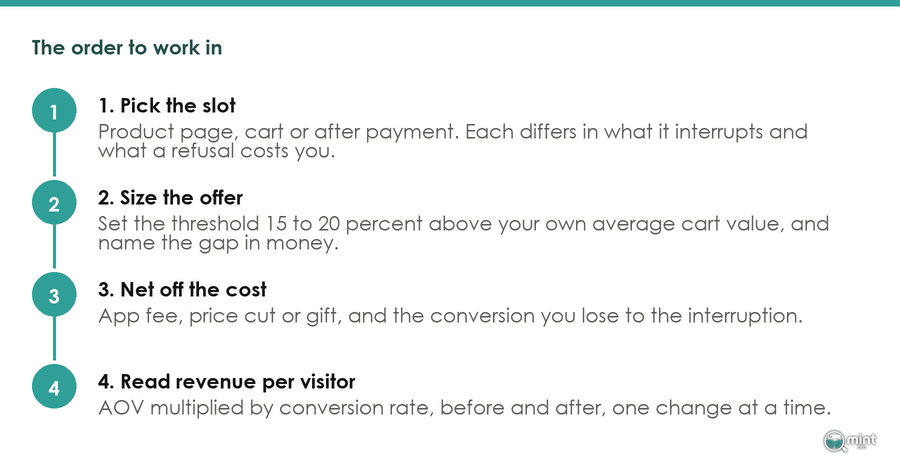
It is an offer running in the wrong slot, bought with a price cut nobody costed, and judged on a number that cannot say whether it worked. Below, the placement, the size and the measurement come in the order you have to settle them.
Where Each Kind Of Offer Belongs
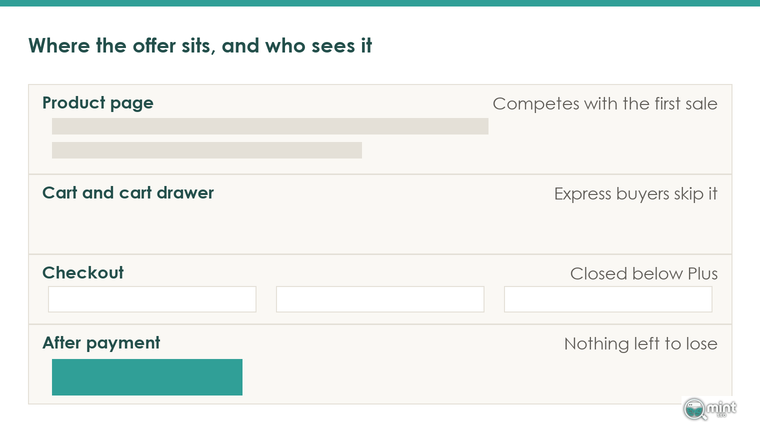
A Shopify store gives ecommerce upselling four possible homes, so pick the slot first and the offer second. Each one differs in what it interrupts and what a refusal costs you.
Published acceptance rates say the same, although they disagree about which slot wins.
The largest published sample belongs to Focus Digital. Over the first seven months of 2025 "our research team conducted a comprehensive analysis of upsell conversion rates across 1,847 digital businesses operating in the North American market", and the method is published in full.
Focus Digital answers the question one way. The EasyAppsEcom benchmark guide, updated in March 2026 and built on Shopify stores specifically, answers it the other way, recording that "Pre-purchase upsells on product pages have the highest acceptance rate at 8-15%; in-cart 5-12%; checkout 4-10%; post-purchase (thank you page) average acceptance rate: 3-8%".
Both measure real stores. They measure different ones, which is your first clue that your own figures are the ones that matter.
On The Product Page, Where You Are Still Selling The First Thing
Your shopper has not committed yet. Anything you add here competes for the same attention as the product you are trying to sell.
Offers that survive on a product page are the ones the first purchase requires, and that is a measured effect. EasyAppsEcom's benchmarks put generic suggestions at 2 to 4 percent against 8 to 15 percent for offers built from what is already in the cart.
An unrelated suggestion therefore costs most of the take rate. ThomasKronevald, a lighting merchant posting on Shopify's forum in November 2024, showed what a necessary pairing looks like.
He sold pendants and table lamps across several sizes, each taking a different bulb fitting, and wanted the right bulb offered beside the lamp. Nobody buys a lamp and then wonders whether they need a bulb.
Bulb and lamp are one job. If your catalogue has no equivalent pairing, this is the wrong slot for you, and optional extras belong further down.
In The Cart, Where Shop Pay Buyers Never See It
Most upsell apps put their progress bars and their nearly-there prompts here. Of the three slots, this one has the quietest failure mode.
Shop Pay, Buy it now and the other express buttons take a shopper from the product page straight into payment. Your cart page never loads and your cart drawer never opens.
The buyers most likely to use those buttons are your highest-intent ones, which is what makes this the expensive slot to get wrong. A merchant called keval3 raised exactly that on Shopify's forum in June 2026.
Check what share of your orders arrive through express checkout before you build anything that lives only in the cart. On most stores that share is largely mobile traffic.
One structural point about this slot. Below Shopify Plus the checkout itself is closed to you. The cart is where an offer has to live, whether you like it or not.
After The Payment Goes Through, Where Nothing Is At Risk
Once payment is confirmed the order is banked, so a refused offer costs you nothing. This is the only slot where you cannot lose the sale you already had.
It is also the cheapest of the three to switch on. Reading across the sales on its own platform in March 2026, SamCart reports that "58% of all revenue processed through SamCart comes from upsell transactions".
Treat that as the ceiling case on a platform built around the tactic. Start here anyway, find out whether your customers will take an upgrade at all, then move the offer upstream once you know.
Doing it the other way round means testing your riskiest placement first, on the traffic that pays for everything else.
That window does other work too, because retention begins on the confirmation page. Plenty of shops now park a chatbot there to field the where-is-my-order questions.
How Big The Offer Should Be
Size the offer against your own average, never against a figure lifted from somebody else's blog. A threshold works when your typical basket can nearly reach it.
Maor_Heruth states the rule directly on that same forum. Take your average cart value and set the free-shipping bar 15 to 20 percent above it, so the gap is one more item and not a second order.
A round number gives you one of two useless outcomes instead. Everybody clears the bar without changing anything, or nobody comes near it.
The offer itself gets sized the same way, against your average. UpsellPlus reports that "cross-sells in the cart page have a cost of 20-30% of the AOV", and puts the post-payment band far higher, at 40 to 60 percent, because the buyer has already committed.
Say the gap out loud in money, too. Ellie-BOGOS reports wording the prompt as "Add $18 more" for the gift, which beats "free gift available" because your shopper sees the size of the step.
Whichever band you pick, keep the count down to one offer, two at the outside.
What An Accepted Upsell Costs You
An accepted upsell is not free money. Three things come out of it before you see any, and the app is the first.
Upsell.com publishes three bands on its Shopify App Store listing, at $4.99, $9.99 and $19.99 a month, each capped by monthly order count or by the upsell revenue it generates.
The Shopify App Store records 4.8 out of 5 stars, 2,796 reviews on that listing, and ratings across the category cluster too high to separate apps.
Order-banding is the part to notice, because the cap is charged against the upsell revenue itself. A quiet month and a busy one sit in the same band until the cap moves. That is worth weighing when you review your Shopify apps.
Beyond the subscription sits the second cost, whatever bought the acceptance. A price cut or a free gift comes out of the same margin, so gross profit on the order falls even as its value rises.
Matthew Dandurand founded ConversionFlow. He puts the longer cost of leaning on price cuts plainly in his profit per visitor guide:
Every time you train a customer to wait for a sale, you're lowering the floor on what your traffic is worth.
He also defines the sum itself, PPV = CVR x AOV x Gross Margin %. Drop that third term and the first two can rise while the business goes backwards.
Dandurand puts the point in two stores. A store converting at 4% on a $20 average order generates less gross profit per visitor than one converting at 2% on an $80 order, which is the argument for reading margin alongside the rate.
That leaves the third cost, the interruption. Every offer you put in front of a buyer invites them to stop and think, which is not what you want from somebody holding a card, and it never shows on your app's dashboard.
Telling A Revenue Lift From An AOV Lift
Average order value can rise while revenue stands still, and the dashboard checked every morning cannot show the difference.
Writing for VWO in February 2026, Shanaz Khan reduces it to one line: RPV = AOV x Conversion rate. Watching the average alone blinds you to the conversion rate your change is moving.
Valentin Radu, who founded Omniconvert, has a worked example of that in his 2026 guide, where "a discount popup increased conversion rate by 20% but reduced AOV by 21%, dropping RPV by 5%". Judged on conversion rate that test was a win, and it made the store less money.
Radu generalises it: a test can lift conversion rate while quietly dropping Average Order Value, producing a flat or falling revenue result that the conversion metric celebrates as a win.
Upsells fail that test the same way in reverse. Chloe.paker warned on Shopify's forum in June 2026 against assuming a higher average order value means the store is doing better. An upsell can look good because a few people accept it while it makes more people hesitate, abandon the cart, or never reach checkout.
Set the three readings side by side and the trap is obvious.
Read revenue per visitor before and after, changing one thing at a time. If you have conversion tracking you can trust the figures are already sitting there.
One last reason to trust your own reading. UpsellPlus reports an average upsell conversion rate of 5.4 percent across its merchants.
EasyAppsEcom records 4 to 8 percent for properly targeted offers. Focus Digital measured post-purchase at 14.6 percent. Your catalogue, your price points and your traffic mix are in none of those samples, which is why the before-and-after on your own store outranks all three.
Upselling And Cross-Selling Are Not The Same Job
An upgrade replaces the product in the basket. A cross-sell puts a second product beside it, and that distinction decides what software you end up running.
Most Shopify apps sold as upsell apps do the second thing. In June 2026 a merchant, JustinasR, went looking for one that would swap product X for product Y when the offer was accepted. Every app he found added Y on top.
So his search came up empty. Mizan-coders then went through the app store on his behalf and reported back that he could find no existing app supporting a true product-replacement workflow in the cart.
Both of them were posting on Shopify's own forum, with nothing to sell by saying so.
A practical upside is buried in all this. Your upgrade path already exists: it is the next size, tier or variant of something you stock.
Running a real upsell therefore needs no new product and no new supplier, only an offer pointed at the right variant and an app that will swap it. Those same variants are what your product feed sends Google.
When An Upsell Is Worth Running, And When It Is Not
Some baskets are better left alone, and ecommerce upselling is easier to get right once you know which ones.
Leave it alone when the offer would only surface at checkout. A promotion your shopper meets after deciding has done no work on the decision.
SectionKit, a developer who audits client stores, described that pattern in June 2026. Revealing the promotion at checkout surprises merchants because it feels like a nice surprise for the customer, when it means the offer did no work on their behaviour. You gave away margin for a thank-you.
The second condition is the product relationship itself. A lamp and a bulb work because one needs the other, whereas a bestseller shown beside an unrelated item is a guess with your conversion rate as the stake.
None of that makes ecommerce upselling a bad idea. It makes it a decision with conditions, which is a different thing.
Where We Fit In
You will have noticed this article says nothing about getting more visitors. That was deliberate, and it leaves half the sum out: raising what one visit is worth also raises what every visit you have not won yet is worth.
Filling that half is what we do at Mint SEO. Eight disciplines, one job, run as a single programme instead of a pile of one-off fixes. Keyword strategy and technical SEO sit at one end of that programme and digital PR at the other.
The pairing with your offer is simple arithmetic. An upsell raises what a visit is worth, and organic search decides how many visits you get without paying per click.
We run it against a revenue number, and you deal with me directly.
Book a free 30-minute consultation if you want to know which searches your catalogue could be winning while you tune the offer. Half an hour, no jargon, no obligation.
Should traffic itself turn out to be your constraint, start by choosing your two organic channels.

About the author
John Butterworth
John Butterworth is the founder of Mint SEO, a Manchester ecommerce SEO agency he started in 2024. He has 11 years in SEO and digital marketing, previously running SEO departments for market-leading brands and several agencies. He specialises in Shopify and ecommerce SEO, and his work has ranked over 100 websites and driven more than 3 million organic visits. He speaks at industry events including the SEO Mastery Summit.
Connect on LinkedIn →