
Knowledge Hub
Your Trade Prices Can Stay Private And Your Catalogue Can Still Rank
By John Butterworth · August 9, 2026
Talk about b2b ecommerce seo usually starts with keywords. On a trade catalogue it starts somewhere else: with what a stranger is allowed to see.
Most wholesale sites I look at sit behind a login, because prices are negotiated and nobody wants a rival reading them. That instinct is sound. Applied to the whole catalogue, it removes the site from search.
Your prices can stay private without that happening. Part numbers, specifications and pack sizes are a different matter, because those are what your buyers type into Google.
My name is John Butterworth and I run Mint SEO from Manchester.
Eleven years and three million organic sessions in, I still open a logged-out browser window before I open a keyword tool. On a trade store that one habit finds more revenue than the rest of the audit put together.
Below I work through that decision page type by page type, then the crawl work behind it, then what to report so nobody cancels the programme at month six.
Decide What A Logged-Out Visitor Can See
Settle this first. Every other part of b2b ecommerce seo waits on it, because until it is settled you have no public URLs for anything to act on.
Googlebot holds no account with you, no customer group and no session. Whatever your template renders to somebody who has never bought from you is the page that gets indexed.
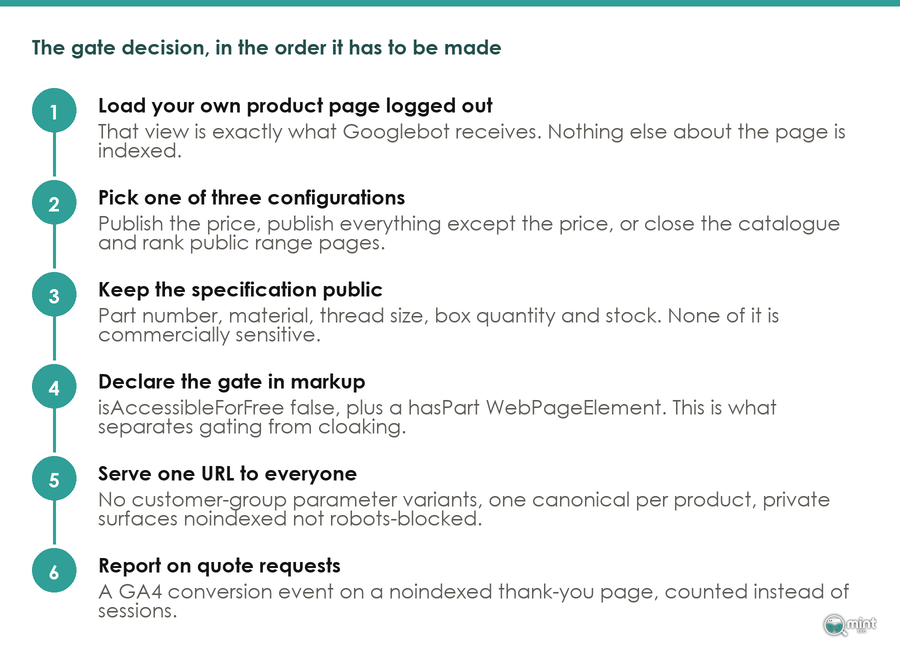
The three shapes a trade catalogue can take
Three configurations are safe. You can publish the price, publish everything except the price, or close the catalogue and rank public pages describing what is inside it.
A fourth option tempts people, and it ends badly. Writing up BigCommerce B2B Edition builds, Dan Kogan puts it plainly: faking the price to crawlers (cloaking) is a policy violation that will get the storefront delisted.
What people want from that fourth option is the ranking benefit of a priced page without publishing the price. No version of it survives contact with a manual action.
What to publish when the price has to stay private
Your sensitive item is the negotiated number. Thread size, material and box quantity are not, and they are what buyers search with.
Cromwell Tools sells on trade terms across a national catalogue, and I loaded one of its machine screw pages logged out on 9th August 2026 to see what a stranger gets. That page gives you MetalMate M4x10 BRASS SLOT CHEESE HEADSCREW DIN84, Box of 200, the SKU, the manufacturer part number and a full attribute table, plus £14.49 Ex VAT and a sign-in link for trade prices.
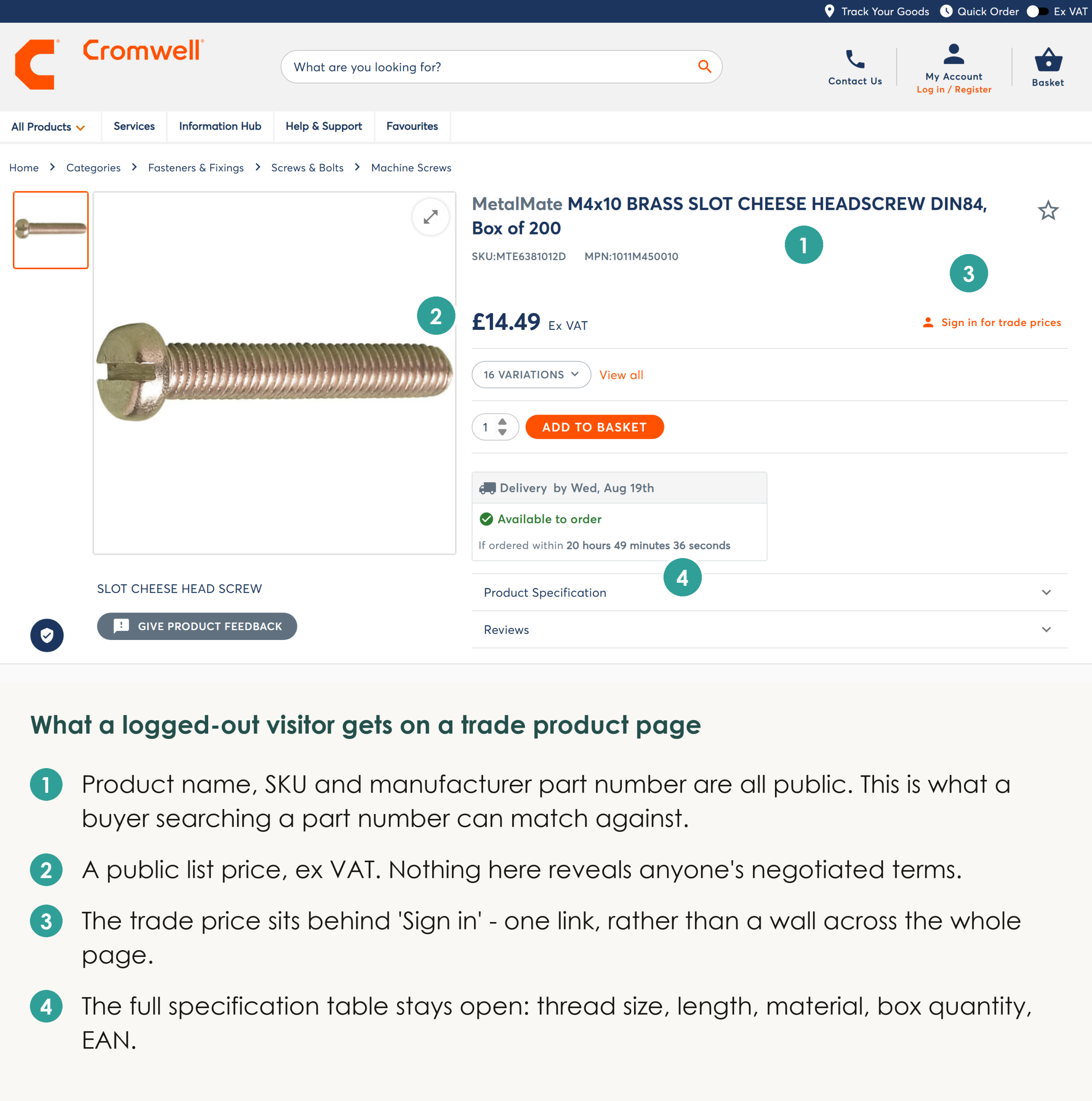
Nobody's negotiated terms appear anywhere on it. A buyer searching a DIN 84 brass cheese-head screw in M4 can still find the page.
Ordinary Shopify wholesale stores run the pattern too.
Mahalo Supplies distributes food and drink brands to farm shops. Its product pages publish the case configuration, the SKU and the description, and the price renders as a placeholder with a login prompt.
Keeping the price block in place matters more than it sounds. Strip it out and the template collapses around the hole.
Net Profit Marketing's BigCommerce guide treats this as the default. Its reasoning is about what happens to the signals.
Product and category pages stay fully crawlable. Prices get replaced with a login prompt, and URLs remain identical for all users.
Declaring the gate in your structured data
A restricted region of a page should be declared in the markup.
Google publishes a structured-data format for exactly this, and its documentation gives the reason. This structured data helps Google differentiate paywalled content from the practice of cloaking, which violates spam policies.
It costs two properties. Set isAccessibleForFree to false on the work. Then identify the restricted part with a hasPart WebPageElement.
Trade sites skip it because the word paywall sounds like a subscription. John Mueller closed that gap on Google's own podcast: it doesn't have to be something that's behind like a clear payment thing, he said, it can just be a login or some other mechanism that basically limits the visibility of the content.
What happens if you leave the login in charge
Half-measures cost the most. Every catalogue URL stays crawlable, and every one of them renders the same login form.
Mueller described what Google does with that in his own words. If you have a very generic login page, we will see all of these URLs that show that login page as being duplicates.
His next line is the one that should worry you. We'll focus on indexing the login page because that's kind of what you give us to index.
Your catalogue does not go missing under that arrangement. A sign-in screen takes its place in the index, and nobody searched for a sign-in screen.
One version of this is deliberate. If a catalogue has to stay shut, shut it properly and put the indexable content somewhere else.
Why B2B Search Is A Different Job From B2C
Your buyer is what makes b2b ecommerce seo its own discipline. A trade buyer types differently and turns up later in the decision, then takes a different next step when they reach you.
They search by part number, specification and quantity
By the time a trade buyer reaches Google, the requirement is written down already. Scube Marketing's 2026 statistics round-up puts 83% of B2B buyers as having defined their purchase requirements before they contact a supplier. Somebody in that position searches a part number, a material grade or a pack quantity, because that is what sits on the specification in front of them.
Your keyword list therefore starts in your own product data. Turning that into a map is its own job, and our guide to building a keyword map for a store walks through it.
The page's job is to produce an enquiry, not an order
There is no basket to complete when the price is negotiated, so a request is the only thing your page can close.
Somebody comparing three suppliers has to be persuaded to raise the enquiry with you. That is a different job from persuading a shopper to add to basket.
A third funnel your gated catalogue is also invisible to
Andy Hoar and Brian Beck run the annual Master B2B predictions report, updated on 4th July 2026, and one of its numbers is the share of searches now answered before the click. It cites a June 2025 study from Xponent21 putting it at 57.6% of US Google searches returning an AI Overview, roughly double the rate from August 2024.
Manufacturers and distributors who planned for two funnels, one starting with a Google search and one on their own site, now need to plan for a third.
That third funnel reads the same logged-out page Googlebot does. A login wall therefore removes you from both at once.
It is also the funnel growing fastest, and buyers who start there never reach a page you can gate in the first place.
Which platform you are on changes how much of this you control, and we have compared them in our piece on ecommerce platforms and ranking.
Getting A Large Trade Catalogue Crawled And Indexed
Deciding what is public gets you nowhere on its own. Google still has to reach the pages and keep them. A trade store makes that harder than a consumer one does.
One URL for everyone
Logged-in and logged-out visitors should meet the same address. Customer-group parameters are the usual culprit, spawning crawlable variants of a page that exists once.
Each of those variants divides the signals. Net Profit Marketing's configuration checklist puts two conditions on it: one canonical URL per product, and no duplicate URL paths from customer-group parameters.
Those two conditions cover customer groups. Filters split the same signals in a different place, and we set out the four answers every filter needs in our piece on faceted navigation.
The noindex that never gets read
Here is the one I find most often, and it makes no noise. A team blocks the trade area in robots.txt and adds a noindex tag to the same pages, believing that is belt and braces.
It is neither. Google's documentation is explicit that for the noindex rule to be effective, the page must not be blocked by a robots.txt file, and it has to be otherwise accessible to the crawler.
Block the fetch and the rule inside the page never gets read. Your URL stays eligible to show up from links pointing at it.
Writing the directive into robots.txt instead does nothing either. Specifying the noindex rule in the robots.txt file is not supported by Google, so check what is indexed before you assume the directive took.
Product markup when there is no public price
A page with a gated price still carries Product structured data. Your offer describes the quote route, with no number in it.
There is a bill attached, and it is worth paying deliberately. Where the anonymous visitor sees no price, Kogan notes that Product JSON-LD must use PriceSpecification with a quote-flow URL, and that the Shopping feed gets rejected.
Gating the price is therefore also a decision to give up Shopping. Most trade suppliers would take that deal if somebody put it to them. Nobody puts it to them.
Where Shopify and BigCommerce put the controls
On both platforms, what a customer sees and what they pay are separate settings. That is the useful part, because you can open the public view without renegotiating anything.
Shopify's developer documentation splits a B2B catalogue into a price list and a publication, and visibility belongs to the publication. Where a publication is not tied to a B2B catalogue, buyers logged into their accounts won't see any products for that location.
Nic Dunn, whose agency Charle builds Shopify B2B stores, describes the shared setup in a guide updated on 15th July 2026. Products, catalogues and inventory are shared with your DTC store. Both channels run from one store and one platform.
Minimum order quantities and price breaks live in the same settings. Both are page content you can publish without publishing a price, and buyers search for them.
For the order to work through the rest of the list, our guide to what to fix first on a store sets out the sequence.
The Pages That Earn Rankings A Product Page Cannot
Even a fully public catalogue answers only the searches that name a product. Buyers ask their first questions before they know which part they need.
Your sales desk already holds the keyword list
Write down what your own phones are telling you. The Master B2B report sets that as a floor: at a minimum, every B2B team should be gathering the full set of questions prospects ask and answering them in a structured way.
A question asked repeatedly by real buyers is demand no page of yours has satisfied.
Hoar and Beck are blunt about the shape it should take. Winning here means generating far more use-case content about how your products are used, not just product descriptions.
The range page a closed catalogue can still rank
A closed catalogue still has its range page, and in the audits I run that page is almost always a heading sitting on top of a grid of links.
What belongs on it is the vocabulary of the range: the grades stocked, the sizes carried and the lead times quoted. Every one of those is a public fact about the catalogue.
How much copy those pages need is a separate question, and our piece on category page copy works through it.
Reporting Organic On Quote Requests
Report b2b ecommerce seo on the enquiries it produces. On the stores we manage, the organic reports that change a decision count quote requests and trade-account applications.
The number that decides whether the work continues
Your quote thank-you page is where an organic visit becomes a recorded commercial event. Set it up before you measure anything else: a short form, a noindexed confirmation page, and a conversion event fired on submission.
Without that event, a programme that is working reports as traffic with nothing attached. Good work gets cancelled that way.
Why the order figure will always look wrong
Judging a trade catalogue on completed orders measures the step furthest from the pages. Forrester's State of Business Buying research found 86% of B2B purchases stall somewhere in the buying process. A funnel with that long a human middle drops most of its entrants before the order. The order count moves months after the pages that caused it.
Where Mint SEO Fits
The first thing I check on a trade store is what the product page returns to a browser with no session. That view is the whole of what Google gets.
It takes minutes to look at. Every later decision in the audit depends on what it shows.
Trade catalogues are where I spend most of my time. What a store sells and what it publishes differ by more than anything else I find.
If you cannot say what your own catalogue shows a stranger, that is the check to start with, and I am happy to do it with you. My free 30-minute consultation is half an hour on your product template, your gating and what your logged-out pages are currently telling Google.
You get the three configurations applied to your catalogue, the ones your platform makes easy, and a rough 90-day order of work. Book your free consultation and I will tell you what your pages show a stranger before you commit to anything.

About the author
John Butterworth
John Butterworth is the founder of Mint SEO, a Manchester ecommerce SEO agency he started in 2024. He has 11 years in SEO and digital marketing, previously running SEO departments for market-leading brands and several agencies. He specialises in Shopify and ecommerce SEO, and his work has ranked over 100 websites and driven more than 3 million organic visits. He speaks at industry events including the SEO Mastery Summit.
Connect on LinkedIn →