
Knowledge Hub
Which Parts Of Local Search Apply To Your Store (And Which Do Not)
By John Butterworth · August 10, 2026
Six pages rank for local SEO for ecommerce and every one of them opens by telling you to claim your Google Business Profile. For a good share of the stores reading that advice, Google itself has already ruled it out.
Google is blunt about who qualifies. Its eligibility guidance says “To qualify for a Business Profile, a business must make in-person contact with customers during its stated hours”. Online-only businesses are named there as ineligible.
I run Mint SEO, a Shopify and ecommerce SEO agency here in Manchester. Owners ring me most weeks about a local package their store is not eligible for.
Local search is the slice of Google filtered by where the searcher is standing when they type. A shop can appear in it. A warehouse on an industrial estate outside Manchester, with a letterbox and a forklift, almost certainly cannot.
Start with eligibility, because it decides what else is available to you. Then the product surfaces a shop gets and a plumber does not, the stopping rule for location pages, and what a directory listing is worth in 2026.
Who Gets A Google Business Profile (And What To Set On One)
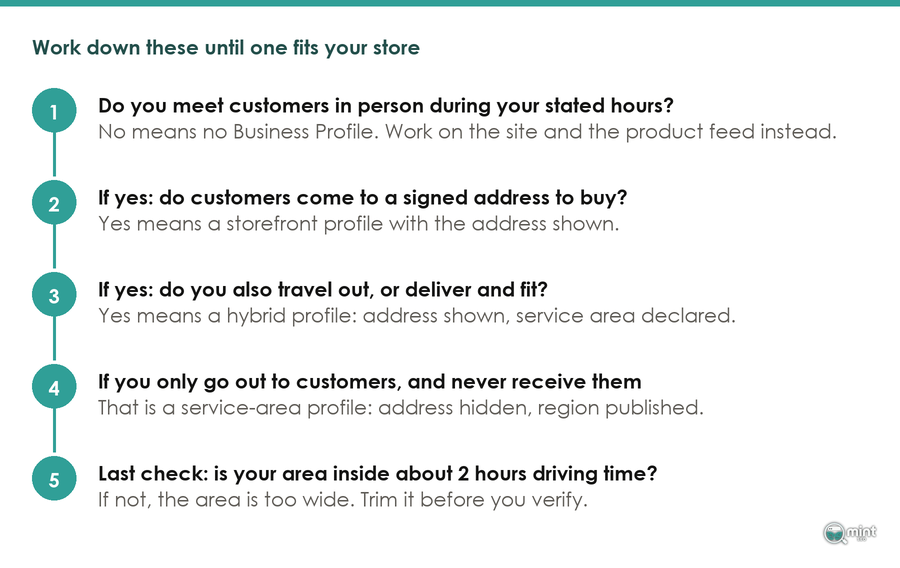
Your position in the map pack is decided on the profile. Before any of that matters, work out which of three branches your store sits in.
The One Sentence That Decides Eligibility
That qualifying test asks how you trade, so the size of your catalogue counts for nothing here. A store that only picks and ships never meets it.
Let customers collect their orders and you meet it, and so does a trade counter that opens two afternoons a week. Turnover is irrelevant here.
Renting an address does not get you past it either. Colan Nielsen of Sterling Sky puts the limit plainly: “Service-area businesses can’t have a Google Business Profile virtual office address unless that office is staffed during regular business hours”, he writes in his guidelines summary.
Three Situations And Only One Is A Shopfront
Branch one is a storefront that receives customers at a signed address. Branch two is the hybrid, which trades from an address and travels out from it as well.
Branch three is the service-area business, and most stores running a warehouse belong there. Colan Nielsen of Sterling Sky, a Google product expert since 2010, sets out the boundary: “The boundaries of your profile’s overall service area shouldn’t extend farther than about 2 hours of driving time from where your business is based”, on his guidelines summary.
Nationwide delivery is therefore too wide to be a service area, and listing more towns will not change that. On that branch the address is hidden and the region is published instead.
Picking The Wrong Branch Is What Gets You Suspended
A wrong branch makes verification expensive, because the test you then fail was written for somebody else. An r/SEO thread on current verification collects what that costs in practice.
Google “Declined his video for the THIRD time because it said not signifigant storefront signage”, reported u/Sad_Seakelp, on a business with no shopfront to sign.
Shared addresses fail in a worse way. u/Repulsive-Type1102 described an office in a complex that also rents virtual offices. “Never got it approved and it’s currently showing suspended”, they wrote.
Neither reader did anything dishonest. Both picked the wrong branch. Getting reinstated takes weeks, which is why this decision comes before anything is submitted.
The Four Settings That Decide Your Local Ranking
Once you are in, the weight sits on your settings. Whitespark’s 2026 Local Search Ranking Factors report scores the top five like this:
Darren Shaw builds that ranking factors report on a method worth knowing. 47 of the best and the brightest local search experts are invited to complete a comprehensive 2-hour survey, weighing and scoring 187 factors. It was published on 6th November 2025.
Your trading hours move your position in the results. A store that closes at four while its profile says six gets downgraded at half past four, every day, on the searches that matter most.
Reviews Have A Shelf Life Now
One factor outside that table moved further than anything in it. Review recency moved into the top five local ranking factors in the 2026 survey, having sat at number 20 in the 2023 edition.
That climb is not a ranking quirk, because buyers moved the same way over the same period. BrightLocal’s Local Consumer Review Survey 2026 ran with 1,002 US adult consumers and reported that “31% of consumers now require a rating of 4.5 stars or better” against 17% a year earlier, with 74% prioritising reviews written in the last three months.
Read those two numbers together and the job changes shape. A profile holding forty reviews with none since spring is losing on the ranking side and on the buying side at the same time.
The Product Surfaces A Shop Gets And A Plumber Does Not
Everything above applies to a dentist as much as to you. What follows is the part of local SEO for ecommerce that only a retailer gets, because your local asset is stock sitting in a building.
Free Local Listings And The Gate On Them
Google runs a separate free surface for products held locally, and most stores have never switched it on. It puts what is on your shelves in front of people near the shelves.
Its reach is wider than most merchants assume. Free local product listings run in 47 countries as of 30th June 2026, according to Google’s local listings documentation.
That reach comes with the same gate you met earlier. Google’s condition reads “You must have a local brick and mortar business location where customers can physically visit, view, and purchase the desired item”. Settle the branch once and both surfaces follow from it.
Pickup And The Date In Your Diary
Pickup lets a nearby shopper reserve or collect what you have in stock, and it now carries a deadline. Google announced on 28th April 2026 that two product attributes become mandatory for in-store products.
Luis Rijo reported the detail for PPC Land: pickup cost and minimum order value are required for the UK, Switzerland and the EEA from 30th September 2026, and “Products that do not comply may be disapproved”.
Feed work with a date on it belongs in a plan. Where it sits against your other channels is covered in our piece on sales channel choices.
When A Location Page Earns Its Place
“Create location-specific landing pages” is the most repeated instruction in this field. Not one of the six ranking pages says how many, or when to stop.
The Stopping Rule For A Location Page
An agency SEO posted what happened when they followed it without a rule. They had built “About 40 pages within a 50-100 mile radius” around one real office, and after sixteen months, “most of these pages have single-digit clicks”, they wrote in their thread. Every one of the forty sat within a hundred miles of a single address.
What made their decision hard was that the pages looked like they were working. Incognito searches put them third or fourth across those towns. Joy Hawkins is a verified local search professional on r/SEO and she cut through it in a reply.
“Rankings mean nothing if the terms are never searched”, she wrote. She added that impressions mislead because so much of them are bots or rank trackers rather than humans searching. Ranking for a term nobody types returns impressions and no orders.
Her point is the rule you were looking for. Build a page for a place you trade from, and treat a town you only deliver to as a delivery run.
What Your Store Locator Page Is Missing
Before building anything new, look at the store page you own. We crawled thirty retailers that sell online and also trade from physical shops on 10th August 2026, following the store-finder link from each homepage and reading the markup behind it.
Of the twenty store-finder pages we reached on 10th August 2026, none carried LocalBusiness or Store structured data. Thirteen of them live inside a map widget or a search box, so there is no page for Google to rank and nowhere for markup to sit.
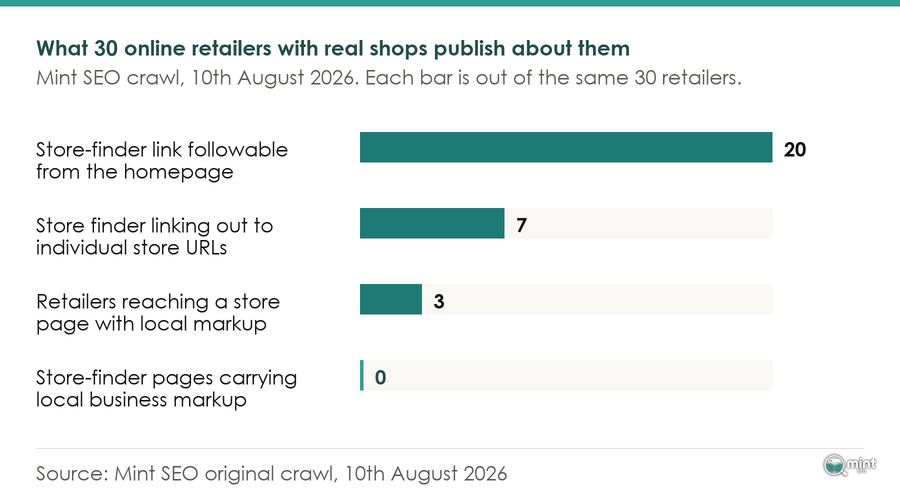
Thirteen missing store URLs matter because markup assumes a page exists. The LocalBusiness type wants a name and a postal address as a minimum, with opening hours and coordinates on top. None of that has anywhere to go inside a search box.
Three retailers in thirty got there. Represent’s London store page carries LocalBusiness structured data with the postal address, the opening hours and the geo coordinates in the same block. That was the only complete example in the sample.
Loaf gives every showroom its own URL and uses FurnitureStore markup with an address and coordinates, though it omits hours. Vuori does much the same with ClothingStore on a per-store path.
What those three share is the URL, and the markup follows it. Give each shop a crawlable page first and the rest is a template change, which usually sits in the same queue as your other technical fixes.
Want This Set Up Properly On Your Store
Almost every expensive mistake in local SEO for ecommerce traces back to the branch decision at the top of this article. Arguing a suspension back takes weeks. Unpicking forty dead location pages takes a quarter.
Branch, feed eligibility and store-page markup are one connected job on a store, and I would rather you got it right the first time. Bring the three questions to a free 30-minute consultation and I will answer them while we are on the call.
Have the store admin open when we speak. Half an hour is enough to settle which branch you are in, and to check each shop has a URL Google can reach. Book your call.
What A Local Citation Is Worth Now (And Where Citations Still Pay)
Four of the six ranking pages tell you to build local citations. None says what one is worth, and the answer moved.
The Map Pack Stopped Paying For Citations
Citation signals are now the smallest weighted group in the 2026 local pack survey. They sit below the profile settings and below the address, and they have drifted down between editions.
Buying directory submissions to move map pack position means buying the weakest factor on the board. Worth knowing before the renewal lands.
Where US Consumers Say They Look For A Local Shop
Those same listings started paying somewhere else entirely. Whitespark’s report notes that “3 of the top 5 AI Search visibility factors are citation factors”, which is a different scoreboard from the one they were sold against.
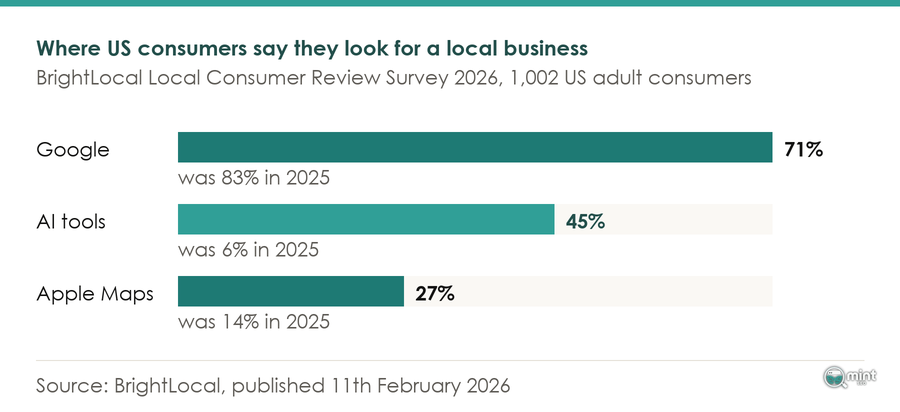
Shoppers got to that scoreboard first. In the same BrightLocal survey the share of consumers using AI tools to find local businesses rose from 6% in 2025 to 45% in 2026. For a shop that means your directory entry is read by a summariser before a buyer ever opens a map.
The surface is moving too. On 27th May 2026 a practitioner reported that “the local map pack is now being replaced with an AI overview” for legal searches, and that it “still follows the local map pack ranking signals”, in this thread.
Another reader there noted the swap is showing on specific queries only. Treat it as early.
Consistency in your name, address and phone number now feeds the systems that answer questions. We cover that shift in our piece on answer engine work.
Treat this as queue work, because local SEO for ecommerce competes for the same hours as everything else on a store. Our guide to which SEO job to do first puts it in the queue.
Your local visitors land on a category page next, and those pages have rules of their own. We set them out in our notes on category page copy.

About the author
John Butterworth
John Butterworth is the founder of Mint SEO, a Manchester ecommerce SEO agency he started in 2024. He has 11 years in SEO and digital marketing, previously running SEO departments for market-leading brands and several agencies. He specialises in Shopify and ecommerce SEO, and his work has ranked over 100 websites and driven more than 3 million organic visits. He speaks at industry events including the SEO Mastery Summit.
Connect on LinkedIn →