Book a free consultation

Knowledge Hub

What Eleven Published Ecommerce Migrations And 892 Tracked Moves Show About Organic Traffic

By John Butterworth · August 6, 2026

Every ecommerce migration case study you can find on Google ends well, whether it is Inflow's Simms Fishing write-up or Shopify's Great Little Trading Company page. That is the first thing worth noticing about them, and the reason I sat down and read eleven in a row.

Your store is moving platform, or it moved six weeks ago and organic search is sliding. You want to know what happens to the revenue that traffic was bringing in, how long the dip lasts, and whether what you are watching is normal.

My name is John Butterworth and Mint SEO is my agency, in Manchester. Store owners keep sending me these pages, usually a deck with a headline percentage on the front, and they want to know whether that number means anything for their own store. Answering that question is a standing part of the week here, and has been across 11+ years and 3M+ organic sessions.

The published record and the measured record disagree about all three, and this article sets out where your expectations should sit.

Eleven Published Ecommerce Migrations And What Each One Reports

On 6th August 2026 I searched the phrase "ecommerce migration case study", then two platform variants of it, and fetched every ranking page presenting a specific client move, from Scandiweb's Kouboo write-up down to a portfolio entry with no numbers in it. 11 pages qualified, and I read all 11 in full.

Agency and clientMoveReported resultMigration dated
Inflow — Simms FishingMagento to Shopify126% more organic traffic year on yearNo
Eastside Co — global brand, unnamedMagento to Shopify22,700 more keywords, 139,000 more monthly sessionsNo
Scandiweb — KoubooMagento 2 to Shopify72% more organic traffic, 107% more revenueDec 2020
RichClicks — Arti and MestieriWordPress to ShopifyLCP 4.5s to 1.9s, INP 170ms to 77msOct 2024
LitExtension — food packaging brand, unnamedWooCommerce to ShopifyMigration completed in two monthsOct 2023
Romexsoft — CorporateGiftOn-premises to AWSUp to 40% lower infrastructure costNo
Valoriz — multi-brand retailer, unnamedSeven brands to cloud100% on time, 30% lower ownership costNo
SEO F1RST — client unnamedShopify to WordPress19.37% more organic traffic in six weeksNo
Rambabu Thapa — Fitness SuperstoreVolusion to ShopifySearch Console clicks fell from ~1,200 to 500May 2025
MAKDigital — SkateAmericaShopify to BigCommerceNo performance result statedDec 2023
Shopify — Great Little Trading CompanyTo Shopify Plus6% conversion lift, 10% more ordersNo
11 published migration write-ups, read in full on 6th August 2026

Nine of the eleven report a gain. One reports a fall, and one reports no performance result at all.

Read down that third column and you would conclude that moving platform is close to risk-free. I went looking for a bigger sample.

Magento To Shopify, The Most Documented Move

Magento to Shopify carries more published evidence than any other route, and every account of it reports a gain. Of the eleven, Inflow's write-up of the Simms Fishing migration is the most cited. It says the brand reported a 126% increase in organic traffic YOY, and credits the new category pages and content built during the move for the gain.

A bigger absolute figure comes from Eastside Co, working for a global brand it does not name: the site secured rankings for more than 22,000 additional keywords, on top of an 139,000 increase in monthly organic sessions.

Read that second one twice. A gain of 139,000 sessions is a delta with no starting point attached. You cannot turn it into a percentage, and you cannot tell whether it doubled that store or nudged it by a tenth.

A twelfth result sits in Shopify's own migration guide, on a page that is not a write-up of one engagement, so it stays outside the 11 I scored: within three months of migrating to Shopify Plus, Kimbo saw an 87% increase in organic qualified leads and a 5.7% boost in organic traffic. That 5.7% is the most believable organic figure anywhere in this article, and the smallest one in it.

Modest numbers like that one are usually the checkable ones, and it is worth holding the bigger figures to the same test.

Recovery Cases, Where The Drop Is The Product

Three of the eleven show a store losing traffic, and in two of those three the agency was called in once the damage was already done. An agency publishes the story that flatters it.

Run the migration and the flattering story is that nothing went wrong. Arrive afterwards and the flattering story is how far the site had fallen before you got there.

Clearest of the three is Rambabu Thapa's write-up of Fitness Superstore. In May 2025, the site moved from Volusion to the Shopify platform, and organic clicks and impressions dropped sharply, with the average GSC clicks dropping from approximately 1,200 to 500.

One recovery specialist, SEO F1RST, reports it the same way: restoring and growing WooCom traffic by 19.37% in one and a half months after a Shopify to WordPress move.

Those three are the only place in the published record where you can watch a move go wrong. Nobody publishes their own failure. The losses only surface once somebody else is being paid to clean them up.

Case Studies That Report No Search Outcome At All

Six of the eleven report no organic search figure whatsoever. Sharpest of them is that Great Little Trading Company page, because search is named as the reason the project mattered: more than 100,000 404 errors, duplicate pages, and loading speed problems were hurting sales from search traffic.

Three months on, that same page reports a 6% conversion rate lift and a 10% increase in overall orders.

Session duration and sitewide bounce rate tend to move first after a rebuild, and both are reported as improved.

Not one organic traffic number appears anywhere in it, on a page whose own problem statement was search.

That same gap shows up in miniature at RichClicks. Its Arti and Mestieri move is the ecommerce migration case study where the split between engineering and business reporting is easiest to see. Its technical section is precise and paired, with Largest Contentful Paint reduced from an average of 4.5 seconds to 1.9 seconds.

Its results section says users are spending more time on the site, with an increase in conversion rates, and revenue has grown. Precise on the engineering, adjectives on the money.

Timing explains most of that. Conversion rate and bounce rate move within weeks of a rebuild while organic search takes months to settle.

A write-up published a quarter after go-live therefore has business metrics to show and no search result yet. That is a publishing-schedule problem. It still leaves you without the number you came for.

What 892 Tracked Migrations Show That No Case Study Does

Eleven write-ups cannot tell you whether your own move will go well, because eleven is not a sample and not one of them was picked at random. For that you need somebody who tracked migrations regardless of how they turned out.

523 Days On Average, 19 Days At Best

Somebody did, and the numbers come from Dan Taylor, an agency partner and consultancy head at 10 Spurs with more than twelve years in-house and in agencies. He expanded the dataset to 892 domains with help from other SEO professionals, then measured how long each new domain took to reach the old one's organic traffic level.

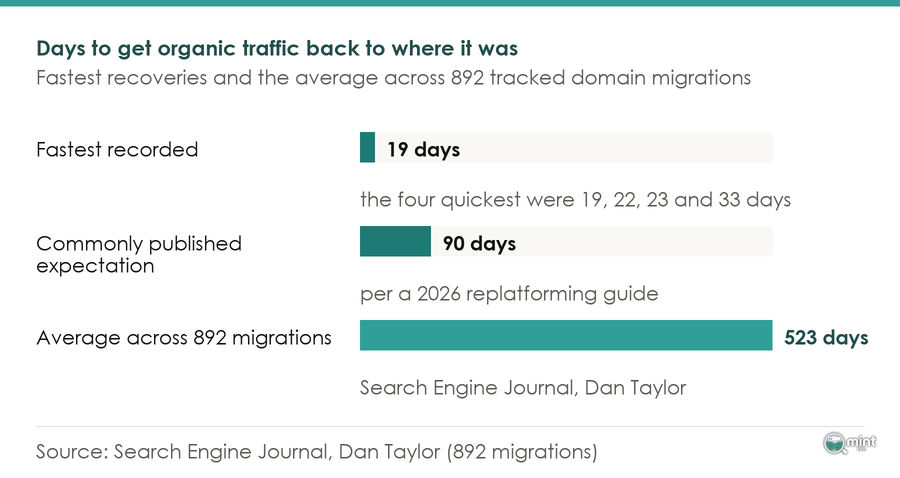
His headline runs to one line: on average, it took 523 days for Domain B to show the same level of organic traffic as Domain A.

Seventeen months, set against a published record in which nine migrations out of eleven simply went well.

What the field publishes against what 892 tracked migrations measured.

That spread is enormous, and its fast end is real enough to plan around.

Its shortest times recorded were 19, 22, 23, and 33 days. Four domains in that sample were back to their previous organic level inside five weeks, so the ceiling on a well-run move is high even though the average sits far above it.

Kouboo is the documented version of that fast end, and Scandiweb's account of the migration records that the website has experienced a mere 8-9% organic decrease, which fully recovered during the first month.

Treat that as the good end of a very wide range, and plan against the middle.

Seventeen Percent Never Get Back To Level

One figure in that Search Engine Journal dataset goes unmentioned everywhere else: 17% of domain migrations in the sample didn't see organic traffic return to the same levels after 1,000 days.

Roughly one migration in six had still not come back inside that window, which is a different problem from a slow recovery. Past a point the site is no longer climbing back; it is competing as a new domain stripped of its history.

Against that sits something far tidier than any ecommerce migration case study lets on. Presta publishes a 2026 WooCommerce replatforming decision guide aimed at mid-market brands, and it states plainly that organic traffic should recover to pre-migration levels within 90 days, and that 90-day figure is the one store owners quote at me when they tell me not to worry.

Why The Fall Usually Arrives Weeks After Launch Week

That fall comes late, which catches people out more than its depth does. Nothing gets re-scored before it has been recrawled, and on a medium-sized store that takes weeks, so a quiet launch week tells you very little.

You can watch that happen in real time. In March 2026 a store owner posting to r/bigseo as u/AideNo9466 described a Wix to WordPress move four weeks earlier:

"Before the migration we were getting around 120–150 daily organic visits consistently."

Then, four weeks after a launch they describe as looking fine at first, the same thread reports where it had landed:

"Right now we're getting around 40–50 visits per day."

Answering them on that thread, u/VRTCLS names the mechanism behind it:

"Google recrawled the new site, noticed structural differences, and is re-scoring everything."

Keep watching for two months at least. A clean first fortnight is not evidence the move worked, and a fall in week four is not evidence it failed.

Why Google Keeps Serving Your Old URLs

This is the section that changes what you do on Monday. It rests on guidance Google published in July 2026 that contradicts almost every instinct a worried store owner has.

The order things happen in after a move, and what Google is doing at each stage.

One-To-One Redirects, And What That Phrase Demands

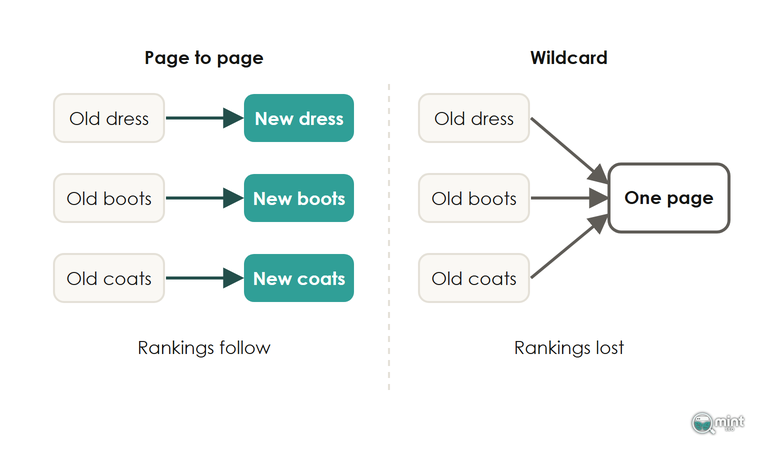
A redirect plan is one-to-one only when every indexed URL resolves in a single hop to its specific replacement. Most plans described that way are not, and precision is what they lack.

Writing on the same thread, u/VRTCLS puts it more plainly than I would:

"'didn't drastically' and '1:1 mapped with 301s' are very different things. Even small differences like trailing slashes, capitalization, or parameter handling can break redirect chains."

Scale is the other half of it. That Great Little Trading Company project moved 11.1M+ data points in 16 weeks, and a mapping exercise that size is not something anybody eyeballs on a Friday afternoon.

Crawl your old sitemap and confirm every URL returns a single 301 to the right destination. Our website migration SEO checklist sets that work out in the order it needs doing.

The crawl and indexation side around it is covered in our guide to ecommerce site health.

180 Days With No Finish Line

Google never signals that a move is finished. On Google's own help forum, the Search Central Community, a Diamond Product Expert posting as barryhunter set this out on 22nd July 2026. That post states that Google does not have a formal end state or completion badge for site moves, and that the Change of Address request simply remains active for 180 days, after which it naturally expires.

Old URLs lingering in the results is expected behaviour: it is entirely normal for your old URLs to remain indexed for extended periods, sometimes for years.

Google keeps serving the established URL until the historical signals have moved across. Watching that in Search Console week after week is unnerving, and it is not a problem to solve.

One Fix That Turns A Dip Into A Permanent Loss

Now the mistake that does the real damage, and the same guidance is blunt about it: do not attempt to sabotage your old URLs to force Google toward the new ones.

Blocking or 404ing the old site severs the redirect, and that redirect is the only route by which links, trust and history reach the new location.

Removing the old URLs places you at severe risk of leaving neither domain functionally indexed, resulting in an abrupt drop in traffic.

A stalled move with clean technicals is the case where owners reach for that switch. Posting to r/bigseo in August 2025, u/Smart_Cheesecake described a domain move that had lost almost everything:

"Overall traffic dropped from 1.1M to 70K for non-branded clicks… No issue with the technicals. We brought in many experts to examine it. We analysed 100s of GB of log file, but nothing was found."

When there is nothing to fix, the urge to do something is what costs you the site. Leave it alone and keep the redirects crawlable.

Content Launched During A Move Indexes Like A New Site

One more thing worth separating out. Pages created during the migration inherit nothing, because no redirect points at them, and the July 2026 guidance notes that where the new domain hasn't established its own trust and authority yet, pages unique to the new domain often sit as crawled and not indexed.

How invisible that is in the published record shows in LitExtension's food packaging migration. Its write-up opens by saying that in October 2023, the LitExtension team just finished a project working with a long-standing client in the food packaging industry, and the client is never named beyond that, so nobody can check what those new pages did.

Launch new content after the move has settled. Otherwise you cannot tell which result belongs to which change, and neither can anyone you hire to work it out.

Why Stores Are Moving Right Now

Adobe Commerce Dates That Forced The Decision

Your inbox is full of migration quotes this month because of two dates. According to Adobe's own lifecycle policy, standard support for Adobe Commerce 2.4.6 ends on 11th August 2026, and extended support for 2.4.5 ends the following day.

An unsupported commerce platform stops receiving security patches, which turns a technical preference into a payments and compliance problem.

That deadline put this wave on the calendar, and it has little to do with which platform is better for search.

Moving By Choice Is A Different Project To Moving By Deadline

A deadline changes which corners get cut, and it cuts the same ones every time. On the numbers, Elogic's 2026 replatforming cost index locates the overrun precisely: 83% of migrations exceed budget or timeline at the data step.

Redirect mapping and data validation both scale with catalogue size, and neither compresses by spending more. So a squeezed timeline takes its cut out of the exact work that protects your rankings.

Its explanation is the schedule around that step. Teams allocate one to two weeks for what turns out to be a four to eight week exercise, so the overrun is booked in before anybody starts.

On budget, Elogic's cost index puts a mid-market replatform at $150,000 to $300,000 all-in, spread over five to ten months of work. It is a capital project. Evidence matters more before that spend than after it.

Stores in this position have plenty of company. For scale, Virto Commerce cites the eCommerce Platforms Report putting 61% of B2B ecommerce sellers on course to migrate within the next 12 months.

If your date is fixed, protect the URL mapping first and let everything else shrink around it. A theme refresh can ship in September. A broken redirect map cannot be un-shipped.

How To Read A Migration Case Study Before You Believe It

Reading eleven of these back to back taught me more about how they are written than about migrations. So I scored all 11 on five disclosures, every one of which you can check by reading the page.

Five Disclosures, Scored Across All Eleven

DisclosureHow many of the eleven
Names the client7 of 11
Dates the migration5 of 11
Gives an absolute before number3 of 11
Discloses any post-launch drop3 of 11
Names the measurement tool2 of 11
All five of the above1 of 11
What 11 published migration write-ups disclose, scored on 6th August 2026
How the eleven scored, disclosure by disclosure.

One ecommerce migration case study in eleven carries all five, and it is the Fitness Superstore write-up: it names the store, dates the move to May 2025, gives Search Console clicks before and after, describes the fall and says which tool produced the numbers.

Three of the eleven give an absolute before number, which leaves eight whose results you cannot anchor to anything. Six report no organic search outcome at all, on pages ranking for migration queries.

Two name the tool their numbers came from. Everything else is a figure with no stated provenance. That is marketing, and it wants reading as such.

Ask For The Baseline, The Date, The Dip And The Tool

Useful questions here are the ones the published record keeps failing to answer, and all four fit inside one meeting.

  • Ask for the traffic before the move, given in sessions or clicks.
  • Ask which month the site went live, and what the eight weeks after it looked like.
  • Ask how far it fell before it recovered, and how long that took.
  • Ask which tool the numbers came from, and whether you can see the property.

That first one matters more than it sounds. On its recovery engagement, SEO F1RST reports cart additions rising by +180%, from 5 to 14, over six weeks of work.

Publishing that base of five is what lets you judge the number instead of being impressed by it. Nine extra carts on a store that size may well be noise, and only the baseline tells you which.

An agency that answers all four in the room is measuring its migrations properly. One that cannot has told you something useful either way.

You can hold their answers against what a documented SEO result ought to look like.

Planning A Move And Want The Search Side Handled

By the time a migration date is in the diary, the decision that sets your search outcome has usually already been made, and written down in a redirect map. Almost nobody outside the build team reads that document before it ships.

Reading that map is what we get hired for. The crawl and indexation work that follows it comes with that, along with site architecture and Core Web Vitals. The same discipline on a Shopify store is what put organic search behind BedShelfie's sales, which reached 256% more sales from Google Search over a 12-week programme.

If your store is moving in the next few months, get a second pair of eyes on the URL mapping before it is signed off. Book a free 30-minute consultation and we will go through it with you.

John Butterworth

About the author

John Butterworth

John Butterworth is the founder of Mint SEO, a Manchester ecommerce SEO agency he started in 2024. He has 11 years in SEO and digital marketing, previously running SEO departments for market-leading brands and several agencies. He specialises in Shopify and ecommerce SEO, and his work has ranked over 100 websites and driven more than 3 million organic visits. He speaks at industry events including the SEO Mastery Summit.

Connect on LinkedIn →

Leave a Comment