
Knowledge Hub
Seven Store Migrations That Kept Or Lost Their Traffic (And Why)
By John Butterworth · September 30, 2026
Your store is changing platform this year, or it has already changed and organic traffic hasn't come back since launch day. This ecommerce migration case study round-up puts seven real moves side by side: three that kept or regained their search visibility and four that lost traffic or sales. Adobe ended standard support for Magento 2.4.6 on 11th August 2026. If your store still runs that version, a replatforming decision is due.
Across those seven, every move that lost traffic changed more than the addresses its pages lived at. Woo moved to a brand-new domain and Topshop sent every old address to one page. LoveCrafts rebuilt its site with new copy, and Marks & Spencer made every customer register again.
A move that changes only where the pages live dips for a few weeks and comes back.
When a store owner planning a replatform asks me whether their rankings will survive the migration, I ask to see the redirect map before I answer. I'm John Butterworth, the Manchester-based founder of Mint SEO. We handle platform moves through our ecommerce SEO services for replatforming stores, from the first map to the weeks after launch.
The Moves That Lost Traffic Changed More Than The Platform
Lay these seven ecommerce store migrations out in one table and the dividing line sits in the column headed "what else changed". Currys, RAC and Pole Design kept or won back their organic traffic by moving the store and nothing more. LoveCrafts, Topshop, Woo and Marks & Spencer each paid in traffic or sales for one extra launch-day change.
LoveCrafts Lost The Visibility Currys And RAC Kept
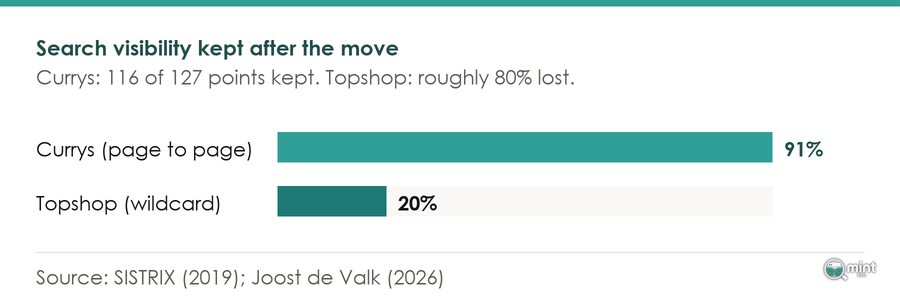
Currys and RAC came through their site merges with their rankings intact, while LoveCrafts lost most of two sites. The difference was whether each old page had a matching page to land on.
Those three were tracked on one scale in August 2019 by a search visibility index. Currys folded pcworld.co.uk into currys.co.uk and sent each PC World address to a Currys page that already existed. Between them the two domains held 127 visibility points before the move, and currys.co.uk reached 116 afterwards.
RAC moved its car sales site at raccars.co.uk into a folder on rac.co.uk with the same structure and content, and kept most of its visibility.
LoveCrafts took the other route. It redirected loveknitting.com and lovecrochet.com, two craft stores that had grown steadily since 2013, into a new site at lovecrafts.com with its own structure and largely rewritten content. Most of both sites' visibility went.
A 301 redirect only carries a page's history if the page on the other end is recognisably the same page. LoveCrafts pointed each old knitting page at one in a new structure with new copy, so Google judged every one of them from scratch.
That rule holds just as well when a single store changes platform.
Pole Design is a UK curtain pole store that moved to Shopify with every URL changing. Its owner names one-to-one redirects as the most important job in the whole move.
Five weeks after go-live the store's traffic sat 59% below its late-January peak, as its owner's own case study of the move shows. It climbed back over the following months and was 118% up on November 2023 by November 2024.
A drop that steep in the first month is normal, because every address changes at once. Plan your launch for a quiet trading month, well ahead of your peak.
Once the store is live, hold on to the old URL list. Work through it page by page, and the pages that haven't come back will usually be the ones whose redirect pointed at the wrong replacement.
If a page is still down after that, find the date its traffic dropped and what changed on the site that day. Check the technical side before you blame an algorithm update.
Don't expect the gains until the next core update: that's when most of the sites I work on see them. Launch week only tells you whether anything broke.
Our site migration SEO checklist covers the practical steps for the move itself, including how to read your numbers in the weeks after launch. For the data a platform will refuse to import, see what an ecommerce migration moves and what it leaves behind.
If your move merges two stores, map each old product and category page to its closest live page on the site you're keeping. A crawl of the old site gives you the list of old URLs to map from. Launch a redesign or rewritten copy later as its own release. If traffic falls after that, you'll know which change caused it.
A Wildcard Redirect Cost Topshop Around 80% Of Its Visibility
A wildcard redirect sends every old address to a single destination, which throws away the page-level match a redirect exists to carry. When ASOS folded topshop.com into asos.com, it used a wildcard in place of page-by-page redirects across two decades of pages, and topshop.com's search visibility fell by roughly 80%. It's the largest measured loss of any ecommerce migration case study in this set.
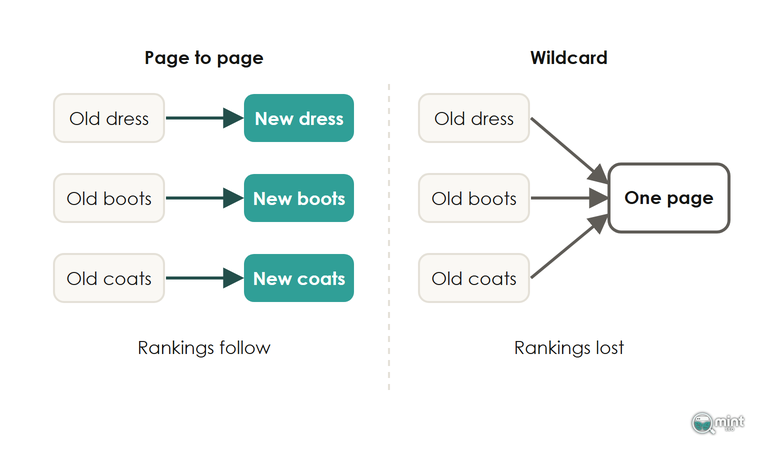
Two decades of pages is the size of catalogue that tempts a wildcard, because mapping them one by one looks like weeks of work. Buy the time anyway. Build the list from the old sitemap and a crawl, then give every old address its own match. Discontinued products and merged categories need a person to decide where they go.
Woo Moved To A New Domain And Moved Back Within Six Months
Keep your domain when you change platform, since a new domain makes Google re-evaluate the whole site from an address with no history.
Woo, the company behind the WordPress store plugin, moved its site to woo.com in October 2023 as part of a rebrand and moved back to woocommerce.com on 9th April 2024. In its announcement of the reversal, Woo wrote that the new domain made its plugin harder to find in Google searches, and that Google's March 2024 update made it worse. It's the one ecommerce migration case study here written by the company itself.
If the domain has to change as well, change it on its own once the platform move has settled, and move the www and non-www versions together.
If you're still choosing the platform, treat the domain as a separate decision from it.
M&S Changed Platform, Design And Logins At Once And Lost 8.1% Of Online Sales
Judge a migration on the orders it keeps, and the quickest way to lose orders is to put a new step between a returning customer and the checkout.
Marks & Spencer's online sales fell 8.1% in the 13 weeks to 28th June 2014, a drop the retailer put down to its new website, as reported at the time. Its new website took three years to build and replaced Amazon's web platform. Every customer had to register again.
On Shopify that reset can't be avoided, since customer passwords don't transfer from the old platform. Email every account holder before launch day and tell them why a new password is coming.
Get Your Redirect Map Checked Before You Switch
Four of these seven moves turned on one document: the redirect map, meaning the list of old URLs and the page each one should land on. Our technical SEO service covers migrations, and that list is where we start.
We check it against every URL your current store has earned traffic or links on. Then we confirm titles and copy arrive intact on the new platform, and read the first weeks after launch against your baseline.
If your store has already moved and the numbers haven't recovered, get a free SEO audit to see which pages lost their rankings and where they went. If the move's still ahead of you, book the check in before your launch date is fixed.

About the author
John Butterworth
John Butterworth is the founder of Mint SEO, a Manchester ecommerce SEO agency he started in 2024. He has 11 years in SEO and digital marketing, previously running SEO departments for market-leading brands and several agencies. He specialises in Shopify and ecommerce SEO, and his work has ranked over 100 websites and driven more than 3 million organic visits. He speaks at industry events including the SEO Mastery Summit.
Connect on LinkedIn →