
Knowledge Hub
The Black Friday Jobs You Cannot Start In November
By John Butterworth · August 13, 2026
Black Friday 2026 lands on Friday 27th November, with Cyber Monday on the 30th. From today that's 106 days.
Timing decides more than most Black Friday advice admits. I am John Butterworth, and the Black Friday audits we run from my Manchester agency have turned up the same problem for eleven years.
The August brief stores hand me is almost always a list of tactics with no dates against it.
Every ranking page for this query is a tip list of between ten and twenty-nine items, and the fourteen we measured score 0.87 mean pairwise cosine similarity against each other. It is one article written fourteen times.
Not one of the fourteen ranking pages we measured contains a single original measurement of a real store.
A tip list ordered by nothing forces the reader to do the prioritising. I have done the ordering here instead, sorted by how long each job's lead time runs, because a tip you can't finish in time is a tip you can't use.
The Black Friday Jobs Worth Doing In August, Ordered By Deadline
Here is the whole answer before the reasoning. Six jobs, ordered by the last sensible moment to start each one.
There are 106 days between today and the sale, which is longer than the lead time on almost every tip the ranking pages give and shorter than the time a new URL needs to rank.
I've ranked these jobs by how early each has to start, which you can check on a calendar.
Settle The One URL Your Sale Will Live At
When a store hands me a Black Friday brief in August, my first question is which URL the sale will live at. Everything else here stays editable through November, while this one decision has already stopped being editable by then.
The reason is mechanical. A page accumulates rankings and links only while it exists, so its clock starts the day it goes live.
The cheapest hour of Black Friday work I can sell anyone is the hour spent in August deciding which single URL the campaign will point at in November.
Daniel Cartland, Head of Strategy at the ecommerce SEO agency NOVOS, puts the requirement in one line in his holiday SEO guide for Lumar. He writes that the URL "should not be dated, as the same URL should be re-used every year", so it keeps the value it built the year before.
Pick something like `/collections/black-friday`. Avoid `/collections/black-friday-2026`.
Fix Whatever Last Year's Sale Page Became
The first thing I check on a store that wants Black Friday work is whether last year's sale page still exists, because if it 404s we are starting the ranking from nothing with three months to go.
Find out what last year's page currently does before you create anything new. On most stores it does nothing at all, which I'll come to in a moment.
It takes one request to find out. Type your own Black Friday URL into a browser and watch what happens: a page loads, an error appears, or you land somewhere else entirely.
Which of the three you get decides whether the job in front of you is a repair or a rebuild. Those are very different amounts of work, and only one of them fits comfortably into 106 days.
Commit The Stock Before The Lead Times Decide For You
Stock carries the longest external lead time here. It's also the one deadline you genuinely can't move.
A merchant on the Shopify Merchants Community described the failure exactly: "we got caught short on some stock which has a 6 week lead time."
Six weeks from a September order lands in late October. Work backwards from that date. If you sell print on demand or dropship, your constraint runs shorter, so move the date and still do the job.
Decide The Offer, Then Build The Discount In The Admin
The offer belongs in September because choosing it is the quick part and building it in the admin isn't. Discount logic behaves differently in a live cart than it looks in the admin, and only a real test order shows you the difference.
Make The Store Survive Its Busiest Hour
Speed, checkout and support capacity belong in October. That peak is short and predictable, which makes it something you can rehearse, and the four jobs it breaks into are set out later in this article.
Write The Emails Last
Putting emails last surprises people. I would rather a store spent August fixing one collection URL than writing six campaign emails, because emails can be written in November and a URL cannot start ranking in November.
Email depends on no external lead time and no accumulated authority. Starting there feels productive while eating the weeks the other five jobs need.
Cartland puts the finish line where the demand is: "Looking at the term “Black Friday” in Google Trends, we can see that searches for that term pick up about a month before the event itself." That's your real deadline for anything meant to rank. Everything on the wider ecommerce SEO plan works the same way.
We Asked 97 Live Stores For Their Black Friday Collection Page
Job one deserves evidence, so I went and measured it.
Here is exactly what we did. On 12th August 2026 we crawled 111 live storefronts, drawn from our own seed list of UK and US brands and screened against the query "black friday ecommerce tips".
The fourteen ranking articles I compared earlier came from that same day's search for the query and its close variants, fetched in full.
Of the 111 storefronts in the seed list, 14 could not be reached at all and were excluded from the count.
Those 97 stores span clothing, homeware, food and outdoor kit, on Shopify, Magento and custom platforms.
The Four Paths We Asked For
The four URLs tested on every store were the ones a shopper or an old link would guess:
- `/collections/black-friday`
- `/pages/black-friday`
- `/collections/black-friday-sale`
- `/collections/cyber-monday`
We followed every redirect through to wherever it finished.
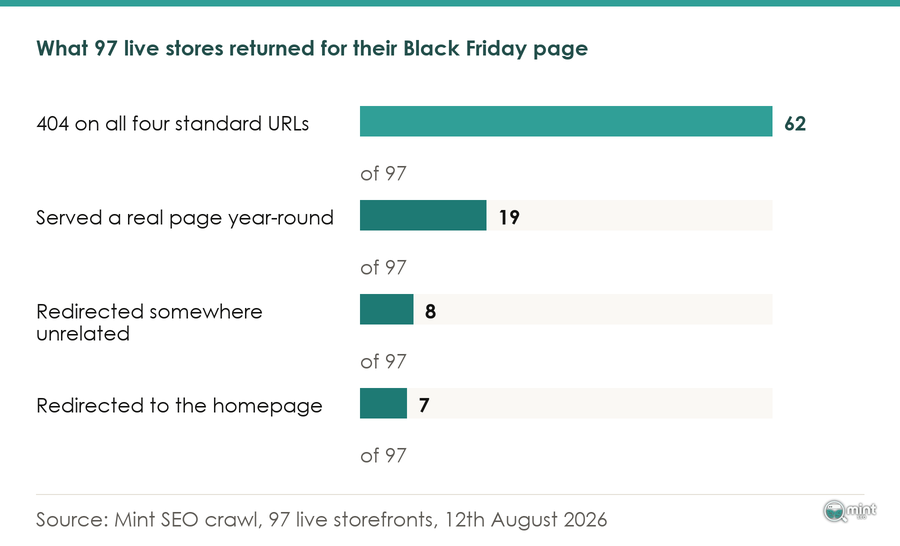
**62 of the 97 storefronts returned a 404 on all four of the standard Black Friday URLs.**
What Came Back
That failure rate held across the whole test. 318 of the 388 individual URL requests came back 404.
A minority had kept the page where anyone would look for it. 19 of the 97 storefronts served a real Black Friday page year-round, in the second week of August, and those are the stores that will start November with a page Google already knows.
Read that number against the sitemap count further down and the gap is the finding. Far more stores publish a Black Friday page than serve one at a path a shopper or an old link would try.
A smaller group had pointed the path somewhere else instead. 7 of the 97 stores redirected a Black Friday URL to their homepage.
Counted per request instead of per store, the same behaviour shows up twice. Across the 388 requests, 15 landed on the homepage after a redirect and 11 were redirected to some other page that was not a Black Friday page.
Someone following an old link, a bookmark or a search result to a store's Black Friday page today mostly lands on nothing.
The Wayback Control
Whether those pages were deleted is a separate question, because a store might never have used that path. I ran a control against the Wayback Machine.
It asked whether each of the 388 URLs had been archived working during Black Friday 2024 or 2025. The archive has skipped most of these paths, so very few of them could be answered at all.
Of the 388 URLs tested, only 9 could be proven to have existed at a previous Black Friday through a Wayback Machine snapshot; of those 9, six still serve a live page, two now redirect elsewhere and one now returns 404.
Nine is far too small a sample to draw a deletion rate from, and I treat it as such. What generalises here is the direct measurement of the present state.
Only one case is proven outright. gymshark.com/pages/black-friday was archived with a 200 response at a previous Black Friday and returns 404 today.
Your Black Friday Collection Page, And Fixing The One You Already Have
Your store sits in one of three states. Each takes a different remedy, and all three aim at the same destination: one undated URL that stays live.
What Google And The Agencies Publish About Seasonal URLs
Settled guidance already covers this, and it has been public for years. In September 2021 Google's John Mueller posted what Search Engine Roundtable reported as a plain reminder: "Just a reminder that having a dedicated page for some seasonal sales events is a good idea for ecommerce sites."
Asked what to do with such a page once the sale ends, he was equally direct. "I'd keep them indexable. Worst case people will find them when there's nothing special on them, but that means they're still finding your site."
Mueller had made the underlying case three years earlier, in a recommendation Matt G. Southern wrote up for Search Engine Journal. "That one URL would collect links over a longer period of time. It would be something that people could refer to and link to in the long run."
Cartland's guide reaches the same conclusion from the agency side: "The pages created for holidays should be kept live all year round; they should not be redirected or removed to return a 404."
The advice to keep one undated Black Friday URL is unanimous across Google's own guidance and specialist agency writing, and our crawl found most stores not doing it.
If Yours Returns A 404
Recreate the page at the undated path and leave it there. Build nothing year-stamped alongside it.
Restoring the original path lets any surviving links and ranking history resolve to a real page again. It's one collection to create in your admin, and it's the highest-return hour in this whole plan.
If You Have Several Black Friday URLs At Once
Stores in this state are more common than the tidy version of the problem suggests. Take Kotn, where kotn.com serves seven live Black Friday URLs at once.
Those seven run across four different naming conventions, from `/black-friday` through `/black-friday-2024` to `/blackfriday2025`. Kotn has done what most stores do, which is create a fresh page each year and leave the old one up.
**42 of the 97 stores still listed at least one live Black Friday page in their sitemap.**
Between them those stores listed 242 such URLs.
One store shows how that accumulates. beginningboutique.com had /collections/black-friday-2026 already live in the second week of August, next to a 2025 page and a sign-up page left over from 2021, so three seasons of the same intent were competing before this year's sale had even been announced.
Some are running the years against each other. 5 of those 42 stores were carrying two or more distinct years of Black Friday URLs live at the same time.
Those year-stamps turned out to be the smaller half of the problem. Only 23 of the 242 live Black Friday URLs carried an explicit four-digit year, so most fragmentation comes from splitting by product or discount.
The Worst Case We Found
It wasn't a year problem at all. castore.com listed 25 separate Black Friday URLs in its live sitemap, twenty of them collection pages split by product type and discount level.
Nearly every store I audit has the same gap between what its marketing calendar says and what its sitemap says, and the sitemap is the one Google reads.
Because the pages already exist, the fix is a redirect map. Pick the undated URL as the survivor, then 301 the dated ones into it. Cartland recommends exactly this: "This includes 301-redirecting dated marketing materials in the months after the holiday occurs to send users to evergreen pages."
That same consolidation logic applies to any seasonal collection page your store spins up and abandons.
What The Page Says For The Other Eleven Months
Keeping a page live is different from keeping it in your March navigation. Mueller addressed that too: "That's fine. I'd take care to get them more visible ahead of time, but if you don't need them for the rest of the year, it's fine & normal to make them less prominent on your site."
Indexability and prominence are separate controls. On the stores we run retainers for, the Black Friday collection stays live and linked all year and changes what it says out of season.
Point it at end-of-line stock, or last season's clearance, or whatever you discount in the quiet months. A page with something real on it in March is easier to justify keeping than an empty one.
Deciding The Offer, And Whether Your Store Can Serve It
An offer becomes a decision once your store can deliver it. Most ranking pages spend their advice on how deep to discount. Merchants asking for help in public are stuck somewhere else entirely.
Read the Shopify Merchants Community in November and the questions turn mechanical. One merchant wrote: "I have created a bunch of discount codes preparing for Black Friday. My biggest issue is that the automatic codes only shows when the product is added in checkout."
Another asked the night before launching: "I'm starting a Black Friday sale tomorrow and the original price isn't showing, despite me putting the compare price correctly"
Both are configuration problems found too late, and both came from people who had settled the interesting question about discount depth weeks earlier. Settle serviceability first, because three checks cover most of it:
- Stock at the volume the offer implies
- The discount code stacking the way you expect
- The compare-at price rendering on a real product page
Place a test order in September and push it through to payment, because one test order answers all three.
What The Offer Actually Moves
Your offer moves average order value. Shopify reported in its BFCM results that 81 million customers bought from Shopify-powered brands over the 2025 Black Friday-Cyber Monday weekend, at an average cart price of $114.70. Shopify's own wording is 81+ million.
Bundles and spend thresholds move that figure, where a flat sitewide percentage mostly leaves it alone.
Getting The Store Ready: Speed, Checkout, Mobile And Support
Every list I read puts this near the top. I've put it last deliberately, and the reason carries the whole argument of this article.
Readiness work runs on a short lead time. A slow template or a broken checkout step or a thin support rota can all be fixed in the first fortnight of November. October therefore splits into four jobs:
- Page speed on the templates the sale will use
- A checkout tested under load
- The mobile view of both
- Support cover rostered for the peak hours
Wayfair announced a five-day "Black Friday Comes Early" event on 16th July 2026, running 23rd to 27th July with up to 80 per cent off.
If a retailer that size will put the words Black Friday on a July sale, then on your store the page carrying those words is a permanent asset that happens to get busy in November.
The peak those four jobs are sized against is worth stating plainly, and two operators publish it.
The Size Of The Peak
Shopify merchants reached $14.6 billion in sales over Black Friday-Cyber Monday weekend, a 27% increase in sales from 2024, with peak sales of $5.1 million per minute at 12:01 PM EST on Black Friday. Its investor release carries the figures.
Adobe measured the same days from the demand side in its Cyber Monday report. Consumers spent $11.8 billion online on Black Friday 2025, up 9.1% year over year, and $44.2 billion across the five days of Cyber Week. That five-day window is the busiest stretch of the retail year online.
Black Friday alone therefore carried around a quarter of the whole week's online spend, and Adobe notes its growth outpaced Cyber Monday's for the second season running. Size the store against the Friday.
That's the shape your checkout has to survive.
Do the readiness work in October, clear of the August weeks the URL needs.
I've written separately about Shopify page speed and what slows a store down. A companion piece covers the urgency tactics that earn a place on a sale page.
Getting Someone To Look At Your Black Friday Setup With You
The check at the top of this article takes a minute once you know what you're looking for. Working out which of your old Black Friday URLs should survive, and where the rest should point, repays a second opinion.
That is what the free 30-minute consultation is for. You get me on the call. We spend the time on your store: what your Black Friday pages currently return, which one is worth keeping, and where the others should redirect.
That check is the first thing I run on a new ecommerce SEO engagement, and on a retainer store I run it across every seasonal collection you have.
Deciding which of those URLs survives is the work behind the 3M organic sessions the stores we run have driven between them.
If your Black Friday page returns a 404 today, that's fixable, and August is the right month to fix it. Book your free consultation and we'll start with your sitemap.

About the author
John Butterworth
John Butterworth is the founder of Mint SEO, a Manchester ecommerce SEO agency he started in 2024. He has 11 years in SEO and digital marketing, previously running SEO departments for market-leading brands and several agencies. He specialises in Shopify and ecommerce SEO, and his work has ranked over 100 websites and driven more than 3 million organic visits. He speaks at industry events including the SEO Mastery Summit.
Connect on LinkedIn →