
Knowledge Hub
The Market Decision That Comes Before Any Hreflang Tag
By John Butterworth · August 15, 2026
You have taken a handful of orders from Germany this year. Someone has said it is time to sell abroad. Every guide to international ecommerce SEO then tells you to install hreflang, pick a URL structure and translate your product pages.
All of that advice is correct. None of it is the decision you are about to get wrong.
That expensive mistake is never the annotation. It is a store that switches on twelve countries it cannot deliver to, support or take payment in, then spends six months wondering why the traffic will not convert.
Put beside that, a broken hreflang cluster is an afternoon's work. A badly chosen market takes a year and a five-figure sum to unwind.
I'm John Butterworth, founder of Mint SEO, and I've run ecommerce SEO for 11+ years, almost all of it on Shopify stores.
A fair number of those stores sell into more than one country. They are where I first noticed how little a store's market list and its language list have to do with each other.
The crawl further down this page began as a check on how far those two counts had drifted.
So here is international ecommerce SEO in the order that costs you least: which countries deserve a version of your store, and what each one costs to keep open at 2026 prices. That second number changed in July.
Choosing Which Countries To Sell Into
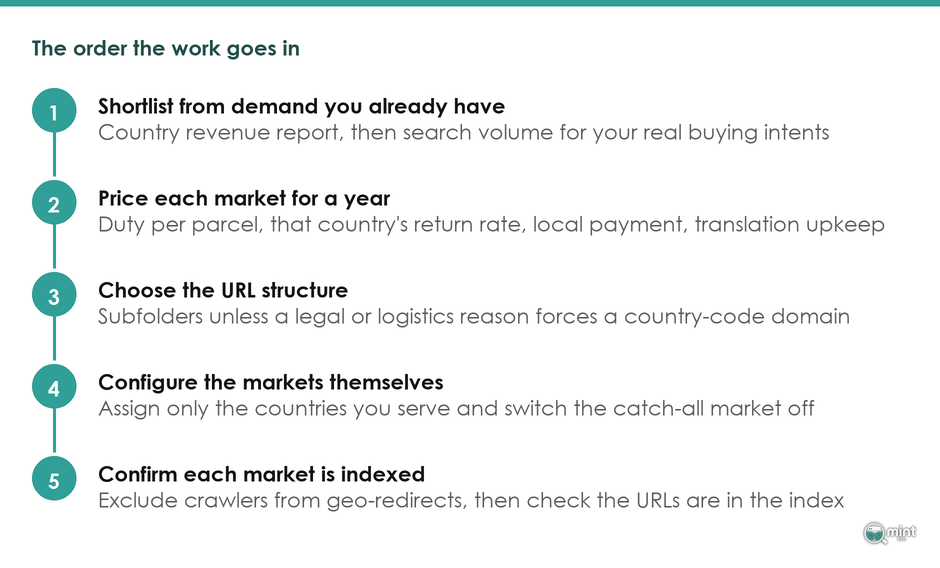
Three questions decide whether a country is a market or a distraction. Are people there already buying from you. Is anyone there searching for what you sell.
The third is whether you could serve them properly if they did. Answer all three and the annotation work becomes a small job with an obvious shape. Skip them and no amount of markup will save the result.
That order is not mine alone. Incremys' 2026 international SEO checklist puts the same sequence on it, stating the prerequisite plainly: product availability by country, local-language support, shipping capability and legal compliance all have to be verified first.
Without those, Incremys argues, even optimised pages create friction for the shopper and send contradictory signals to search engines. The rest of this article follows that order.
The Demand You Can Already See In Your Own Orders
Start where the evidence is free. Your own country report already holds a shortlist, and it costs nothing to read.
Whatever sits at the top of it will be specific to you, and that is the useful part. A country that has already sent you orders has proved three things at nobody's expense.
Your delivery reached it. Your payment methods worked in it. Somebody there wanted the product enough to buy in a language and a currency that were probably not their first choice.
Despite being free, this report is the one that gets skipped in the reviews I run. A store picks its expansion markets from a competitor's footprint or a founder's holiday, then finds out much later that its second-best real market was in the country report all along.
Sort that report by revenue, not by sessions. Start the shortlist there, and check it against the conversion tracking you already trust.
Whether Anyone Is Searching For You There
Existing orders tell you where you have traction. They say nothing about the size of the prize, and demand for one product is not spread evenly across borders.
Incremys records the query "how to choose a mattress" at 140 searches a month in Canada against more than 2,200 a month in France. Same intent, same category, a fifteen-fold difference.
Volume and position then multiply together. Incremys puts the top three organic results at around 75% of clicks, with the second page of results drawing 0.78%.
A small query pool therefore caps what even a first-place ranking can return. A large pool returns almost nothing if you land on page two, which is the argument against spreading one budget thinly across nine countries.
Check country-level volume for the two or three intents that drive your revenue. Not the head term for your category, but the queries your best-converting collection pages already rank for at home.
Whether You Can Serve The Market At All
Volume settled, one question remains, and it is the one search cannot answer for you. Can you ship there at a price a shopper accepts, take payment the way that country expects, and answer support in the right language.
If any of those is no, the country is not a market yet, whatever its search volume says. Search brings the visit and nothing more.
Everything after that click belongs to your delivery promise, your checkout and your inbox. None of the three sits inside international ecommerce SEO.
Which is why market selection belongs to the founder and the operations lead as much as it belongs to whoever runs the site.
What Changed For Cross-Border Sellers In 2026
A market is not a launch. It is a recurring bill, and the destination country sets four of its lines. You set none of them, and two shifted this year.
The End Of The Duty-Free Parcel
The European Union has removed the exemption that made small cross-border orders viable. The change comes from the Commission's own Taxation and Customs Union, the body that writes the rule itself.
Member States agreed within the Council on 13th November 2025 to remove the 150 EUR customs duty relief threshold, so parcels under that value are no longer exempt from customs duty.
Avalara puts the interim mechanism at a flat 3 euros per customs declaration line item from 1st July 2026.
That may not be the end of it. Avalara notes the Commission has also proposed an EU-wide handling fee on low-value goods, with the amount and start date due to be settled in autumn 2026.
Read it as a fixed cost per order. It is not a percentage. A flat charge takes a far larger share of a small basket than of a large one.
If your EU margin was modelled last year it is wrong now, and it is most wrong on your cheapest products. Avalara's timeline replaces the interim rate with standard tariffs once the EU Customs Data Hub is available in mid-2028, so today's rate is a floor with more to come.
Returns Behave Differently In Every Country
Duty is only the first line. Return rates are the second. They belong to the destination market, and your returns policy has little say in them. Eightx's 2026 benchmark puts the all-category German return rate at 20%, the highest market it tracks.
German online fashion is worse again. Eightx puts returns there at 50% or higher, against roughly 40% in the Netherlands and 36% in the UK.
Two things drive it: consumer protection norms, and bracketing, where a shopper orders three sizes intending to keep one. Neither is something your policy page can change.
But timing hurts as much as the rate. Branvas reports cross-border return rates of around 25% across categories and a refund cycle of 21 to 45 days or longer, with customs clearance on re-entry adding three to ten business days.
Every one of those days is your cash in transit and a support conversation somebody is being paid to have. One figure in that same report reads like good news and is not.
Branvas records cross-border orders generating 30% to 50% fewer returns than domestic ones, largely because returning is harder and dearer for the customer. A low return rate produced by friction is a satisfaction problem wearing a favourable metric.
Getting Paid The Way The Market Expects
Payment is the third line, and it decides how much of a market's traffic converts at all. Gr4vy's 2026 analysis puts iDEAL at around 92% of online payments in the Netherlands and Bancontact at 73% in Belgium.
Gr4vy estimates that offering the right country-specific method lifts checkout conversion by 10% to 20%. A shopper who reaches your checkout and recognises none of the payment options does not persevere.
That loss lands at the most expensive point in the funnel. You have already paid to acquire the visit, and the shopper has already chosen the product.
The Translation Bill That Never Stops
Payment is a one-off configuration. The fourth line is a standing cost, and it is the one most plans price only once.
Every product you add, every campaign page and every legal notice has to be redone in each language you have committed to. That work continues for as long as the market is open.
Shopify's Markets documentation says as much itself: translating store content word-for-word is a good start, and adapting content for each market improves rankings further. Adaptation is the expensive word in that sentence, and it recurs.
The reward for doing it properly has grown. ContentGrip reports 63% of global companies already optimising localised content for AI search visibility, and 45% reporting stronger visibility in fully localised markets than in English-only ones.
F-G's 2026 analysis of multilingual AI explains why. Because models collapse multilingual content into shared semantic representations, translated pages that add no new intent or authority are rarely retrieved, and the most confident version of a concept usually wins globally.
A translated duplicate therefore earns nothing. Budget by language count, because languages are what generate the work.
What 51 UK Stores Declare To Google
Enough theory about what stores ought to do. On 15th August 2026 I read the hreflang annotations served by the homepages of 55 UK storefronts, every one a direct-to-consumer brand selling its own products online, and counted the distinct locales and languages each declares. I measured 51 of the 55, a yield of 93%.
The four I dropped returned a 403, a 404, a refused connection and a JavaScript shell with no markup in it.
Of the 51 I measured, 39 run on Shopify, so this is largely a picture of Shopify stores.
Nothing, A Handful, Or Almost Everything
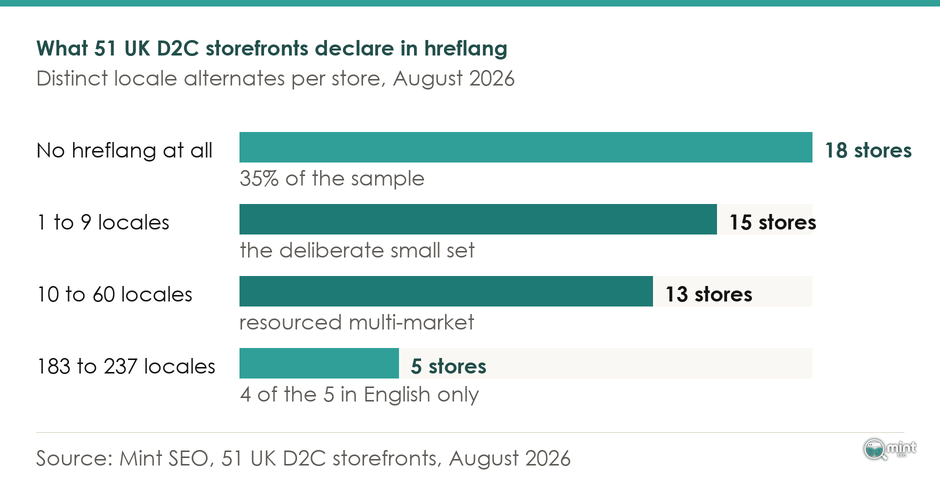
I found 18 of the 51 serving no hreflang at all, which is 35% of the sample. At the other end of that same sample, five stores declare between 183 and 237 distinct locales, close to every country code in existence.
Between those two poles sit the other 28, and the median store declares just three locales. A handful of countries, in other words. Nobody drew a map.
That is the shape of a decision made by toggle. Declaring a country is free and commits you to nothing, so the configuration settles wherever the default left it.
Before you change anything, find out which of the two extremes your own store sits in. It takes one look at your page source.
Subfolders Have Already Won The Structure Argument
Knowing which pole you are at raises the structure question next. Six of the nine pages ranking for this topic devote a section to weighing country-code domains against subdomains against subfolders.
Those stores have already voted. Of the 33 in my sample declaring any alternates, I counted 20 serving them from subfolders, five combining subdomains with subfolders, three on subdomains and five on a country-code top-level domain.
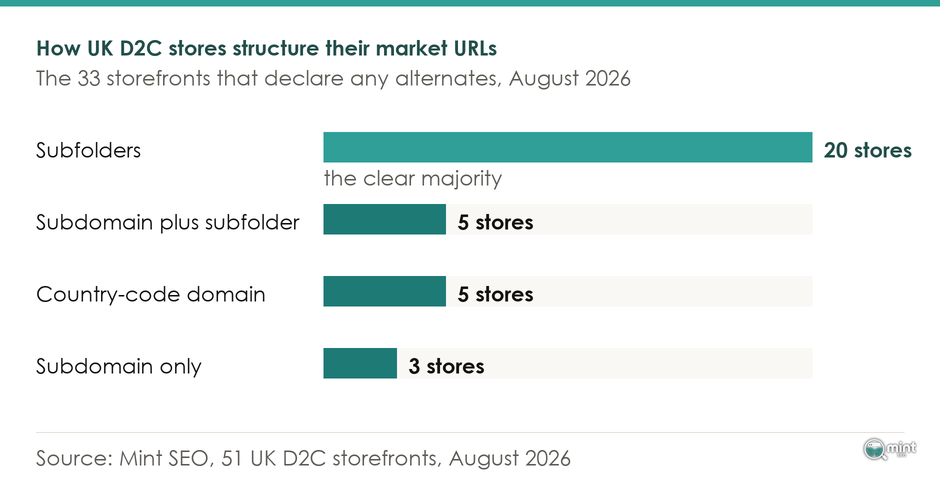
Why that majority exists is no mystery. A subfolder inherits authority already built on your root domain and needs no separate hosting, no separate link acquisition and no second stack to maintain.
A country-code domain starts from zero on all three counts. Unless a legal requirement or a logistics arrangement forces your hand, subfolders are the default, and the burden of proof sits with anyone arguing otherwise.
Whichever you pick, give the market its own URL. A market sharing a URL with your home market cannot be targeted in search at all.
What A Declared Country Buys You
Structure settled, here the sample gets uncomfortable. Of the 33 stores declaring any hreflang, I found 15 serving exactly one language, which is 45% of them.
The store is in English and the annotation points that single English store at a list of countries. Bird & Blend Tea Co. is the clearest case, declaring 232 distinct locale alternates, every one of them English, against one storefront.
Nothing behind those declarations is priced, written or supported differently by market. Compare that with Rapha, declaring 31 locales across seven languages, or Myprotein, running 47 locales across 24 distinct languages.
Those two have paid for what they declare. Hreflang exists to tell a search engine which version of a page to serve, and pointing 232 countries at one English page tells it there is nothing to choose between.
Run the ratio on your own store by dividing declared countries by languages. A large answer means you have a currency switcher on your hands.
Huel makes that same point from the other end. Its UK homepage served no hreflang alternates and no x-default when I checked it, despite the brand selling in several countries.
Trading somewhere and telling search engines about it are separate jobs, and plenty of real international businesses only do the first.
What Shopify Markets Handles, And What It Leaves To You
If your store runs on Shopify, a good deal of the international ecommerce SEO work is already done for you. The trouble starts where that help stops.
The Annotations Shopify Writes For You
Shopify's Markets documentation is explicit about what it generates. Hreflang tags are created automatically from your market and language configuration.
Canonical URLs are set automatically on every page to point at the primary version. Sitemaps include all market-specific URLs, and automatic redirection applies to customers while excluding search engine crawlers.
Your international ecommerce SEO problems are therefore almost never in the tags. They sit in the configuration those tags are generated from, and one mistake there propagates into every annotation at once.
That is worth taking seriously, because nobody can tell you which of two contradictory signals will win. On 29th July 2026, Google's John Mueller confirmed there is no publicly defined order of precedence for metadata reconciliation.
Search Engine Roundtable reported his advice plainly: fix conflicting metadata, do not test whether it will work regardless, because the signals carry different weights that change over time.
Consistency is the whole strategy here. No lookup table is coming.
The Catch-All Market That Duplicates Your Store
Inconsistency of exactly that kind has one common source. The catch-all international market is the most frequent self-inflicted wound, and switching it on generates hreflang alternates for every country you have not explicitly assigned.
Those alternates all point at one subfolder holding the same content as your primary store. A merchant posting as juanpfc set the problem out in the Shopify Community, describing duplicate pages indexed across three markets.
They traced it to annotations generated for every country in the International market. Their fix was to strip those annotations for every country except the two they served.
Sharing a language between two markets creates the same problem faster. A merchant posting as entspannend ran separate .at and .de stores with word-identical German content.
After adding the Austrian domain to their webmaster tools, they reported Google canonicalising to it and their German organic traffic collapsing. Two markets with one language and one set of content do not add reach.
They compete, and one of them loses. Assign the countries you serve, then turn the catch-all off.
Redirects, Googlebot And The Market That Never Gets Indexed
The last of the three is invisible in your reporting, and that is why it persists. Analyzify points out that Googlebot generally crawls from a US IP address.
An aggressive geographic redirect written for shoppers can therefore send the crawler away from your international URLs before it ever sees them. A market with no indexed pages cannot rank.
In your analytics that looks identical to a market with no demand. You will conclude the country was a bad choice when a redirect rule was the real problem.
That one is fixable. Exclude crawlers from automatic redirection, then confirm each market's URLs are indexed before drawing any conclusion about whether the market works.
None of this is exotic. Semrush found 58% of 20,000 multilingual sites carrying hreflang conflicts in the page source, with a missing self-referencing tag behind 96% of them. Broken international annotation is the normal state of the web.
Where Mint SEO Fits
Most of what I have described is a decision problem with a technical tail. The decision is far cheaper to check before it is built than to unpick once you have customers in a country.
Translation, delivery arrangements and local support are commitments to people. People are what you cannot unwind in a quarter.
Book A Call About Your Market Plan
If you have a shortlist and want it pressure-tested by someone who has done this on Shopify stores, that is what our free 30-minute consultation is for.
You bring the country revenue report, I will bring a read on where the store ranks now. We work out which of those markets you could serve today, which one earns the first 90 days, and which to leave for another year. Straight answers, no jargon.
There are two other places to start. The piece on choosing an ecommerce platform covers the decisions hardest to reverse later.
Sometimes that exercise ends with one country on the list, which is a perfectly good answer. Our ecommerce SEO strategy guide covers what to do with the budget instead.
Where it ends with three, the build order sits in our guide to technical SEO on a store.
Book your free consultation and bring the country report. We will work through the shortlist together.

About the author
John Butterworth
John Butterworth is the founder of Mint SEO, a Manchester ecommerce SEO agency he started in 2024. He has 11 years in SEO and digital marketing, previously running SEO departments for market-leading brands and several agencies. He specialises in Shopify and ecommerce SEO, and his work has ranked over 100 websites and driven more than 3 million organic visits. He speaks at industry events including the SEO Mastery Summit.
Connect on LinkedIn →