
Knowledge Hub
The Shopify Alternatives Worth Your Time (And What Leaving Actually Costs)
By John Butterworth · August 15, 2026
Every shortlist of the best Shopify alternatives names the same five platforms, and the shortlist itself is right. Wix and Squarespace come first, then BigCommerce and WooCommerce, with Adobe Commerce at the top end.
My verdict on them is shorter than you would expect. Wix suits a small catalogue you want selling this month. Squarespace suits a design-led store with a short product list.
WooCommerce suits an owner who wants the software in their own hands and can run it. BigCommerce suits steady revenue that sits inside a plan cap. Adobe Commerce starts at enterprise budgets, which puts it outside the comparison below.
Fit no description above and your money's better spent on the store you already run. That is the one answer nobody selling a platform has any reason to give you.
Shopify itself is rented software: you pay monthly, and in return they run the servers, the checkout and the updates for you.
Every alternative on the shortlist changes one of those terms, and every one of them charges you for the change somewhere you were not looking.
Before writing a word I read the competition properly. Nine pages that rank for 'best shopify alternatives' were fetched and read in full on 15th August 2026, five from the top of the results and four from deeper down.
Who pays for those pages turns out to matter. Most of them are published by a platform that competes with Shopify, or by an affiliate site earning commission on sign-ups, and BigCommerce ranks itself first in its own list of alternatives.
Those incentives show up in the prose. The ranking pages repeat each other closely enough that reading all nine tells you barely more than reading two.
What the whole field leaves out is the more useful finding, and it is the same omission on every page. Coverage of what a replatform does to organic search traffic runs to one two-sentence FAQ answer across the five top-ranking pages. My name is John Butterworth. I have run Shopify and ecommerce SEO retainers for 11 years, migrations included.
So here is each option, priced at a real order volume. Then what the move does to your rankings, and how to tell whether the platform is your problem at all.
Where Wix Actually Wins
Wix is the right answer when your catalogue is short and you want to be selling this month. You move a block yourself, no developer brief required.
The nine ranking pages recommend 14 distinct platforms between them. Only five names appear on seven or more of the nine, and Wix is on all of them.
Objectors call it a website builder wearing an ecommerce hat and predict it will be gone in three years, and the first half of that is fair while the second is not borne out by the data. GravityKit's analysis of HTTP Archive data puts year-over-year change in detected origins at +11.7% for Shopify and +8.4% for Wix eCommerce, with WooCommerce down 6.8%.
Catalogue depth is the constraint that ends the Wix case. Filtering, variants and collection logic hurt first as the product count climbs, and those are the parts Wix does last.
A store listing a few hundred products and adding steadily will feel that ceiling long before its accountant does. Wix quotes its plans in shifting dollar tiers, so only the platforms publishing a comparable UK card are priced below.
Squarespace And Square Online Serve Two Different Stores
These two share a name and suit opposite businesses, which is worth ten seconds before you shortlist either. Squarespace is for a design-led store where the site does the selling.
It also markets itself hard on this query. Squarespace's 8 Shopify Alternatives for 2026 opens its numbered list with Squarespace, which tells you what that page is for.
That is the field's normal condition. Six of the nine pages ranking for this keyword are published either by a platform that competes with Shopify or by an affiliate site earning commission on sign-ups.
Square Online is for a shop taking most of its money over a counter. Sharing inventory and payments with the till you already own beats anything else in this article, if that till is your main channel.
Make that companion product your primary storefront, though, and you have asked the wrong tool to carry the business. That is the one mistake I see repeated with this pair.
Cost is where Squarespace gets misread, and its published UK pricing states an online store transaction fee of 2% on Basic at £12 a month, on Core at £17 and on Plus at £29. Card rates start at 2% plus 25p on top, and Squarespace drops the store fee only on Advanced at £79 a month.
So the plan a small store is drawn to charges it twice. The plan that stops doing so costs four times the headline you were comparing.
What Running WooCommerce Yourself Actually Involves
WooCommerce ends the app subscription bill. In exchange it hands you the hosting, the security patching and the updates.
Whether that trade works depends on who's maintaining your site when checkout breaks on a Tuesday afternoon. Ask that question before you ask about features.
One thing about how WooCommerce gets written about is worth knowing before the trade-off. Descriptions of it are the most recycled part of this field. Across the nine ranking pages we fetched for this keyword, mean pairwise cosine similarity is 0.8785.
Paragraph-level duplication across the ranking set reaches 0.9585 between two different publishers describing WooCommerce, which is two writers producing one paragraph.
It is also the only platform on this shortlist going backwards. GravityKit's data has WooCommerce detected on 6.64% of the measurable web against Shopify's 4.76%, so its footprint remains the larger of the two. Its share reached a plateau above 7% and has edged down over recent months.
For a store picking a platform, level matters less than direction. A platform losing origins is one whose app ecosystem, theme market and developer pool are contracting around you.
For a store with in-house development, WooCommerce still stacks up. It stops making sense for a founder who chose it to save the price of a hosted plan and has nobody to call.
Self-hosted audits we run regularly end at a two-year-old plugin conflict nobody owned.
What Shopify, Squarespace And BigCommerce Cost At Your Order Volume
Headline monthly pricing is the smallest component of what the best Shopify alternatives cost a real store, and it is the only component the ranking pages compare.
Shopify publishes a full UK rate card, and so do Squarespace and BigCommerce. Priced at £10,000 a month in orders, the ranking changes.
The monthly price
Shopify publishes Basic at £19 a month, with card rates from 2% plus 25p. Squarespace states £12 for its entry tier.
Shopify's figures then put Grow at £49 and Advanced at £259. Plus is published from £1,800 a month.
BigCommerce publishes in dollars instead. Core is $29 a month billed annually, with Growth at $79.
BigCommerce's documentation puts Scale at $299 a month, with Performance quoted from $1,499.
Read as a list, Squarespace wins and Shopify looks expensive. That reading survives exactly as long as you ignore the percentage.
The cut taken on every order
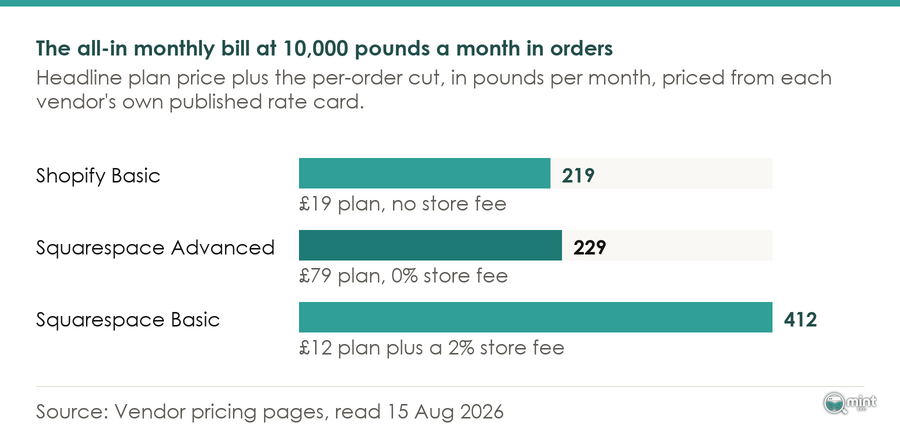
Squarespace's figures put Basic at £12 a month plus a 2% store fee, and running £10,000 of orders through that plan turns the fee alone into £200 before a single card rate is charged. Card rates from 2% take the monthly bill to about £412.
Shopify's figures put Basic at £19 with no store fee, so the same volume costs about £219 all in. The platform that looked £7 a month cheaper is around £193 a month dearer, and across a year that difference outweighs what most small stores spend on apps.
BigCommerce documents a second cut that is easy to miss. BigCommerce charges an Open Payment Provider Fee on Core, Growth and Scale.
That fee applies to orders processed through a provider not on its Embedded list, and it lands as a separate invoice line.
The plan caps that raise your price as you grow
BigCommerce's plans are bounded by revenue rather than by features, and that model is the one most often misread. Its Essentials pricing puts Core at up to $30K trailing-twelve-month GMV before the plan auto-upgrades to Growth. Growth runs to $100K before it upgrades to Scale.
That ladder has one more rung, and it is the one that bites. BigCommerce's documentation caps Scale at $33,333 a month in GMV, with 0.9% charged on everything past it. Move because BigCommerce looks cheaper and you have bought a bill that grows with your own success.
Shopify publishes a version of this too, and it is the largest jump on any card here. Its step from Advanced at £259 to Plus from £1,800 a month is roughly sevenfold.
That step is the most common reason a profitable store starts reading articles like this one. A merchant on Shopify's own community forum put it this way: 'not using Shopify Plus… that's an insane jump and one which leaves me looking for an alternative platform.'
Margins decide whether that jump is survivable, and we work through the arithmetic in our guide to store profitability.
What Changing Platform Does To Your Search Traffic
A correctly executed replatform costs you a few weeks of ranking volatility and a redirect map you maintain for at least a year. It does not cost you your link equity.
Nothing in the ranking field will tell you that, which is why it goes first here. None of the five top-ranking pages we fetched covers what a replatform does to organic search traffic.
The cost is real, it is survivable, and decisions you make in the fortnight before the switch determine almost all of it.
What survives the move
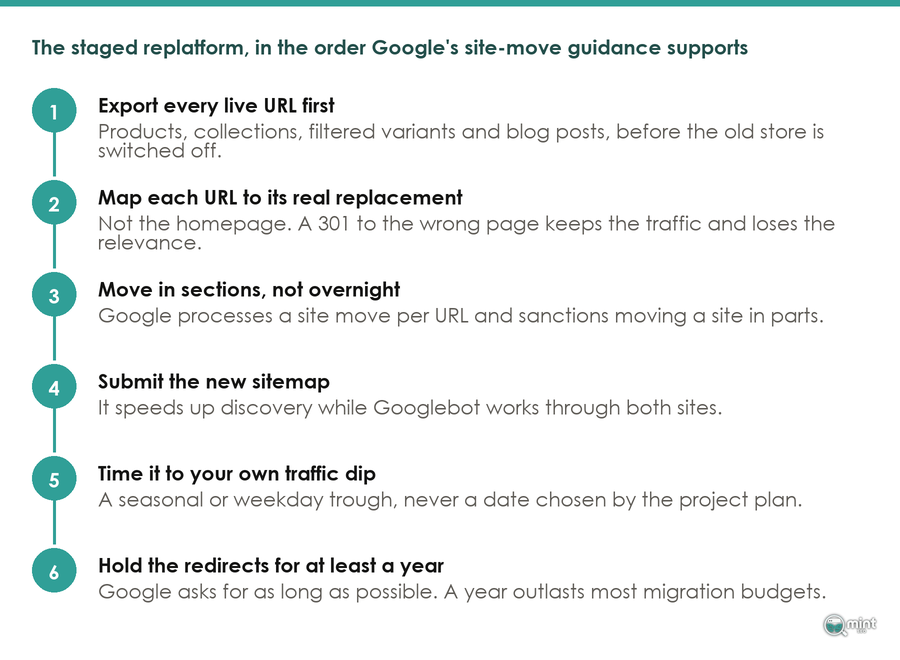
Merchants fear losing the authority their URLs have built. Google's site-move documentation answers that directly: 301 and other permanent redirects do not cause a loss in PageRank.
Authority your old URLs earned transfers with them, provided each one points at its real replacement instead of the homepage.
Google also documents the timeline, and puts a medium-sized site in weeks of temporary ranking fluctuation. Googlebot has to visit every URL on both the old site and the new one at least once.
Moves complete per URL, so shifting a store in sections is sanctioned and a submitted sitemap speeds up discovery.
What actually goes wrong
Almost every failure I see is a redirect written to the wrong place.
Three versions of that show up again and again. Collection URLs get pointed at the new homepage. Product URLs get mapped by best guess, and filtered variants get dropped because nobody exported them first.
Keep the redirects for at least a year, which is what Google asks for and longer than most migration budgets run.
Since moves process per URL, a staged migration is the safer shape for a store with real organic revenue. Time it to a genuine dip in your own traffic, never to a date in a project plan.
Our ecommerce migration guide covers the export order that stops the variant problem. Every item gets a pass condition in the store migration checklist.
Why Most Stores That Look End Up Staying
Merchants who ask me about the best Shopify alternatives usually have a visibility problem, and their platform did not cause it. A move will not fix it either.
Narrow GravityKit's data to the top-1M popularity tier and the market-share order reverses.
GravityKit's figures put Shopify at 6.08% of that tier against WooCommerce's 3.12%, which is the opposite of the whole-web picture.
Busy stores concentrate on the platform people leave for being expensive, which should be the first clue that price is not the whole decision.
What to rule out first
Establish which ceiling you have hit before you shortlist any of the best Shopify alternatives: the platform, or your own store's search performance.
Pick the twenty pages you expect to carry your organic revenue, then answer three questions about each. Is it indexed, does anything internal link to it, and is the query it targets one people type?
Thin, orphaned or misaimed pages are an SEO ceiling, and no migration has ever fixed one. I have watched more than one store pay for a rebuild and land on the same traffic line it started from.
Our ecommerce website checklist separates the checks your platform already handled from the ones you are failing.
There is a fresher reason to test this properly. Shopify told investors in August that AI-driven traffic and orders to its stores had tripled year over year in the second quarter, with half of all AI-referred sessions landing straight on a product page, 2.5 times more than traditional search.
Whatever you make of that framing, store discovery is starting in more places than it did.
Structured product data and clean product pages are what get rewarded, and those are on-page problems that follow you to whichever platform you land on.
What moves without a migration
Templates and layout, internal linking, page speed and product data are all changeable on the platform you are on this week. Those five levers are what move organic revenue.
On a hosted platform, page speed is mostly theme weight and app weight. Neither needs a new platform to fix.
One page in the field says so outright. Charle, a Shopify agency, is the only page in the set I fetched for 'best shopify alternatives' on 15th August 2026 that sets why most brands stay beside when an alternative wins.
That single honest framing, out of nine ranking pages, is the shape of the question you are asking.
For the platform read specifically, we compared them on ranking terms in our guide to the best ecommerce SEO platform.
Get A Straight Answer On Your Own Store First
Weighing a move is cheap. Finding out which ceiling you have hit before committing a migration budget is cheaper still.
Mint SEO offers a free 30-minute consultation with the founder, and that is the fastest way to settle it. You can book the call here.
You get me on the call. I look at where your store ranks now, at what is holding back the pages that should be earning, and at whether one of the best Shopify alternatives would fix it.
I have driven over 3 million organic sessions for stores, and I run our retainer projects myself from Manchester. Mint SEO's model is eight disciplines, one job, and six of the eight travel with you whichever platform you pick.
If you should move, I'll say so, and the migration guidance above is what we'd follow. If your product pages are the real constraint, you get that answer plainly, and it costs less to fix.
Book your free consultation and find out which one you are looking at.

About the author
John Butterworth
John Butterworth is the founder of Mint SEO, a Manchester ecommerce SEO agency he started in 2024. He has 11 years in SEO and digital marketing, previously running SEO departments for market-leading brands and several agencies. He specialises in Shopify and ecommerce SEO, and his work has ranked over 100 websites and driven more than 3 million organic visits. He speaks at industry events including the SEO Mastery Summit.
Connect on LinkedIn →