Knowledge Hub
What To Put On An Ecommerce About Page (And In What Order)
By John Butterworth · August 12, 2026
Your About page is probably the oldest copy on your store. It gets written in an afternoon during launch week, linked from the header and the footer, and then left alone for years.
I have spent eleven years running organic search for ecommerce stores at Mint SEO, where we took Hidden Garden Flowers from 251 to 24,021 monthly organic visitors in twelve months, and I open this page in every audit. In the store audits I run, the About page is almost always the thinnest page on the site that still sits in the main navigation.
It is linked from every template and carrying two paragraphs written the week the store launched.
That combination is why a weak one costs more than it looks like it should. Who reads it also changes how you write it.
The reason is the audience. A returning customer does not open your About page, and the person who does is deciding whether to hand card details to a shop they have never used.
What follows is the content that belongs on the page. It runs in the order that person needs it, and it finishes with how to create and link the page in Shopify.
What a stranger needs from this page
Treat it as a pre-purchase page. Everything on it settles a doubt that would otherwise stop the order.
Anna Kaley and Jakob Nielsen of Nielsen Norman Group spent three rounds of research on this one page type. Across the three studies, we tested 100 websites and reviewed an additional 65 sites, they write. They observed over 70 users and produced 85 guidelines from it.
Their finding about stores like yours is blunt.
Ecommerce sites, transactional sites, and online services sites need a strong About Us section, because users often wonder who's behind a business, how it's funded, and whether it's credible.
Because those doubts are practical, so is the fix. Their participants turned up asking whether they could trust the company to ship the package.
They also asked whether a return would be accepted if the product turned up damaged. A third worry was data and spam.
None of that gets answered by a founder's childhood. It gets answered by evidence that a real business ships things and takes them back.
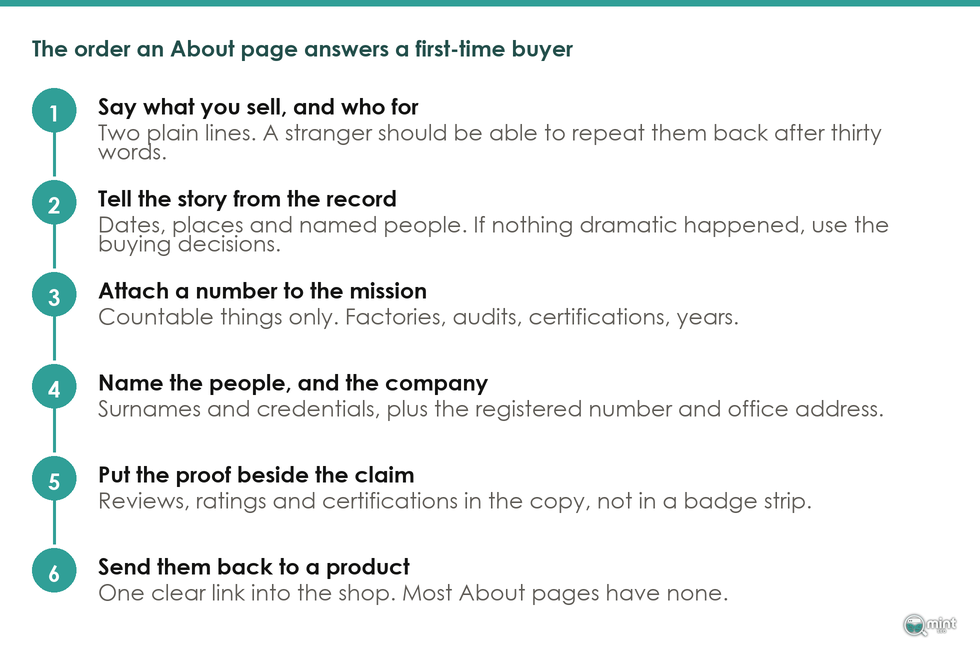
That last row is the one that gets forgotten. Most of the About pages I open in an audit have no link out of them at all. A reader finishes the story and then has to find their own way back to a product.
Shopify puts the same point to its merchants. Include a specific request for your customers that matches the goal of the page, its guidance says, otherwise known as a call-to-action.
Name your customer and your product up front
A stranger should be able to say what you sell and who it is for after thirty words.
This sounds too obvious to write down until you watch it fail. Whether your site includes a single About Us page or an entire About Us section, the NN/g guidelines state, you must provide a clear explanation of what your company does.
Their testers watched journalists and investors give up without working out what a business did.
Shopify sets out the same job as five questions. Its help documentation asks what you sell and anything that makes your products unique.
The next two questions are why you sell it, meaning your company mission or values, and who you are. That last one covers your company or your founder or your producers.
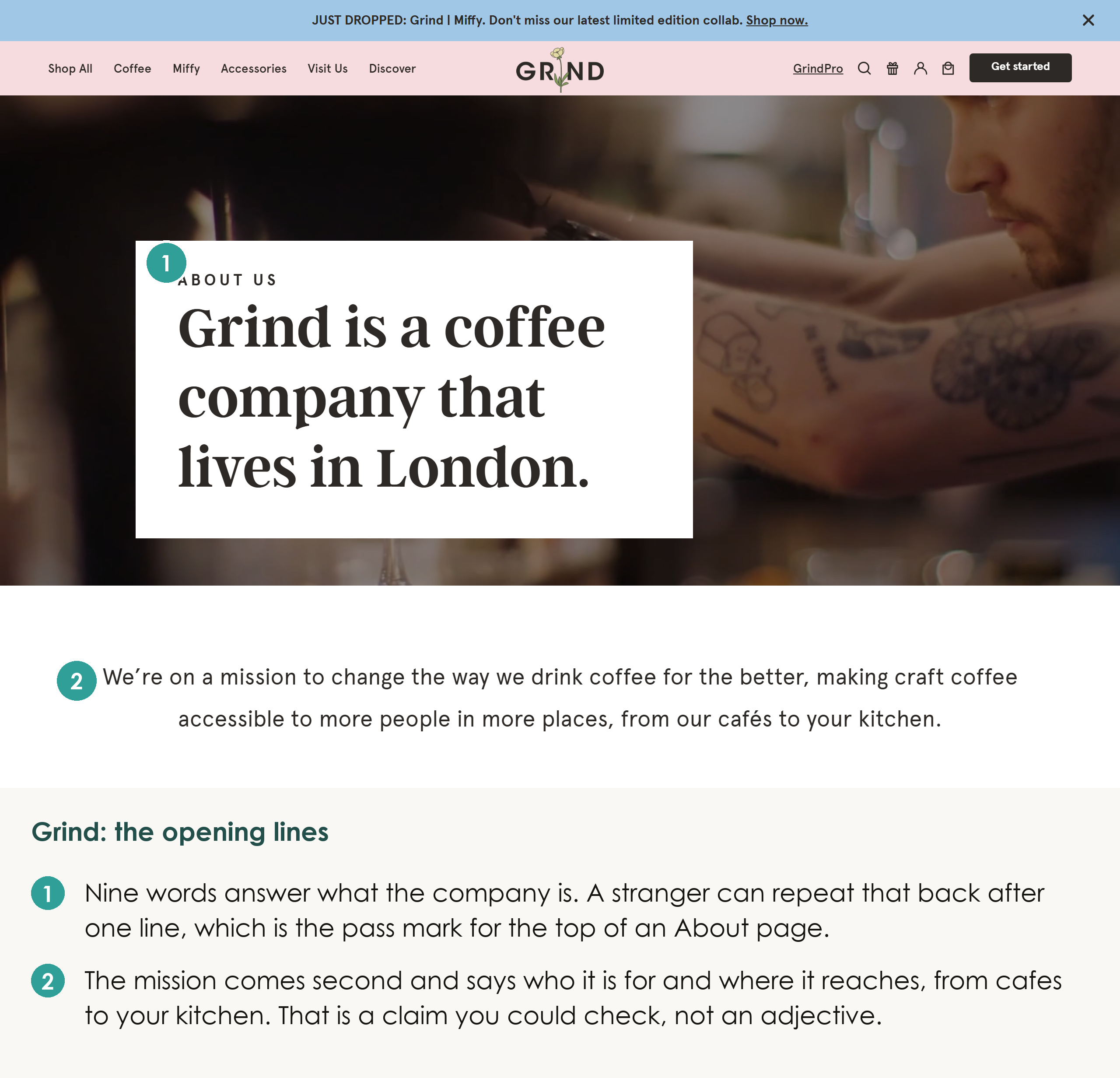
Answer the first of those in the opening lines and the rest of the page has somewhere to go. One store does it in a single sentence.
Since 1959 Vitsoe has made long-living furniture, always striving to be better rather than newer.
Those words open the Vitsoe About section and nothing else sits above them.
Everything else there lives on separate linked pages for ethos, history and Dieter Rams. The summary therefore stays where a stranger lands, and the depth is one click away.
If the first line of yours reads like a mission statement, it is doing the wrong job. Our guide to ecommerce copywriting formulas covers how to tighten it.
Build the story from the record
Write the story from the record. Who started the business, when, and what changed since.
The clearest working example I have found belongs to Hiut Denim. In the 1960s, the town's jeans factory employed more than 400 makers and produced around 35,000 pairs a week, its page says. Production moved offshore in 2002 and the jobs went with it.
Hiut was founded in 2011 to put that knowledge back to work and to train a new generation of makers.
Every claim in that passage is a date or a place or a count, so a reader can check any of them. The reason the company exists doubles as the reason a pair costs what it costs.
An origin need not start with the product you sell now. One page opens somewhere else entirely.
Yep, way back in 1991 Rex and Marilyn Trimnell got things started with X-Lite UK.
Its story therefore begins with bicycle forks on the Muc-Off About page. Its cleaner came later because Rex was frustrated at how long it took him to wash his bike.
Three sentences are enough for Pact Coffee. In 2012, Stephen Rapoport wanted something simple: to brew a great cup of coffee at home. Living in London he expected that to be easy, and freshly roasted coffee turned out to be near impossible to find.
The objection I hear most is that nothing dramatic happened.
When a store owner tells me they do not have a story, what they usually mean is that nothing dramatic happened.
Their buying decisions carry it: which suppliers they chose and which range they carry and what they refuse to stock.
Register matters as much as content here. Stock photography and copy with no substance are the two things I cut most often from a draft About page, because both read as evasion to somebody already deciding whether to trust you.
Shopify offers a fix for a stuck writer that costs nothing. If you struggle to write in an authentic voice, then try recording your speech and copying it down as a first draft.
You get the register right first time and edit the rambling out afterwards. Where the page sits in a wider rebuild is covered in our guide to ecommerce web design.
Put your mission somewhere a shopper can test it
A values line becomes worth reading the moment something countable sits behind it.
One brand answers that with its supply chain. Today we work with 28 partner factories, says the Community Clothing mission page, including spinners and weavers and knitters and dyers. They sit mostly across Lancashire and Yorkshire and the East Midlands and Scotland and South Wales.
Most of those factories are family owned. One is in its seventh generation and the oldest dates back to 1776.
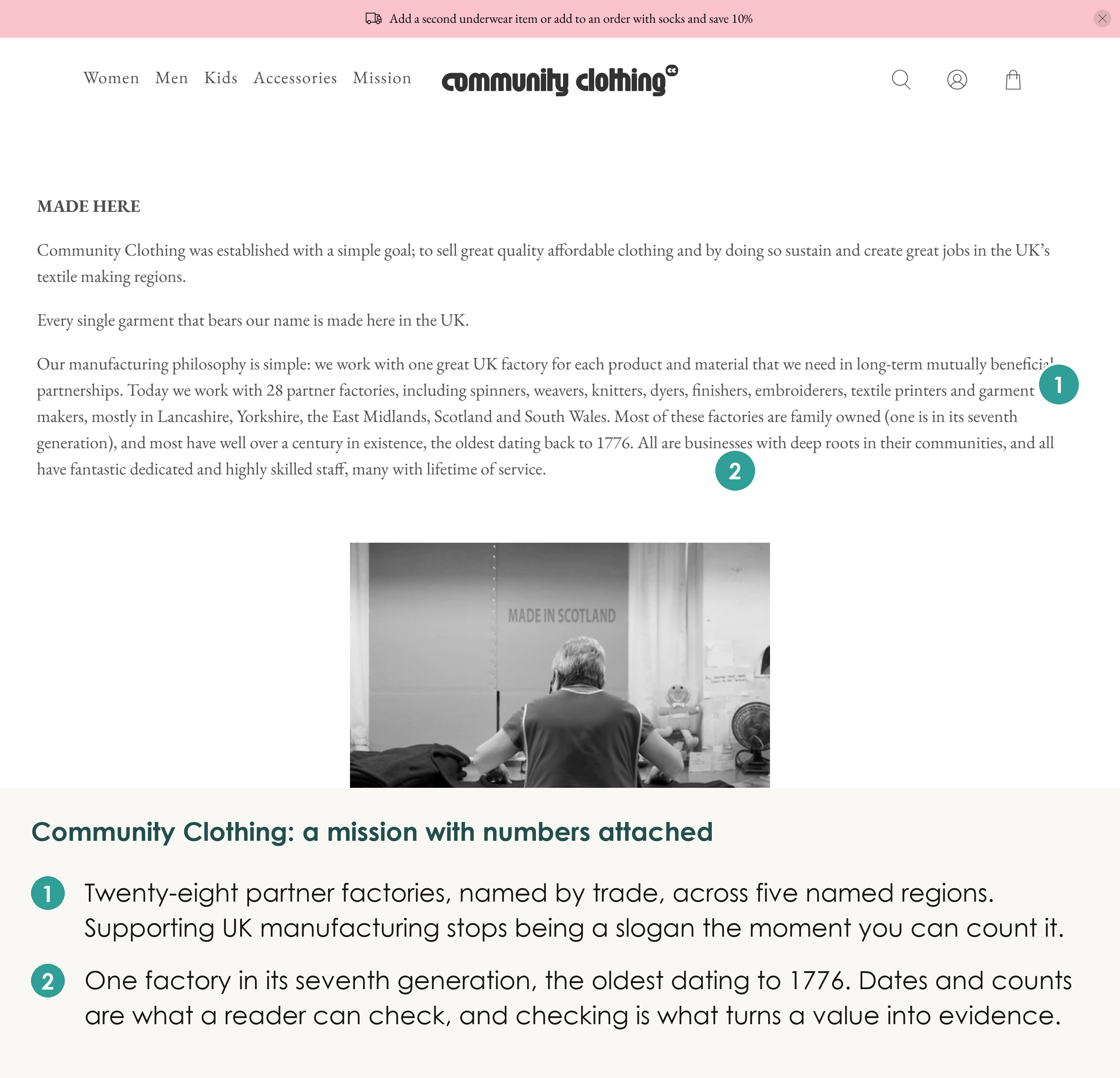
Supporting British manufacturing stops being a slogan the moment you can count it.
A different page points at its paperwork. Its promise is grounded in traceability spreadsheets, wool micron graphs and supply-chain audits, says Sheep Inc.
Those are the documents most brands keep to themselves. Every store says it cares, and documents are what separate the ones that do.
If your mission cannot survive that treatment it is a preference. A preference does not need a heading.
Name the people, and say where you are
This is the accountability section. It also has a legal floor that plenty of UK stores sit below without knowing it.
Start with the people. One coffee brand names them properly.
Its first profile reads David Abrahamovitch, Founder & CEO. Alongside the name, the Grind About page gives the year and the place he started the business. Its head of coffee Howard Gill has worked in coffee for nearly 20 years and is a qualified Q grader.
A role and a date and a credential are all checkable.
A team page that gives first names and roles only is friendly. It is not verifiable.
One tea brand stops a step short of that.
Its opening line runs we started life as a TEAm of two. From there, the Bird & Blend team page introduces everyone by first name and job title.
It reads warmly and a reader still cannot check a single person. The difference is a surname.
Now the part that is not optional.
On business letters, order forms and websites, you must show: the company's registered number; its registered office address; where the company is registered.
Those requirements come from GOV.UK on running a UK limited company, and the fact that it is a limited company goes there too.
Selling online adds more obligations before an order is even placed.
You must provide your business name, contact details and address, says the guidance for online sellers. A description of the goods and the price including all taxes go with it.
Since you publish that information anyway, put it where a nervous buyer will see it.
Give them more than one route to a person while you are there. Telephone numbers and a physical address and email and chat together score better than a lone contact form on its own.
What makes you credible is what other people say
Everything above is you talking. This section is the evidence from outside, and a shopper weighs the two differently.
That difference shows up in what they do next. Across twenty moderated sessions, NN/g recorded that the word reviews was used over 40 times.
One participant described going straight to blogs and review sites before taking the website at face value.
Given that, the evidence belongs beside the claim it supports.
Founded by Kristian Tapaninaho and Darina Garland, Ooni is the world's No. 1 pizza oven brand with over 3 million ovens sold globally.
Those two sentences open the Ooni About page, and its review count sits in the same passage.
The claim and the reason to believe it therefore arrive together, and a reader can weigh one against the other in a single glance.
Certifications work the same way. Name the scheme, say what it audits, and link it.
An unexplained badge is decoration. What that proof is worth in orders is the subject of our guide to ecommerce conversion rate.
Where these signals belong across the wider store is a separate question, and our guide to ecommerce user experience covers it.
Build the page in Shopify and link it so people find it
Copy is half the job. This page sits in the site-wide navigation on almost every Shopify theme, which makes a weak one a store-wide problem.
You need the finished copy and admin access. You are aiming for a published page that appears in both the main menu and the footer.
Create and publish the page
Shopify documents the sequence. From your Shopify admin, go to Online Store > Pages, its guidance says.
Click Add page, then enter a title and content for the page.
Be descriptive and clear when choosing your page title. Your page title is displayed in the tab or title bar of browsers, and also in search engine results.
The Visibility section is where you decide whether it goes live, and Save commits it.
Here is the whole sequence, from an empty admin to a page in both menus.
- In your Shopify admin, go to Online Store > Pages.
- Click Add page.
- Enter the page title, then the body content.
- In the Visibility section, select Visible.
- Click Save.
- Go to Online Store > Navigation and add the page to your main menu.
- Add it to your footer menu as well.
Pause on the title. That field is the line that shows in Google.
Name the page so people click it
Shopify does not force the wording. You don't have to name the page About Us, its guidance notes. Instead, you can add a title that is more meaningful to your business, such as Our story or Values.
Take the plain option anyway, because obscure link labels lose clicks. A shopper skimming a menu will not stop to decode a name they do not recognise.
Our Story is fine. Anything more inventive is a page nobody opens.
Link it from the navigation and the footer
Saving the page does not surface it. After you create your About Us page, Shopify says, you need to add a link to it from your online store menus to display it in a menu on your store.
Put it in the footer as well as the header, because that is where people go when a menu fails them. Layering it is better still. A tagline on the homepage, a short summary on the About page, sub-pages underneath for anyone who wants more.
Two menu entries cost nothing and decide whether the page gets read at all. How the rest of the store should point at it is covered in our guide to internal linking for ecommerce.
What Google's guidance says about this page
It is tempting to treat this page as somewhere to put keywords. Google's own documentation asks something else.
Its list of trust signals includes this page by name.
Does the content present information in a way that makes you want to trust it, asks the self-assessment published by Google Search Central, such as background about the author or the site that publishes it.
Its ranking of the four parts of E-E-A-T is unambiguous. Google calls trust the most important of the four, with experience and expertise and authoritativeness all feeding into it.
Google also offers a shorthand for checking your own work.
Consider evaluating your content in terms of Who, How, and Why as a way to stay on course with what our systems seek to reward.
An About page that names who, explains how you operate and says why you exist answers all three at once.
A second test in the same document reads like it was written for this page.
If someone researched the site producing the content, would they come away with an impression that it is well-trusted or widely-recognised as an authority on its topic?
Because that research happens off your site, consistency matters. Your Companies House record and your Google Business Profile and your About page should agree with each other.
The same trail feeds AI assistants summarising your brand. What that changes for a store is covered in our piece on how AI search reads a brand.
A second opinion on your About page
Reading your own About page is hard, because you already know every answer it is supposed to give. That is why it stays thin for years.
Eleven years of running organic search for ecommerce stores has made the pattern easy to spot. The same three things are usually missing: a plain first line, a named human, and a route back to a product.
It takes about ten minutes to spot them on any store. That makes it one of the cheapest fixes available on a site.
Send me the URL of yours and we can go through it together, along with the rest of your store. Book a free 30-minute consultation and you will get straight answers and a rough direction for the next ninety days.

About the author
John Butterworth
John Butterworth is the founder of Mint SEO, a Manchester ecommerce SEO agency he started in 2024. He has 11 years in SEO and digital marketing, previously running SEO departments for market-leading brands and several agencies. He specialises in Shopify and ecommerce SEO, and his work has ranked over 100 websites and driven more than 3 million organic visits. He speaks at industry events including the SEO Mastery Summit.
Connect on LinkedIn →