Knowledge Hub
What AEO Adds To SEO For An Online Store
By John Butterworth · September 24, 2026
The Shopify App Store now lists a run of apps promising to get a store into ChatGPT's answers, and many of them are built around an llms.txt file. When store owners ask me about SEO vs AEO, my answer is simpler than those listings make it sound. The pages on your store that answer engines read are built with the same work that gets them ranked. The one new job is getting your brand mentioned on the pages those answers cite.
I'm John Butterworth, and I've spent 11 years in SEO. At Mint SEO, answer engine optimisation (AEO) runs inside the same retainer as the rankings work, as one of our eight disciplines. If you'd rather skip the legwork, we'll send you a free AEO strategy for one keyword.
SEO Ranks The Page, AEO Gets The Store Named In The Answer
Search engine optimisation gets a page on your store ranked in a list of results that a shopper clicks. AEO gets your store named inside the answer that ChatGPT, Perplexity or Google writes for that shopper. You'll also hear generative engine optimisation (GEO), which usually means the longer-term version: mentions built up across the web until the models themselves know your brand.
For an online store, the practical answer to the SEO vs AEO question is to run them as one programme. For Google's own results, its guidance on AI Overviews, AI Mode and Search Console for site owners backs this up by filing optimisation for those features under SEO. Your crawlable product and collection pages are what an answer engine reads, so an AEO supplier who rebuilds those pages is charging you again for SEO work.
Being inside that answer has mattered more since the end of August. That's when AI Overviews started opening as a full answer in the style of AI Mode for some searches. A box for asking a follow-up question now shows by default, as Android Authority reported on 31st August. On those searches the expanded answer takes up much of the screen, so a brand named in it is seen before the first organic link.
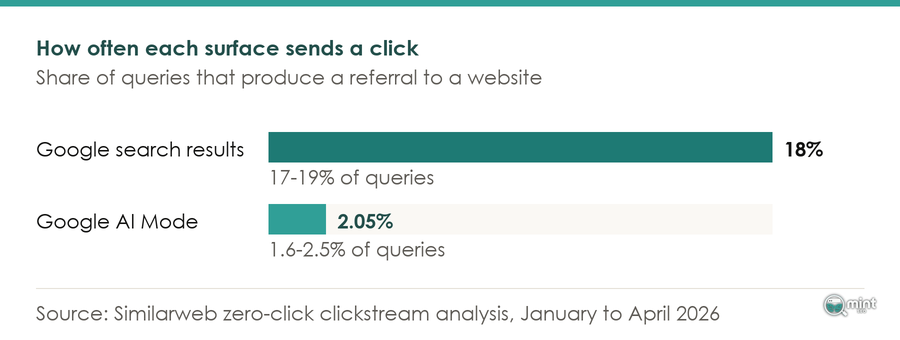
For most stores, AI answers still send a small share of visits next to organic search, so the rankings remain where most of the traffic comes from. Keep your SEO strategy for online stores running and add the one job it leaves out.
The New AEO Job Is Getting Named On The Pages AI Cites
The new part of getting named in AI answers happens off your store, and it's the one real difference in SEO vs AEO work. An answer engine largely recommends the brands its sources recommend, so this work is finding those sources for your buying questions and getting your brand onto them.
Run Your Buying Queries Through ChatGPT And Log Every Page It Cites
Many AI answers are assembled from several searches at once. Google calls this query fan-out: the model runs a set of related searches behind the one the shopper typed and cites whichever pages answer them. That is why ranking for your head term doesn't guarantee a mention, and why you find the cited pages by asking the questions yourself.
Write down ten questions a buyer asks before choosing a store like yours, in their own words, such as which waterproof walking boots suit wide feet. Run each one in ChatGPT with search switched on, in Perplexity and in Google's AI Mode, then log every cited URL in a sheet beside the question and the date. Run each question two or three times, because the list of brands in an answer changes from one run to the next.
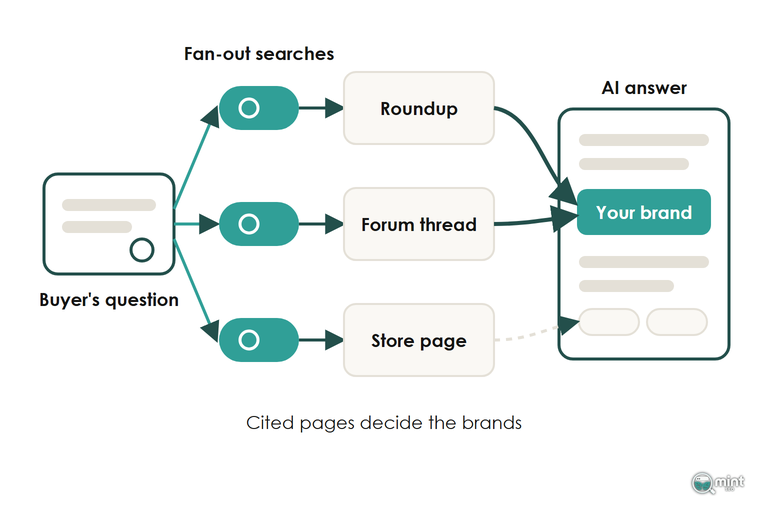
Your log will fill with roundups, forum threads and review pages, spread across a lot of sites. For US ChatGPT answers in early 2026, a synthesis of nine citation datasets by the PR agency 5W put Wikipedia and Reddit together behind more than 25% of citations, with no other domain above 3%. Outside those two, citations spread thinly. For your niche, the cited pages are likely to be smaller sites a store your size can approach.
Earn A Genuine Mention On Each Cited Page
- Roundups: pitch the editor for inclusion and ask for a direct link to your collection page. Our guide to getting onto roundups covers the pitch.
- Forum threads, Reddit included: answer the question in the thread as a named member of your team. Moderators remove posts from accounts set up to plant a brand, so post from an account that says who you are.
- Review platforms: in that 5W synthesis, brands listed on G2, Capterra, Trustpilot and Yelp were cited about three times as often as brands without those profiles. For a store, Trustpilot and Yelp are the ones that apply. That's a correlation, but collecting Trustpilot reviews puts your brand on pages answer engines read.
A product roundup on your own blog still sells, but it can't get you named in AI answers, because it isn't a third party vouching for you.
Ranking your own brand first in your category is a different thing again. In a June interview, Lily Ray, whose research tracked the fall of self-promotional listicles from January 2026, said that "Self-promotional listicles are already getting hit. Google has changed how it ranks this content, and ChatGPT appears to be following suit." Keep your own roundups selling, and put the AEO effort into the third-party roundups and threads in your log.
Make Your Store Readable For AEO Before Paying For Any App
The on-store side of AEO is ordinary SEO you can check yourself. Answer engines have to reach your pages and read the facts on them, and you can check both for free. I run the three below in order on a Shopify store, because product facts and files only help once the crawlers can reach the pages.
Let ChatGPT's Search Crawler Reach The Store
Open yourstore.com/robots.txt and look for OAI-SearchBot on a Disallow line. OpenAI's publisher FAQ tells site owners to "make sure you aren't blocking OAI-SearchBot" if they want their pages in ChatGPT's summaries and snippets. Shopify's default file doesn't block it, so a block there has been added by an app or an edit to the robots.txt.liquid template.
Next, submit your sitemap to Bing Webmaster Tools as well as to Google. Bing Webmaster Tools now reports how often Microsoft Copilot cites your pages, and a store that has only ever submitted a sitemap to Google leaves Bing to discover it unaided. Our crawl and indexing checks cover the rest of crawl access.
Put Product Facts In The Page Text And The Catalogue
An answer engine can only repeat what it can read. On Shopify's second-quarter earnings call, president Harley Finkelstein said half the visits that AI answers send to Shopify stores now start on a product page. Your product pages therefore carry a large share of your store's AEO. Write the size, materials, delivery time and returns terms into the description text. A fact that only appears inside an image is easy for crawlers to miss or misread.
Those facts also need to reach the data AI shopping channels read. Shopify switches Agentic Storefronts on by default for eligible stores. Open it under Sales channels, then Agentic, confirm it's active and check which AI channels your products go to.
Google's AI Mode and Gemini take products through the Google & YouTube sales channel, so fix any disapproved products in your product feed as well.
Finkelstein also said AI searches powered by Shopify's catalogue converted twice as often as searches using scraped data. That's the case for filling in the product category and its category metafields in the product editor. Keep the Product structured data your theme outputs, because there's no special AI schema to add. Our guide to product page SEO goes further on the page itself.
Skip The Paid llms.txt File
Google's guide states that Google Search doesn't use llms.txt or any other AI text file, so paying for one does nothing for AI Overviews or AI Mode. Lily Ray's view is that the file is fine to add if it's easy, as long as you don't expect more citations from it.
OpenAI's publisher FAQ, the page ChatGPT points site owners to, asks for crawler access and doesn't mention llms.txt at all. Before paying an app for one, open yourstore.com/llms.txt, because Shopify may already generate it for you.
Measure AEO Beside Your SEO In Search Console And Your Orders
Open Search Console's generative AI performance report first. Every site now has it, and Google's guide points site owners to it for seeing how their pages perform in AI Overviews and AI Mode. For Copilot, Bing Webmaster Tools has its own AI report, which counts how often your pages are cited and shows the grounding queries behind those citations.
Read the citation log in the table's last row as a rate. Because answers shuffle their brand lists from run to run, Rand Fishkin concluded that "any tool that gives a 'ranking position in AI' is full of baloney." Track the share of runs that name you instead.
Copied links and a switch from phone to laptop both strip the AI referrer, so the analytics rows undercount the sales that come from answers. For most stores these numbers are still small next to organic search.
Report AEO beside SEO for that reason, and judge both on revenue, with the citation rate as the early signal for AEO. Our guide to conversion tracking covers setting up the channel segments.
Where An AEO Programme Fits Beside The SEO You Run
Our AEO work covers the product facts and page copy that engines quote, and the crawl checks above. It also covers consistent mentions on the sources AI already trusts, which is the work a citation log like the one above points to.
It sits in the same retainer as your SEO and I manage it myself, so the rankings work and the answer work are run together. We've ranked more than 100 websites, and the aim for yours is more revenue from organic search, whether the shopper finds you in the results or inside an answer.
We can write your first AEO plan for you: a custom plan for getting cited in AI Overviews or ChatGPT for one keyword. If you'd rather talk it through first, you can book a free 30-minute consultation with me. Otherwise, send us your keyword and get your free AEO strategy for it.

About the author
John Butterworth
John Butterworth is the founder of Mint SEO, a Manchester ecommerce SEO agency he started in 2024. He has 11 years in SEO and digital marketing, previously running SEO departments for market-leading brands and several agencies. He specialises in Shopify and ecommerce SEO, and his work has ranked over 100 websites and driven more than 3 million organic visits. He speaks at industry events including the SEO Mastery Summit.
Connect on LinkedIn →