
Knowledge Hub
An Ecommerce SEO Checklist Where Every Line Is A Test You Can Run
By John Butterworth · August 17, 2026
Open a product page on your store and read the title tag. If it’s the product name followed by your store name, your theme wrote it and one line of your ecommerce SEO checklist is answered in ten seconds.
My name is John Butterworth and I run Mint SEO, a Shopify and ecommerce SEO agency in Manchester. Eleven years of audits have taught me why store owners abandon these lists halfway through.
The lines are written as instructions, so nothing tells you which ones are already fine.
You get three things here. The list in the order the work pays back, a pass condition on every line, and the items worth deleting outright.
Where To Start, And Why Not Where The Lists Tell You
Start with whether Google can reach your pages and pick the right one. Next comes whether each page is aimed at a search it could plausibly win. Page-level work on titles, images and links comes third, and off-site work comes last.
Grouping By Discipline Is Not A Sequence
An ecommerce SEO checklist is normally filed under technical, on-page, off-page and content. That grouping tells you what kind of job each item is.
What it doesn't tell you is when to do it. A fault that makes a page ineligible to rank ends up sitting beside a fault worth a few clicks, and both look like one tick box.
That is not a small problem, because these lists are long. On 17th August 2026 I crawled the 50 pages Google returns for ecommerce and Shopify SEO checklist searches, and 43 of them carried enough article text to measure.
The 43 measurable checklists I crawled advertise between 8 and 150 items, and the item count is the main thing they compete on.
What Decides Which Item Goes First
An item goes first when leaving it undone stops the later items working at all. That single rule sorts any list you are handed.
Take two examples from opposite ends of the usual filing. A product page Google has not indexed cannot benefit from a better title.
A collection page aimed at a query Google answers with product pages will not be rescued by structured data either.
On an audit we sort findings by what the store loses while the fault stands, then by how quickly each fix pays back.
Kyle Risley, who leads SEO at Shopify and has worked in search for twelve years, is blunt about that second question. Small fixes such as updating page titles may deliver results quickly, while the rest often takes three to six months.
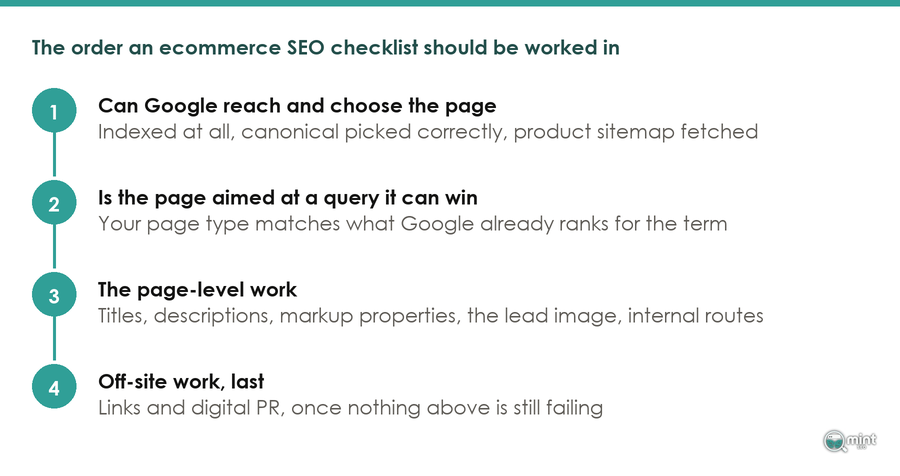
The Checklist In Full
Every line below is a test with a result. Run it, write down pass or fail, then move on.
Each line gets its reasoning and its pass condition in the sections below.
Keyword Mapping, And Which Page Gets Which Search
Search the term you want, look at what Google is ranking, then give that query the same page type. Get this wrong and the rest of the list cannot pay off at all.
Read The Results Page Before You Assign Anything
Look at what is ranking, Risley says, and 'target the query with a product page' where that is what you see. A results page is Google's own answer to what satisfies the query. No keyword tool reports that.
He is blunter about ignoring it. A page aimed at the wrong intent 'is probably going to be short-lived, and you're not going to make many sales.'
Collection, Product Or Article
Plural, category-shaped searches belong on collection pages. Specific model and variant names belong on product pages, and questions belong in articles.
The mapping error I see most often on Shopify stores is a head term aimed at a product page. An owner picks their best seller, points 'merino running shoes' at it, then competes for a slot the results page does not contain.
Where a category page turns out to be the right answer, how much copy it needs is the next decision to make.
How To Tell If The Mapping Is Right
If the page types match, the item passes. If they do not, you re-aim the page or accept it will not rank, and that gets settled before any title is touched.
The question comes up on the Shopify Community forum in a different form constantly. One merchant had written three supporting articles for a collection page stuck below page one for months.
He wanted to know whether out-writing a competitor would settle it.
Out-writing a competitor is not a pass condition, so the question has no answer.
Product Page SEO, With The Tests That Matter
Almost every store ships product structured data. Very few ship the properties Google added or tightened this year, so your gap sits inside the markup, in the properties themselves.
The Title A Shopify Theme Writes For You
A Shopify theme builds the title tag by joining fields it already holds, usually the product name and the store name. That result is accurate and unsearched at the same time, which is a strange thing for a title tag to be.
Rewrite the titles on your best sellers first. You want the words a shopper types, and they're rarely the words your supplier printed on the box.
Your theme has already done more of the product page work than you might expect, which is exactly why the title is where your effort belongs.
Descriptions That Are Not The Manufacturer's
Supplier copy leaves Google nothing to choose between you and everyone stocking the same item. Every remaining tiebreaker favours the larger retailer.
You can test this in a minute. Paste one of your own sentences into Google inside quote marks and count how many stores come back with it.
The Markup Properties Worth Adding
I inspected seven live Shopify product pages while writing this on 17th August 2026. All seven carried Product structured data. Two carried a star rating, one carried a return policy, and none carried FAQ markup.
Two of Google's July 2026 documentation updates are worth acting on if you run sales. It added a section on sale duration to the merchant listing guide, explaining how to use the validFrom, validThrough and priceValidUntil properties to set the effective range for a sale price.
That same July brought a second change worth knowing about, a new review snippet guideline covering fake and undisclosed incentivised reviews.
Return-policy markup sits in the same family and is achievable on a normal store, yet almost nobody bothers with it.
For a working example, Brooklinen's sheets collection carries 253 words of category copy, and its product structured data includes a MerchantReturnPolicy block.
Product Images, And What Google Reads From Them
Image work pays on the image a shopper sees first and barely anywhere else. Treat this as a question of which images, and the answer is usually one.
Where Alt Text Stops Paying
Write alt text for the lead image on every product. Do that before you touch the fifth photograph of any single one. Google uses structured data markup and the og:image meta tag when deciding which thumbnail represents a page.
That is why the return concentrates on one image. A seventh photograph of the same shoe from another angle earns you nothing, and a filename in the alt attribute earns you less.
Weight, Format And The Vitals Threshold
Image weight is the item most likely to be quietly failing on your store. It is also the only one whose pass condition Google publishes as a number: Core Web Vitals puts Largest Contentful Paint under 2.5 seconds.
On a product page your largest element is nearly always the hero image, so that threshold is really an image budget. Where your Shopify speed score says otherwise, measure the image and ignore the score.
What A Passing Product Image Looks Like
Your lead image loads inside the threshold and carries alt text a person could recognise the product from. Both halves are observable on one page in under a minute. Check five products and the image line on your checklist is answered.
Internal Links, And Where A Store Leaks Them
Your internal linking fault is rarely too few links. It is a catalogue shape that buries products several clicks away from anything with authority.
How Many Clicks From The Home Page Your Products Sit
Click depth is how a crawler infers importance when nothing external points at a product. A product four clicks from the home page is being told by your own structure that it doesn't matter much.
Count the clicks to your three best sellers. Four hops on any of them is your finding.
Collections As The Distribution Layer
Every product inherits its internal links from the collections containing it. A product in one thin collection therefore has exactly one route in, and the fix is usually a collection you have not built yet.
Routes are the whole of it. Deciding which pages deserve an internal link comes down to the same question.
Collections earn attention for a second reason. At Rothy's flats collection you get 450 words of category copy alongside the product grid, and its product pages publish star ratings in structured data.
The Three-Click Test
Every product you want to rank is reachable in three clicks from the home page and sits in more than one collection. You can count both from your navigation without a crawler.
Ecommerce SEO Requires Consistent Work To See Results
Parts of an ecommerce SEO checklist stay done and parts of it rot. Tell the two apart and your monthly review takes twenty minutes. Get it wrong and the review never happens at all.
Your Catalogue Decays Faster Than Your Structure
Your catalogue turns over every week. Products arrive, sell out and get retired, and each one is a new URL carrying a new title.
Your platform shifts underneath you as well, sometimes without an announcement. Structural work stays done: your navigation, your collection shape, your canonical handling.
What To Put In Your Calendar Each Month
Two checks earn a recurring slot. One is a monthly comparison of what Google has indexed against what you sell.
The other is a five-minute read of a dated changelog, checking whether anything you depend on has changed at Google or Shopify.
That second check matters more than it sounds, because fixes are not instant either. Google updated its canonicalisation troubleshooting guide in July 2026 with clarifications on re-evaluation time, after people expected same-day results from a change that takes longer.
The Items You Can Delete From The List You Are Holding
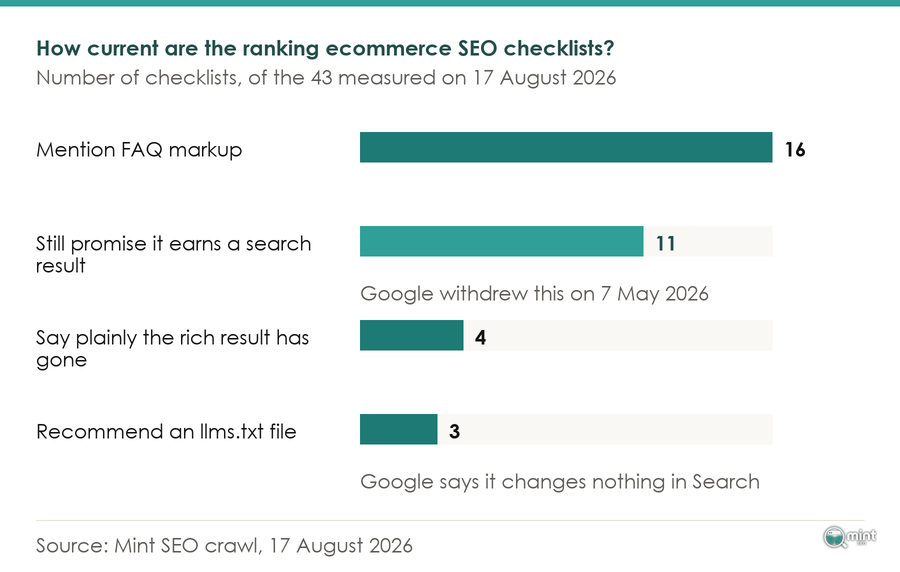
I read every mention of FAQ markup and llms.txt across those 43 ecommerce SEO checklists by hand. A keyword match would have counted the warnings as recommendations.
Sixteen of those 43 tell you to add FAQ markup. Eleven still promise it will earn you something in the search results.
The FAQ Markup That Stopped Working In May
Google's changelog records the deprecation notice and the date. 'This feature will no longer appear in Google Search starting May 7, 2026.'
By June the spec had gone too. Google removed the documentation for the FAQ rich result feature, so a Rich Results Test line now validates against nothing.
Four of the sixteen lists that mention the markup say plainly that the rich result has gone. Twelve still recommend it on the old terms.
If you're carrying an FAQPage block on your product pages because one of those twelve told you to, it's doing nothing for your appearance in search.
The llms.txt File Shopify Redirected Under You
Three of the 43 tell you to build and optimise an llms.txt file. Google's June 2026 note on the format says it changes nothing about how your store appears in Search, in either direction.
That advice was already out of date on Shopify anyway, because the platform moved the file underneath everybody. /agents.md is now Shopify's primary AI discovery file, and both /llms.txt and /llms-full.txt redirect to it by default as of May 2026.
Merchants found out by accident. Consentmo builds a compliance app for Shopify storefronts and watches these routes for a living.
It documented the change as it happened: routes like /llms.txt and /llms-full.txt 'stopped working as expected', redirecting to the new file with no changelog entry.
On 17th August 2026 I requested both routes on two live Shopify stores, Allbirds and Brooklinen. Each returns the same Shopify-generated Agent Instructions file at /llms.txt and at /agents.md.
A hand-written llms.txt is therefore not what any crawler reads. Edit the agents.md template instead.
How To Date-Check Any Checklist In Two Minutes
Search any list for 'FAQ'. One promising rich results from that markup has not been touched since 7th May, which tells you what its other 40-odd items are worth.
That test applies here too. If you're reading this long after August 2026, check the changelog yourself.
Duplicate Content, Crawling And Indexing On Shopify
Collection URLs, nested sitemaps and filters are the three to check here. Not one of the 43 lists I crawled asks about any of them, and no test you run on a single page will surface them either.
The Same Product At Several Addresses
Shopify serves the same product under every collection path it belongs to. The better organised your catalogue, the more duplicate addresses you have.
A merchant on the Shopify Community forum laid out the symptoms a year into the job. On-page scores checked with a grader, alt text written and a fast site.
Better backlinks than the competition too, and collection pages ranking while the products under them did not.
Which of those addresses ranks is not your decision by default. If you don't specify a canonical URL, Google will identify which version of the URL is objectively the best version to show to users in Search.
Make the decision yourself, using the strongest signal you have. Google ranks them plainly: 'Redirects: A strong signal that the target of the redirect should become canonical.' A sitemap entry is only a weak one.
There is more to put right on a Shopify store than canonicals, though canonicals come first.
Allbirds shows what starting here looks like. Request /collections/mens-shoes and you are redirected to /collections/mens, with the canonical pointing there too.
The Sitemap That Looks Submitted And Is Not
Your sitemap.xml on Shopify is an index. It points at separate product, collection, page and blog files. Google accepting that index is not the same as Google fetching the four files under it.
Several merchants arrived at the same workaround independently. What finally moved their indexed counts was sitemap_products_1.xml submitted on its own, one level below the index.
Compare your indexed count against your catalogue count, then submit the children where the two disagree. There is more your store can change about its sitemap before you blame the file.
How Many URLs Your Filters Generate
Filters are the third fault, and they scale worst of the three. Six filters with five values each describe more addressable combinations than most stores have products, and Shopify will serve every one of them.
Shopify gives you one place to control that. Your filters live in the Search & Discovery app, and your theme has nothing to do with them.
Decide deliberately which attributes are worth filtering on. Everything you leave switched on is an address.
Where Mint SEO Fits
The list is the easy half. What stalls people is deciding what to do with everything it turns up.
What An Audit Gives You That A Checklist Cannot
By now you may have a page of findings and no way to sequence them. That is the normal outcome, and it is the one thing a list cannot supply, because ordering findings needs a view of what each fault costs you while it stands.
We sell that ordering. Our SEO audit and strategy is a full teardown of where a store is leaking rankings and revenue, covering technical issues, on-page gaps and the priority order to fix them.
It runs across the eight disciplines we work in, from keyword strategy and technical SEO through to digital PR and answer engine optimisation.
If you’d rather not sequence it yourself, get your SEO audit and we will hand your findings back in the order to fix them.

About the author
John Butterworth
John Butterworth is the founder of Mint SEO, a Manchester ecommerce SEO agency he started in 2024. He has 11 years in SEO and digital marketing, previously running SEO departments for market-leading brands and several agencies. He specialises in Shopify and ecommerce SEO, and his work has ranked over 100 websites and driven more than 3 million organic visits. He speaks at industry events including the SEO Mastery Summit.
Connect on LinkedIn →